
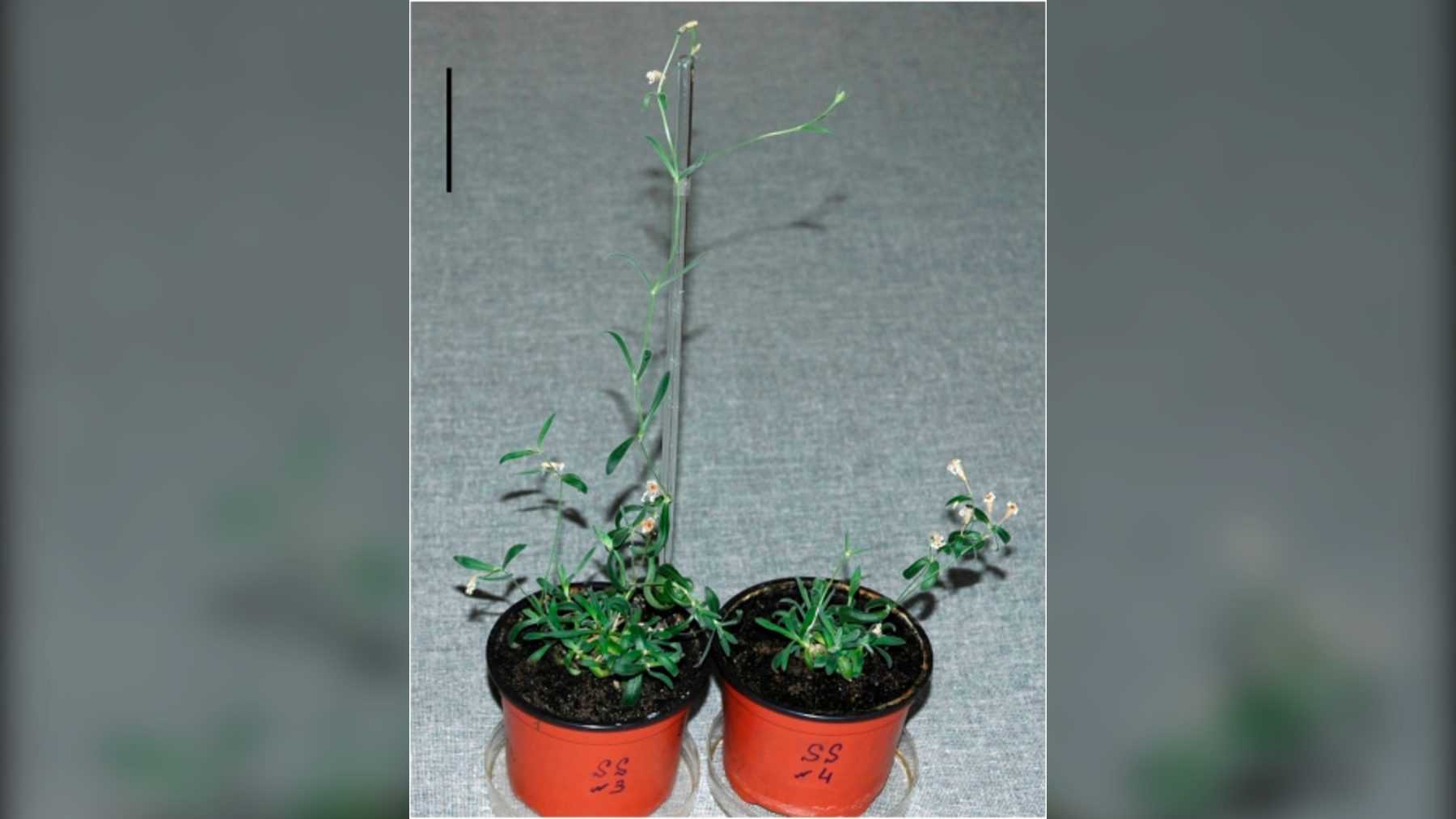
A ground squirrel hid fruits in a Siberian burrow during the last glaciation and left a cache that would eventually reach the laboratory. From its tissues, a team at the Russian Academy of Sciences managed to cultivate 36 plants that flowered and produced seeds. The finding was published in PNAS in 2012.
The key lay in cells preserved for millennia in the permafrost, the ground that remains frozen. The flowers obtained showed differences from the modern plants used for comparison, though the story has an important nuance. A genetic study published in 2021 corrected the initial identification of the plants studied.
A pantry under the ice
The fruits originated from Duvanny Yar, near the lower course of the Kolyma River, in northeastern Siberia. They were inside an ancient ground-squirrel burrow, buried 38 meters below the current surface.
How did they verify their age? The researchers radiocarbon-dated the seeds contained in the fruits and obtained an age of 31,800 years, with a margin of 300 years. That is why, rounding, we speak of about 32,000 years.
According to the study, the sediments had remained frozen since their formation, with no signs of thaw. The mean annual soil temperature in the region was about seven degrees below zero. That persistent cold helped preserve tissues capable of regrowth.
The key lay in the tissue
The procedure was far more complex than simply planting a seed and waiting for a shoot. Previous attempts with ancient seeds had not yielded adult plants, so the team searched for another part of the fruit that retained sufficient regenerative capacity.
They found it in the placental tissue, the inner structure to which the seeds attach during development. Scientists extracted fragments from three immature intact fruits and grew them in laboratory nutrient media. From these they managed to develop shoots and roots.
Using micropropagation, a technique that multiplies plants from small tissue portions, they obtained twelve specimens from each fruit. They then transferred them to pots and controlled light and temperature. Flowering and seed production occurred during the second year of cultivation.
The flowers gave the surprise
The team compared the 36 regenerated plants with another 29 obtained from modern seeds collected in the same region. During vegetative growth they appeared the same, but when blooming, the ancient ones displayed narrower petals and less divided. The differences referred to the specimens of the experiment.
In addition, the regenerated plants were able to reproduce via artificial cross-pollination. The seeds obtained from them achieved 100% germination in laboratory tests, and their offspring completed the life cycle. The first generation retained the traits observed in their progenitors.
But these floral differences did not remain fixed forever. In a scientific response published also in 2012, the authors explained that after several years of cultivation, the petals of both groups had acquired similar shapes. That follow-up cautions against interpreting their appearance as an immutable imprint of the past.
DNA corrected the name
The original work identified the plants as Silene stenophylla, a name that still accompanies many news reports about the discovery. However, other botanists questioned that classification in 2012 when examining the characteristics of the leaves, flowers, and seeds.
In 2021, a study led by Tatiana Kramina analyzed two DNA markers from an ancient clone and a modern one. The results placed both within the Silene linnaeana group and discarded the initial identification as Silene stenophylla. The markers used did not allow precise species determination within that group.
What does this change for the reader? It is not enough to compare two flowers to conclude how a single species evolved over 32,000 years. The revision corrects the botanical identity, while the central outcome of the experiment remains the regeneration of fertile plants from preserved tissue.
A repository for biodiversity
The environmental interest of this story lies in what it enables researchers to learn about the conservation of plant material. The authors noted that permafrost can store ancient genetic resources and offer clues about how certain tissues survive prolonged cold.
That opens possibilities for research, but the experiment depended on well-preserved fruits and precise lab care. It does not prove that any ancient plant can be revived simply by thawing. The survival of some cells and the obtaining of a complete plant are separate steps.
The original research was published in PNAS in 2012. The subsequent study revising the plant identity appeared in 2021 in Wulfenia.
Image: Yashina et al. / PNAS (2012)