
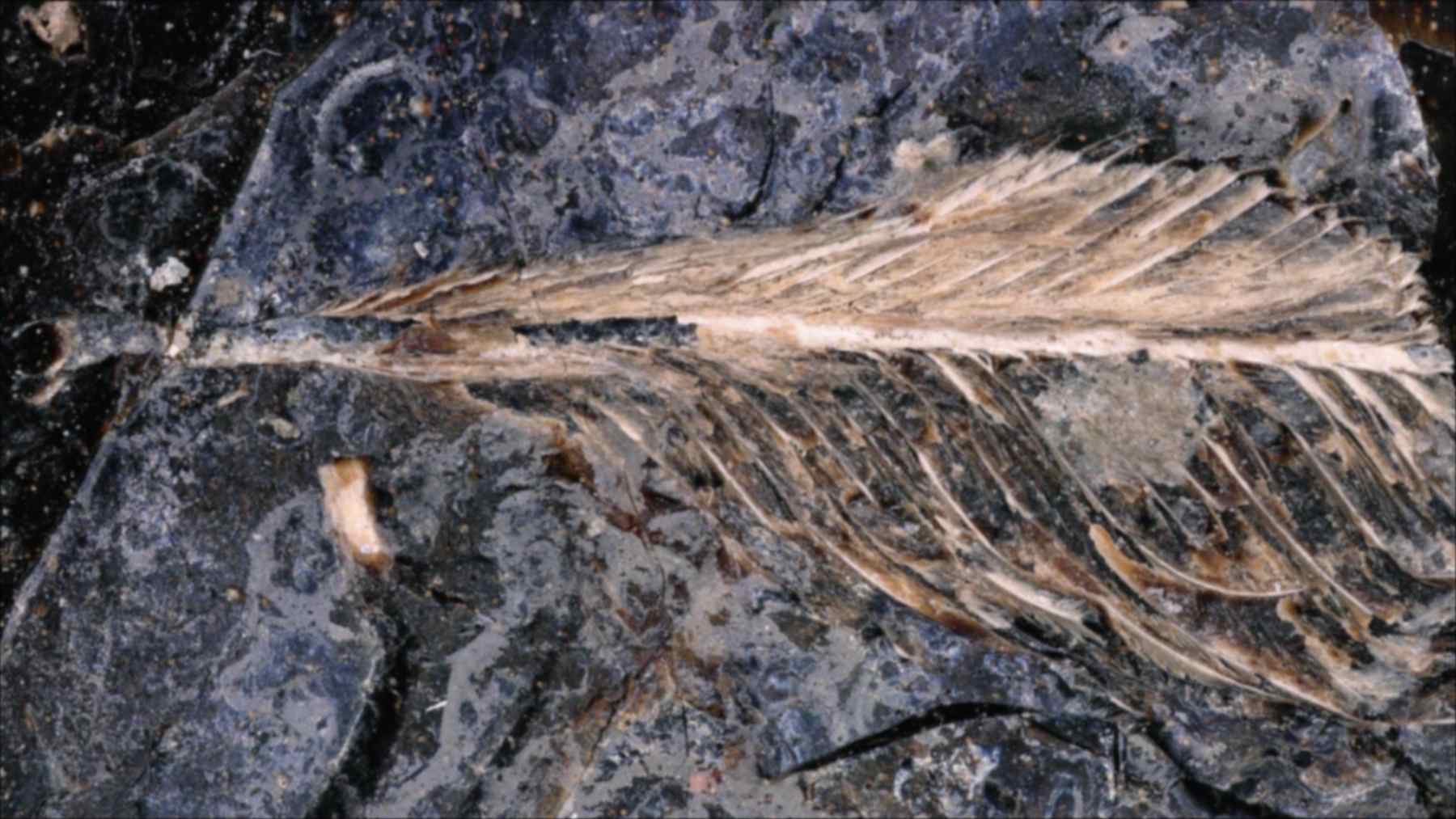
A feather preserved inside a fossilized dinosaur coprolite has opened an unusual window into life roughly 66 million years ago. The discovery, from Montana (United States), shows that certain birds predating the great extinction already had feathers with an internal structure similar to that of modern birds.
But the surprise goes beyond its preservation. Alongside those modern features appear forms of plumage that are more primitive, a combination that could help explain why some groups of birds disappeared after the asteroid impact while others survived.
A surprise among the rocks
The discovery occurred in 2016 when a researcher affiliated with the University of Washington and the Burke Museum was searching for fish fossils in the Hell Creek Formation. There he collected a small reddish-brown fragment about the size of half a golf ball.
Upon inspecting it with a magnifying glass, he discerned a tiny feather exposed on the surface. The researcher recalled in the university’s press release that he could hardly believe what he was seeing.
The piece turned out to be a coprolite, the fossilized dung. To probe its interior, the team used computed tomography, a technique that combines X-ray imaging and allows three-dimensional reconstruction of what a rock hides.
Clues from a meal
Inside emerged more feathers, remnants of leg bones, and small fish scales. The bones suggest the bird belonged to the hesperornithiformes, an extinct group of aquatic diving birds that is not part of the lineage of modern birds.
That association makes it likely that the feathers belonged to the same animal. Their structure also fits an aquatic lifestyle, because they bear features that would hinder water from passing through the plumage.
The scales add another link to the story. The researchers interpret them as remnants of a fish that the bird had eaten before being consumed by a theropod dinosaur, although they have not been able to definitively identify the producer of the excrement.
A lightweight and sturdy design
What makes such a small feather special? The analysis reveals a shaft with a square cross-section and a sponge-like interior, a combination that provides lightness and rigidity and that is also found in the feathers of modern birds.
Think of a structure that must bear loads without adding too much weight. The outer layer and the inner core work together, and the fossil allows us to observe that design in detail seldom seen in rocks from the age of the dinosaurs.
According to the University of Washington, the discovery pushes back by about ten million years the known record of the spongy interior of these feathers. This documents a specific architectural feature, though by itself it does not pinpoint when all the traits of modern plumage first appeared.
Cold enters the scene
The coprolite also contained small body feathers arranged in a more primitive fashion. Therefore, the bird would have combined different forms of plumage, a mix that has drawn particular interest from researchers at the Field Museum in Chicago.
Body feathers help retain heat, somewhat like the function of a coat. The researchers propose that the primitive forms might have provided less protection against cold than the plumage of the birds that survived the end of the Cretaceous.
In the winter scenario after the impact, that difference could have had significant consequences. A plumage sufficient for earlier conditions might have fallen short under severe cooling, but the fossil alone does not prove that this caused the disappearance of these birds.
An open mystery still
The research provides a clue to a question that remains open in paleontology. Modern birds belong to the Neornithes, the group that survived that extinction, while other lineages of birds disappeared.
Living near water is not enough to explain that difference, as the team notes, since hesperornithiformes were also aquatic. Comparing their plumage with that of other groups can help assess what advantages the survivors had and what limitations weighed on the others.
Further CT scans of additional coprolites are proposed to search for more feather remnants and broaden the comparisons. The study was published on September 10, 2026, in Current Biology.
Image: Researchers / Current Biology