
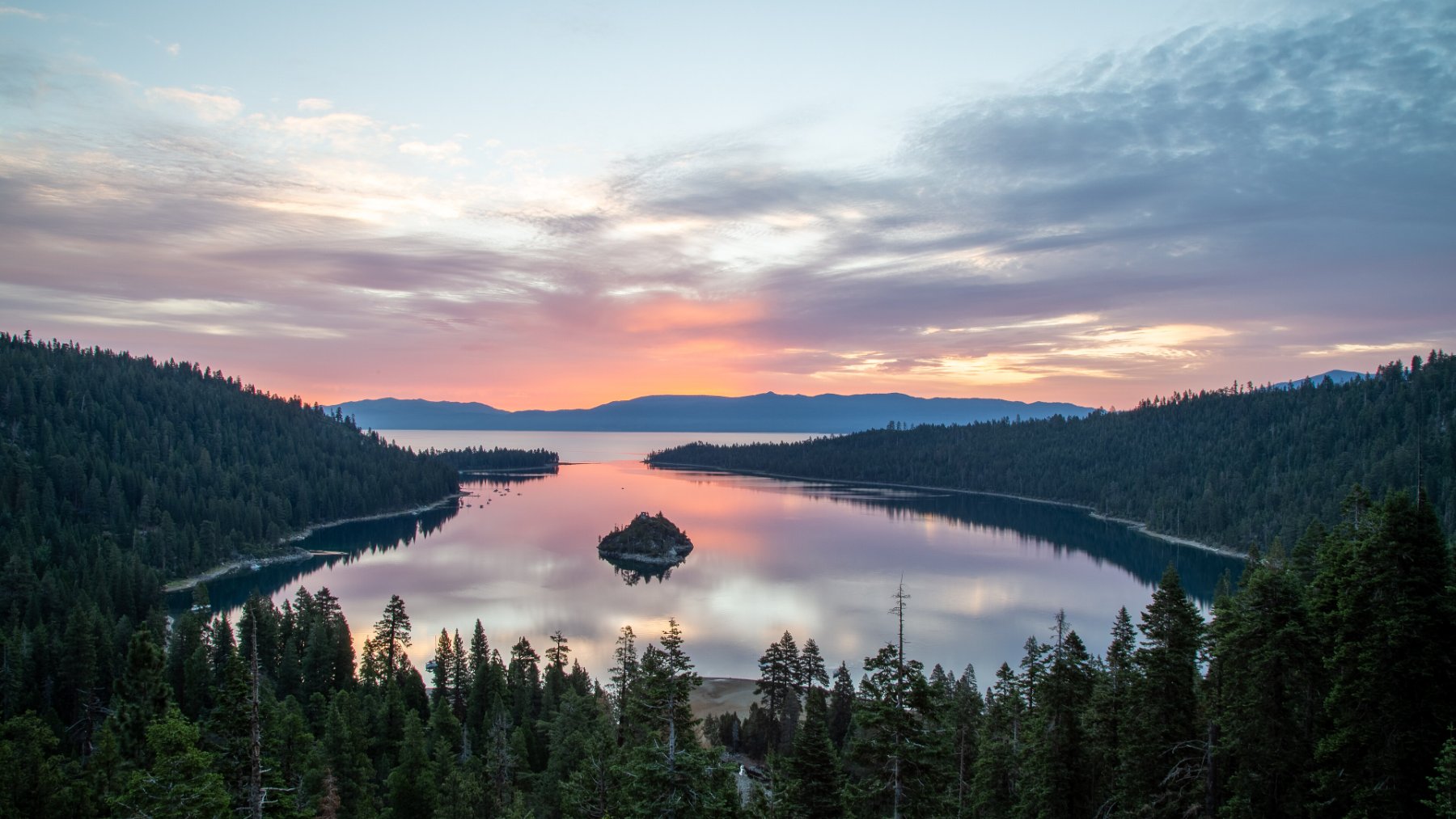
In 2012, researchers at the University of California, Davis (UC Davis) prepared 238 rubber mats to cover a section of the lake bottom at Lake Tahoe, in the United States. They aimed to deprive the invasive Asian clams of oxygen. The project achieved a mortality rate close to 90% in the treated area, according to results announced by the university.
The intervention focused on Emerald Bay, where about two hectares were covered and the mats were removed in late 2014. The experience showed that it was possible to reduce these mollusks without applying pesticides, although some living specimens remained and there were effects on other bottom-dwelling animals.
An underwater invasion
The Asian clam (Corbicula fluminea) was detected for the first time on the southern shore of Lake Tahoe in 2002. It later spread to different parts of the lake, with densities of thousands of individuals per square meter in some areas, according to the Tahoe Environmental Research Center of UC Davis.
Its presence can alter invertebrate communities and nutrient cycling. Moreover, its excretions promote the growth of algae that currents can carry to beaches, where they accumulate and decompose. For swimmers, the problem ends up being quite visible.
A dive operation
The figures give an idea of the work behind it. Each roll measured about 30 meters long and weighed approximately 136 kilograms, and the assembly required nearly 16 kilometers of reinforcing bars and 16,000 eyelets to secure the material.
The panels also included valves to withdraw water samples without lifting them. Geoffrey Schladow, then-director of the center, explained that they were aiming to “minimize the time divers have to spend under the water.” Preparing each piece properly was part of the experiment.
How the mats worked
The barriers limited the arrival of oxygenated water to the sediment, while biological activity consumed the oxygen trapped beneath. In Emerald Bay, organic material was added to accelerate that consumption. The goal was to maintain conditions that the clams could not endure for long.
The idea already had prior tests. A study published in Environmental Management in 2012 described a 2010 trial covering about 1,950 square meters for 120 days. After removing the barrier, the abundance of clams had fallen by more than 98%, and remained reduced by more than 90% a year later.
The bottom complicated the experiment
Why was it harder to repeat that result in Emerald Bay? The UC Davis 2014 report describes currents capable of overturning the barriers and a bottom of porous, irregular glacial materials. The oxygen-rich water could flow through those gaps and reach the animals underneath the coverings.
That population had been chosen for its isolation and relatively small extent. But local conditions forced checking what happened under the mats, and samplings through October 2013 placed mortality around 90%. The shape of the bottom also determined the outcome.
What the percentage hid
An evaluation included in the 2015 management plan calculated an average reduction of 88% in the density of Asian clams after removing the barriers. The population fell from about 60 to about seven specimens per square meter. That figure measures abundance, a metric different from mortality.
The same document recorded a decline in native Pisidium clams, from about eight to one per square meter. The oxygen deprivation also affected species that were intended to be preserved. Therefore, assessing the result required looking beyond the invaders eliminated.
Furthermore, earlier trials at Marla Bay and near Lakeside Marina showed another limitation. At 22 months after removing the barriers, the abundance of Asian clams returned to levels comparable to untreated areas. That timeframe corresponds to those tests, not to Emerald Bay’s follow-up.
What happened next
The technique was used again between 2017 and 2020 in Sand Harbor, another Tahoe area. A follow-up conducted in 2021 found fewer than five clams per square meter inside the treated area. Yet, the researchers considered that the extent of the invasion probably exceeded what could be eradicated effectively and economically with these barriers.
Their recommendation was to study localized actions and continue monitoring the recovery of the populations. These later results were published by UC Davis in February 2022 in the 2021 annual report on Asian clams in Sand Harbor.