The climate agreement signed between Spain and California opens five years of cooperation in renewables, storage, droughts, and wildfires. Its practical scope will depend on the work plan prepared by both administrations.
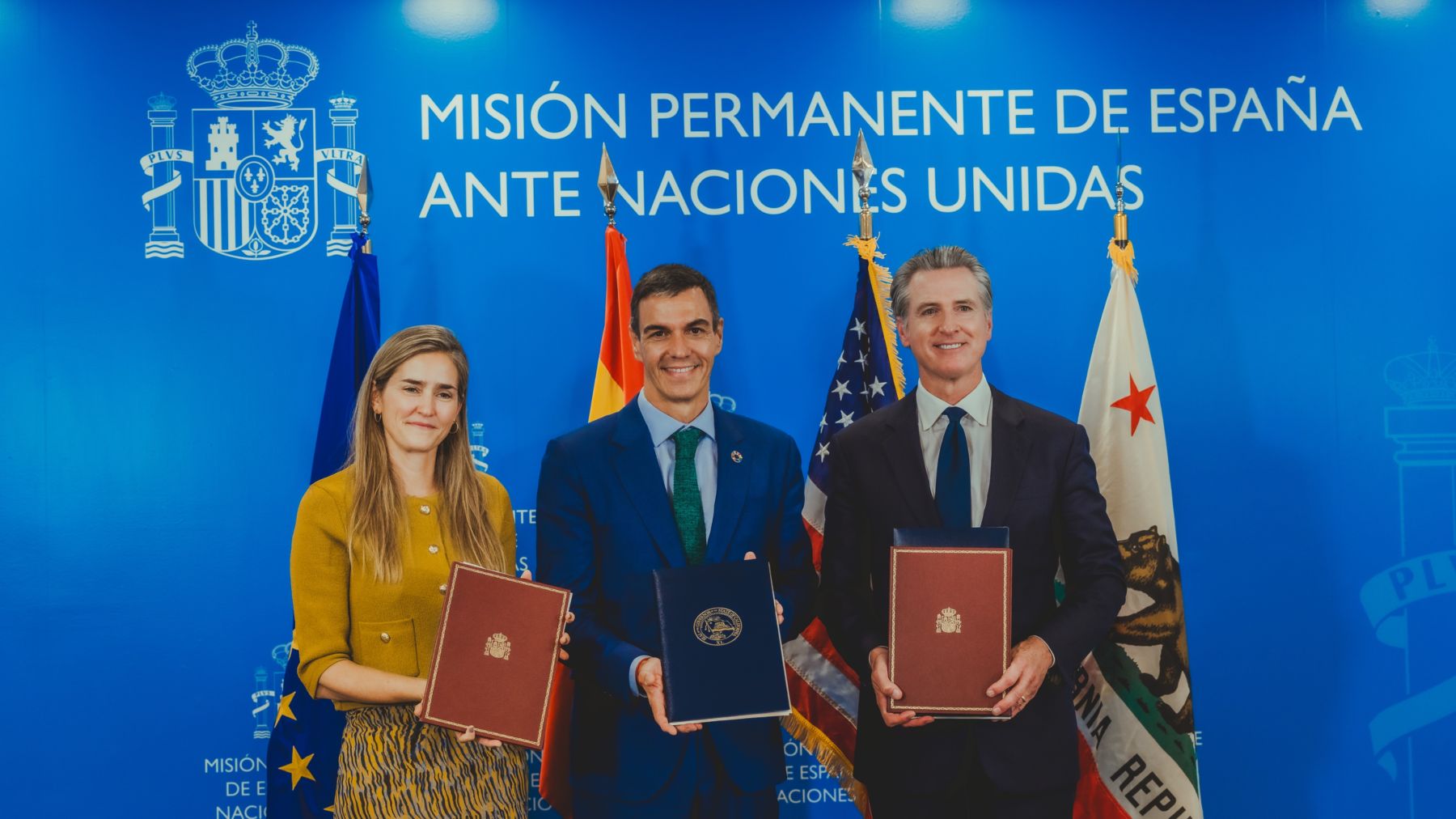
Sara Aagesen, the government’s third vice president and minister for the Ecological Transition and the Demographic Challenge, recently met with California Governor Gavin Newsom in New York City, and they signed a Memorandum of Understanding (MoU) aimed at cooperating on environmental and climate matters.
The climate agreement they have reached will prioritize, among other areas, the deployment of renewable energy, its integration with storage, integrated drought and wildfire management, and the reduction of greenhouse gas emissions.
What are the objectives of the climate agreement between Spain and California?
The Ministry for Ecological Transition and the Demographic Challenge (MITECO) and the California Environmental Protection Agency (CalEPA) have signed in New York a Memorandum of Understanding (MoU) or a climate agreement that is oriented toward establishing a flexible framework for collaboration in the climate and environmental arena.
The agreement seeks to reduce greenhouse gas emissions, promote an energy transition and a more just and sustainable economy. It also aims to strengthen community and ecosystem resilience, and, in parallel, to promote climate governance that is fair and inclusive.
Signing and Key Points
The climate agreement document has been signed by Sara Aagesen, as the government’s third vice president and minister for the Ecological Transition and the Demographic Challenge, and Gavin Newsom, California’s governor, during the bilateral meeting held with the California governor and Spanish Prime Minister Pedro Sánchez. The signing coincided with the United Nations General Assembly and New York Climate Week.
Aagesen stated: ‘We share goals on reducing emissions, in the push for adaptation and resilience, and in pursuing governance that is increasingly participatory, where we will act jointly and share experiences.’
The minister reaffirmed: ‘From Spain we want to share our eight years of changes, that 180-degree turn of our agenda with renewables as protagonists and that has allowed us to reduce our dependence on fossil fuels’.
The MoU or climate agreement establishes an initial cooperation period of five years, renewable, and covers a series of strategic axes for technical, regulatory and political work.
- Deployment and integration of renewables, energy efficiency, renewable hydrogen and storage.
- Resilience and climate adaptation: early warning for heat waves, integrated management of wildfires, water resilience and biodiversity.
- Electrification and decarbonization of transport.
- Exchange of experiences in carbon markets, monitoring and reduction of methane emissions, circular economy, residential climate control and resilient urban planning.
California and Spain are global climate benchmarks
The climate agreement strengthens the relationship between two world leaders in the fight against climate change, who are already part of the Global Offshore Wind Alliance and the Beyond Oil and Gas Alliance, and moreover solidifies subnational climate diplomacy at a time that is crucial for sustainability on the international stage.
Spain and California share structural challenges arising from their similar climates and are characterized by greater exposure to extreme weather events, such as prolonged droughts, heat waves and high-intensity wildfires.
The collaboration under this climate agreement will enable the sharing of lessons in integrated territorial management, efficient water use, and the application of advanced technologies such as artificial intelligence and satellite monitoring in preventing environmental emergencies.
A Lot of Work Ahead
Furthermore, both administrations stand at the global forefront of the push for renewable energy and the integration of storage systems into their power grids. This is a field where their shared experience will help them move toward fully clean systems and to guarantee the security of supply.
To develop the agreement, MITECO and CalEPA will coordinate the rollout of a joint work plan. It will include technical workshops on best practices, missions of institutional and business delegations, and periodic bilateral meetings at multilateral forums such as the United Nations Climate Summit (COP) or the Climate Weeks in London and New York.