
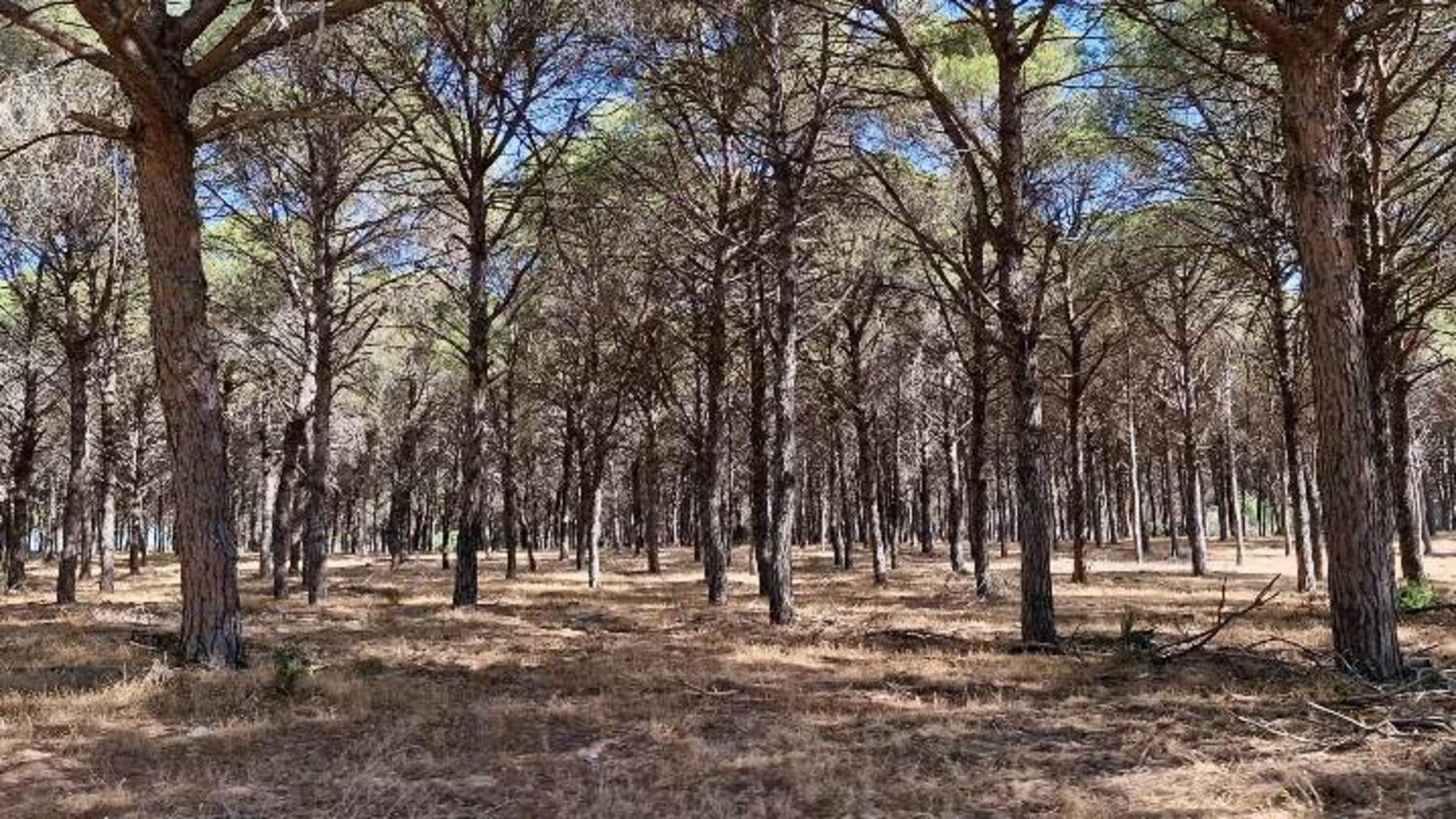
The Guadalquivir Hydrological Confederation (CHG) has begun restoration work at the Pinto Pine Forest in Hinojos to remove trees affected by wood-boring insects, reduce the dry biomass, and promote a more resilient forest until October 2027.
The Guadalquivir River Basin Confederation (CHG) has rolled up its sleeves to undertake the restoration works at Pinar del Pinto, in Hinojos (Huelva), with the aim of improving the conservation status of this forested area in the Doñana region.
These measures are intended to carry out the removal of trees infested by wood-boring insects, as well as the reduction of the dry biomass that has accumulated across these stands, with the idea of reducing the risk and fostering a more resilient forest mass.
The works will span one year, and the objective is to recover the vitality of the pine forest and strengthen its capacity to face future threats. The tasks will be carried out in a planned manner to minimize the impact on the natural environment.
Intervention at Pinar del Pinto in Doñana
The Guadalquivir Hydrological Confederation (CHG), within the Doñana Action Framework, is implementing an environmental restoration and climate-change adaptation project at the Monte Público Pinar del Pinto, in the municipality of Hinojos (Huelva), with an investment of 1.46 million euros.
The objective of these works, which will continue through October 2027, is to improve the health status of the forest mass and reduce fire risk in one of the spaces of highest ecological value in the Doñana area, the CHG reported in a statement.
Laura Martín Murillo, the Commissioner for the Water Cycle and Ecosystem Restoration at MITECO, has visited the works, accompanied by Gloria Martín Valcárcel, president of the CHG, as well as by staff from the basin organization and the Doñana Technical Office, the body responsible for monitoring the measures under the Territorial Action Framework.
The intervention is taking place in a forest stand affected by processes of tree decline and the presence of wood-boring insects, circumstances that increase the accumulation of dry biomass and, therefore, the vulnerability to fire.
To reverse this situation, silvicultural improvement treatments are being carried out, removal of affected specimens, and environmental restoration work that will enable a healthier, more stable forest mass adapted to future climatic conditions.
Among the actions already completed are environmental signaling and marking, the felling and removal of affected trees, the bucking and storage of the timber obtained, and preventive fire surveillance tasks during the period of greatest risk.
Restoring the Pine Forest
To reverse this situation, silvicultural improvement treatments are being carried out, removal of affected trees, and environmental restoration work that will allow the creation of a healthier, more stable forest mass adapted to future climatic conditions.
The Commissioner for the Water Cycle and Ecosystem Restoration reiterated that “climate change and the drop in the water table are affecting the pines around Doñana: droughts, pests, trees drying up. Restoring the pine forest is removing fuel for potential fires. Investing in more mixed and resilient forests, with greater biodiversity.”
For her part, the CHG president, Gloria Martín Valcárcel, emphasized that “in a time of significant environmental change, the Confederation is intensifying its prevention efforts; we must act before problems arise.”
This intervention combines ecological restoration, adaptation to climate change, and fire prevention in a space of extraordinary environmental value, such as Doñana.