
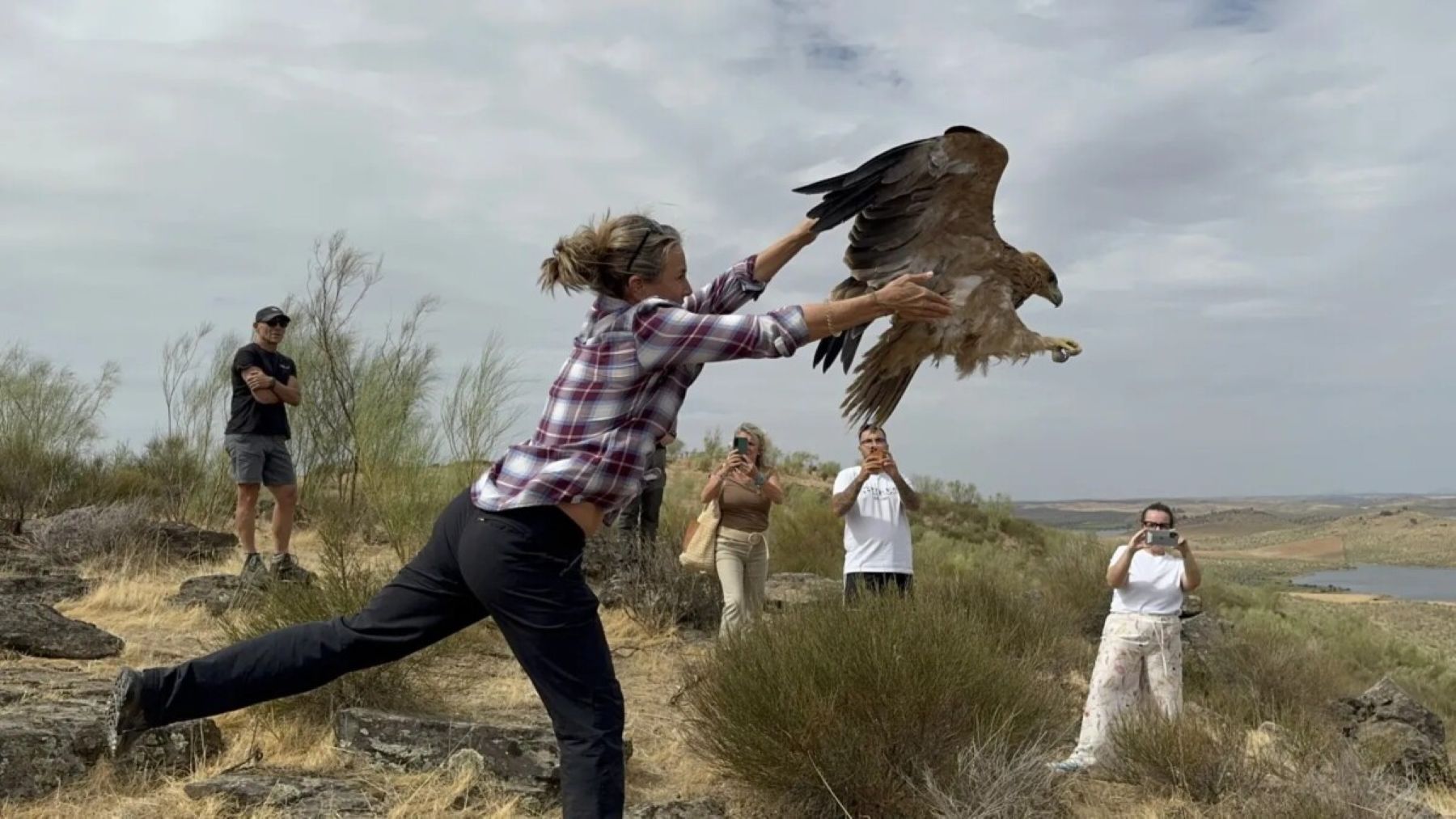
Thanks to the rescue of birds of prey, many are returned to the wild. Félix is a prime example, as this Iberian imperial eagle fell from its nest due to the heat. AMUS cared for six other chicks of the species last summer.
The Iberian imperial eagle Félix soars again over the Matachel valley, located in Badajoz, after attempting to leave the nest prematurely at barely three months old. Odile Rodríguez de la Fuente was responsible for naming the bird in honor of her father and for releasing it after its recovery, thanks to the intervention of the raptor rescue experts from AMUS.
Excessive heat causes birds to abandon nests ahead of time, and when they fall to the ground they are left completely defenseless, at the mercy of predators and with a high likelihood that their parents stop provisioning them, so the fate of these chicks is usually fatal unless those who dedicate themselves to raptor rescue discover them.
In this case of raptor rescue, the bird was taken to AMUS’s wildlife hospital, where several adult Iberian imperial eagles, who for one reason or another cannot be reintroduced into their natural habitat, reside and fulfill the role of foster mothers, teaching the chicks the species’ behaviors, which facilitates their release once recovered.
Félix is alive thanks to AMUS’s raptor rescue
Moved, reivindicative and with a warning message about the consequences of climate change, the naturalist and science communicator Odile Rodríguez de la Fuente expressed as she released this Tuesday a recovered Iberian imperial eagle named after her father, Félix.
“It’s impressive… a marvel; please, may my father, from wherever he is, help this eagle have a long and prosperous life,” she stated very moved after releasing the bird from a high-altitude vantage point in the Matachel Valley, in the province of Badajoz.
Félix has returned to nature in the same area where the raptor rescue experts found him, at the beginning of July, on the brink of death, after prematurely leaving the nest due to thermal stress caused by the high temperatures.
In fact, the release of this Iberian imperial eagle, whose recovery has been possible thanks to the work carried out by the professionals at the Wildlife Hospital of the association Acción por el Mundo Salvaje (AMUS) in Villafranca de los Barros (Badajoz), is part of a campaign to raise awareness about the effects of climate change on wildlife.
This summer seven chicks of the species were rescued
AMUS’s raptor rescue staff recovered a total of seven Iberian eagle chicks this summer, according to its president, Álvaro Guerrero, who explained that they were “cast into the void” by the heat, since their nests remain exposed to the sun all day.
If they are not located in time, these individuals can die due to the terrain conditions or be preyed upon by dogs, foxes or wild boars, in addition to the risk that their parents stop feeding them when they are found outside the nest.
The recovery process lasts about two months and is not limited to the animal’s physical development, “but also constitutes psychological development,” which is why they suffer when separated from their parents, Guerrero explained.
AMUS uses unrecoverable adult individuals of the same species as tutors, who help the youngsters develop eagle-specific behaviors and stay away from humans. Once released, they wear GPS transmitters that allow monitoring their movements and detecting the threats they face.
This raptor rescue is a symbol of ‘hope’
Odile Rodríguez de la Fuente has baptized this eagle in honor of her father because, like him, “it represents that hope” in humanity and because “there are people with sensitivity, who have a deep empathy for all forms of life.”
The communicator has warned that climate change measures must be taken in time and has emphasized that its consequences will not only affect other species but also people, especially those who have contributed the least to global warming.
For Rodríguez de la Fuente, what is most vertigo-inducing is “the lack of timely reaction, not listening to what science is telling us,” in a context where “we are at a very critical moment for our species and the different life forms that accompany us on this planet.”
“We are completely denaturalized and dehumanized,” she lamented, though she has not hidden her more optimistic side, as reflected by the AMUS team. “I am optimistic on occasions like this, because I see that in the end there are people with sensitivity, who have a deep empathy for all life forms,” she stated.
We live on an irreplaceable planet
The release of Félix is framed within the ‘Planet I: Irreplaceable’ campaign, driven by AMUS to draw attention to the consequences that climate change is having on wildlife.
Rodríguez de la Fuente has been the first of the personalities to participate in this initiative, which will also involve representatives from fields such as music, poetry, journalism, literature, communication and environmental outreach.
The campaign aims to highlight increasingly frequent situations such as premature abandonment of eagle nests or black vultures’ nests, the death of young eaglets over crops that reach temperatures above 45 degrees, or the fall to the ground of swifts and kestrels when the interior of their nests becomes a “heat trap.”
This campaign, developed with funding from the Ministry for Ecological Transition and the Demographic Challenge (MITECO), places the focus especially on large raptors, considered species particularly exposed to the consequences of global warming.