
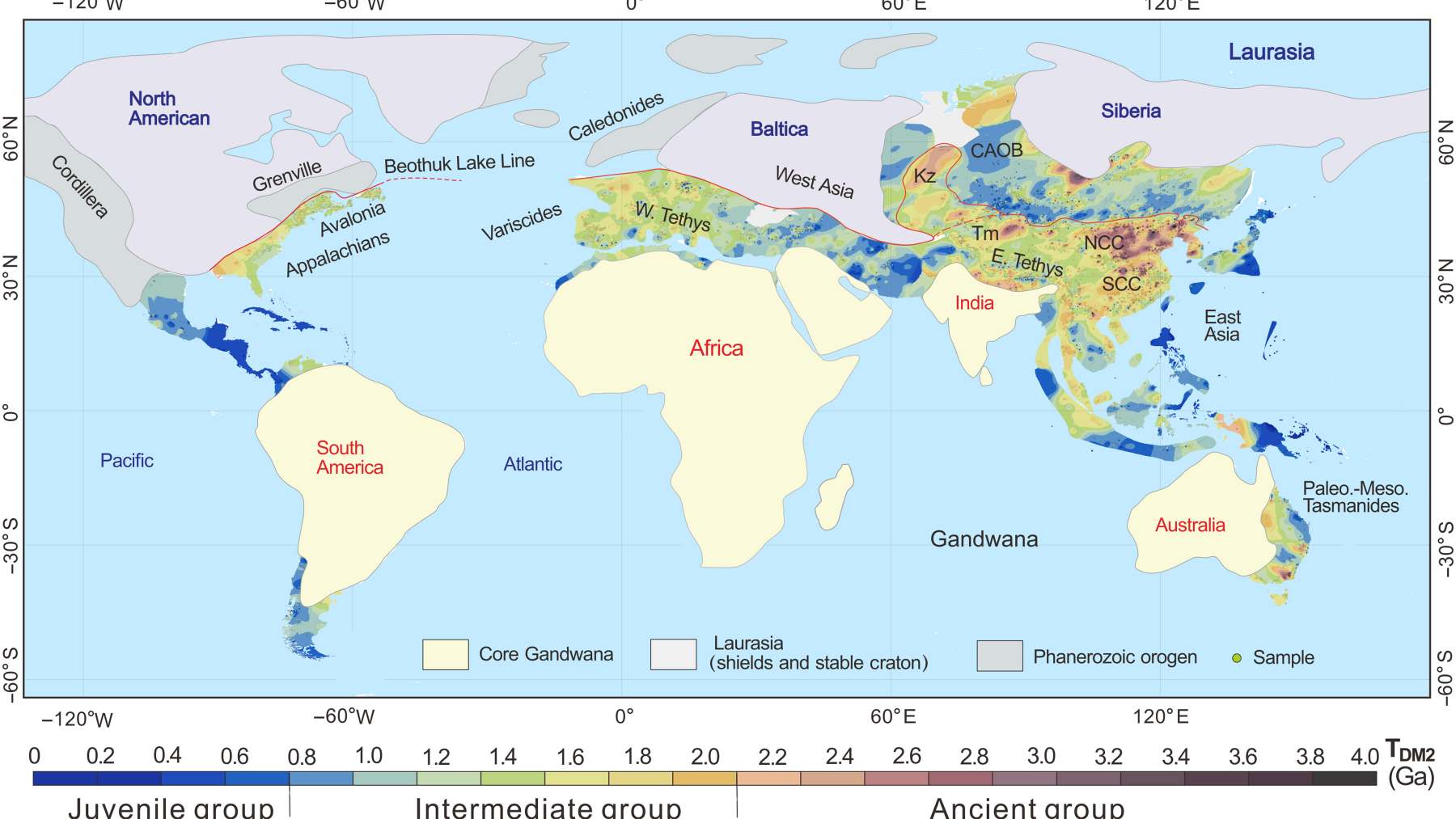
The rocks that today form part of a mountain may hold clues to a continent that split apart millions of years ago. An international team has used data from 25,346 rocks to reconstruct Gondwana and estimates that it encompassed about 80% of the planet’s continental surface, compared with the 64% previously estimated.
The study, published on September 9, 2026 in Science Advances, identifies ancient fragments hidden beneath the mountain belts of Asia, Europe, and North America. Its authors propose a “Greater Gondwana” and suggest that its formation may have favored environmental changes linked to the diversification of animals.
What does that 80% mean?
The figure needs context. It refers to the proportion of the continents that would have remained joined in Gondwana, not counting the oceans as part of that surface.
The reconstruction focuses on roughly 550 to 500 million years ago. It expands the territory traditionally associated with Africa, South America, Antarctica, Australia, and India, incorporating pieces whose history had been hidden beneath later rocks.
The change amounts to about 16 percentage points added to the previous estimate. Put simply, the proposal brings together in a single mass roughly four-fifths of the continental surface of that era.
A memory within the granite
The key lies in the isotopes of samarium and neodymium, variants of these elements that allow researchers to investigate the origin of rocks. Their ratios preserve information about ancient materials, even after part of that crust melts and gives rise to new rocks.
This makes it possible to distinguish two moments in the same history. One corresponds to the formation of the granite we observe, and the other to the estimated age of the materials from which it originates.
It’s like renovating a house by reusing its old bricks. The construction may be new, but part of the material retains an earlier history, and that difference helps identify continental fragments that are no longer obvious at first glance.
The Help of AI
The work gathered analyses previously carried out by numerous researchers. According to William Collins, coauthor of the study, to ConnectSci, a tool called GeoChatGPT helped collect data from samples already studied and their locations in a large database.
The contribution of artificial intelligence was to gather that information to enable large-scale work. The geological reconstruction was then supported by isotopic signals and by comparison with maps of the ancient Earth.
“It’s a bit like a time machine for Earth’s history,” Collins explained as he described the global compilation. The image helps to understand the method, although what scientists obtain is a reconstruction based on chemical and geological clues.
The hidden past beneath Asia
One of the clearest examples appears in the Himalayas. Collins describes granites formed 20, 50, or 120 million years ago whose materials of origin point to a much older continental block connected with Gondwana.
The team traced these signals from India and Southeast Asia, across a large portion of China, to Kazakhstan. Some areas previously interpreted as ancient ocean floors with chains of volcanic islands would instead include fragments of continental crust.
Therefore, a young mountain range can conceal a history that is much longer. The mountains we see when traveling tell only part of what has occurred beneath our feet.
Volcanoes, climate, and animals
The authors also propose a link between the union of Gondwana and the major environmental changes of that era. Their hypothesis includes the formation of an extensive volcanic belt around the supercontinent, associated with the subduction of one tectonic plate beneath another.
Those volcanoes would have released gases such as CO₂ for millions of years, contributing to climate modification. According to the team’s hypothesis, this transformation could have helped create favorable conditions for the large diversification of animals during the Cambrian.
It is important to distinguish this proposal from a proven and exclusive cause. Complex life already existed before the Cambrian, during the Ediacaran, so that diversification extended a history of life that had begun long before.
An Open Map
The main contribution of the study is to broaden the reconstruction of Gondwana through signals preserved in rocks. Its possible influence on climate and evolution opens another line of inquiry, which requires testing the timing and mechanisms of these changes.
The result invites looking at mountains as archives of the planet’s environmental history. The original study has been published in Science Advances, under the title “Buried fragments reveal a ‘Greater Gondwana’ supercontinent.”
Image: Tao Wang et al. / Science Advances (CC BY-NC 4.0)