
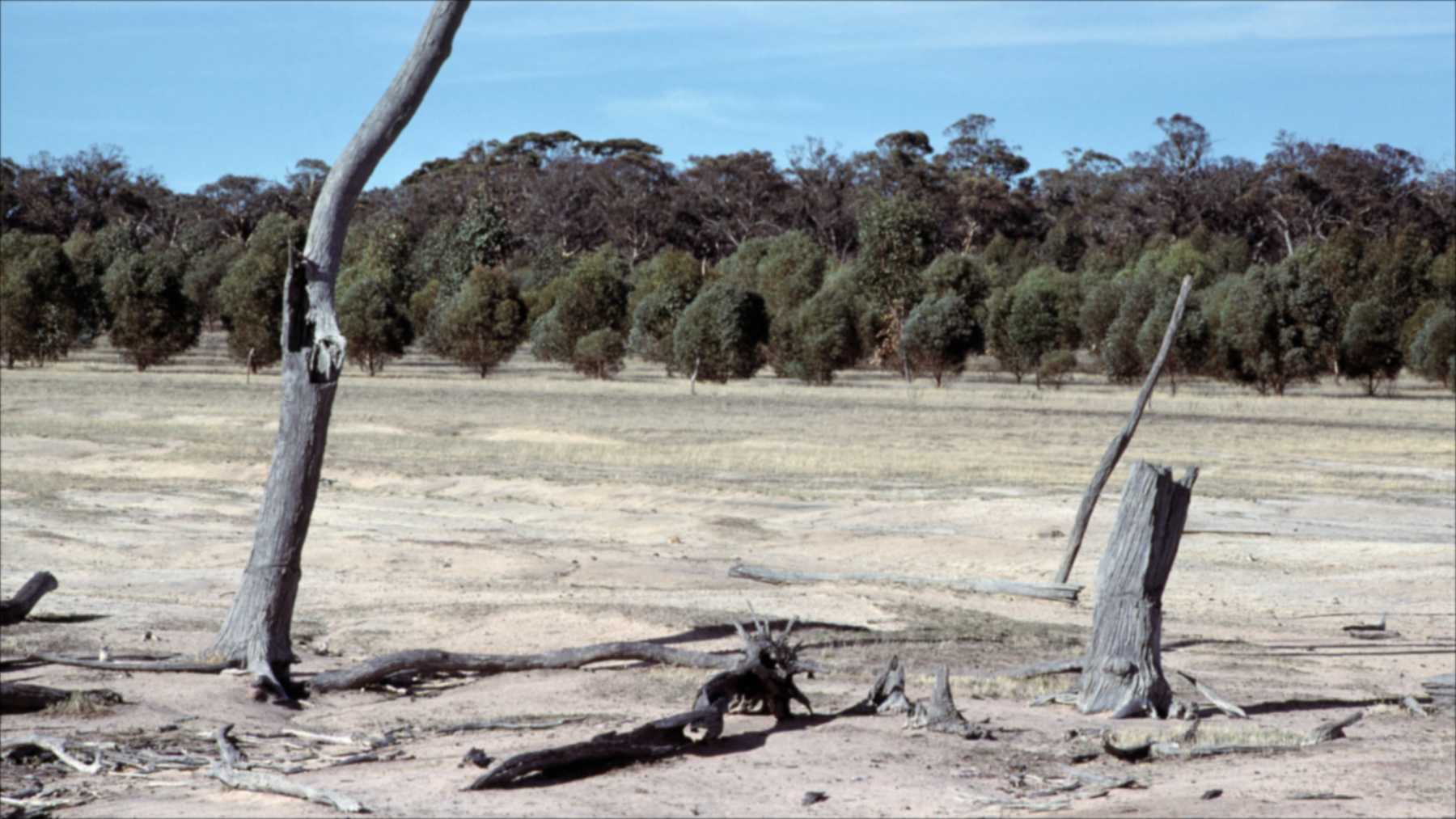
Planting trees seemed to be a way to reclaim salt-damaged croplands. In southwestern Australia, a eucalyptus trial showed that these trees consumed more water than nearby crops and grasses, but they did not manage to halt the influx of saline water that the project aimed to control.
The plantation was established in 1976, and its results, after 15 years of monitoring, were published in November 1995. That study offered a useful lesson for understanding these environmental interventions. To reclaim land, one must also understand what happens beneath the surface.
Why Salinity Reaches the Roots
In agricultural zones, changing vegetation can alter the path of water. When annual crops allow more water to infiltrate into the subsoil, the water table can rise and push salt into the zone where the roots grow.
The Department of Primary Industries and Regional Development of Western Australia describes this process as a cause of dryland salinity. Its effects can be seen in lower yields, plants that disappear, and patches of bare ground with saline crusts.
The idea of planting eucalyptus aimed to address that imbalance. If the trees could use more water, they might reduce the amount feeding the groundwater system and help slow the problem.
A Trial Under Monitoring
The researchers planted several species in about 12% of a small agricultural catchment, upslope from an area where saline water surfaced. One of their main objectives was to compare the trees according to their potential water use, using indicators such as leaf area and survival.
Below that property there were two groundwater systems, one deep and permanent and another shallow and seasonal. The team tracked their levels and salinity using piezometers, devices that allow observation of groundwater.
Water Changed, Salinity Persisted
Monitoring the water levels showed that the plantation consumed more water than neighboring crops and grasses. During the trial, changes in the composition of the deep water were also recorded.
Between 1977 and 1984, the chloride concentration in the deep aquifer fell by about 20%. That drop was greater on the middle slope than at the bottom, a detail that shows the response varied even within the same catchment.
Did that mean the soil was recovering? The researchers continued to observe significant salt discharge at the upwelling zone throughout the trial. They also found greater salt reserves in the soil at the lower part than on the mid-slope.
The Challenge Was Underground
The authors pointed out as an important factor the location of the plantation on a zone where the aquifer appeared confined. In such aquifers, relatively impermeable layers limit the movement of water into and out of the system.
In this case, consuming more water was not enough to control the system that fed that saline upwelling. The result points to a practical precaution to keep in mind before planting. Choosing trees with high water demand does not guarantee salinity control if their location limits their influence on the problem.
Which Eucalypts Responded Best
Growth was rapid up to 1981 and then declined. After 15 years, four of the types evaluated stood out, Eucalyptus cladocalyx var. nana, Eucalyptus cladocalyx, Eucalyptus occidentalis and Eucalyptus sargentii.
They were the most promising under the trial’s conditions. But surviving and thriving in that place did not equate to reclaiming the saline land, and these results do not allow recommending the same species for any other region.
What Should Be Checked Before Planting
For land workers, the question is simple. Does it truly improve the soil, or is it just altering the water that circulates beneath? A reduction in chloride in an aquifer does not by itself prove that salinity around the roots has decreased.
Current guidance from the department recommends measuring both soil salinity and groundwater salinity and tracking the depth to the water table for at least five years to assess trend. They also advise addressing salinity within a plan for the entire farming operation and, preferably, for the entire catchment.
The takeaway from this trial is that a planting needs a site diagnosis and monitoring to know whether it fulfills its function. The original study was published in November 1995 in Agricultural Water Management.
Image: Willem van Aken / CSIRO (CC BY 3.0)