
P-22 spent more than a decade in Griffith Park, a refuge of about 23 square kilometers surrounded by the city of Los Angeles. His story revealed how highways can trap a wild animal, even when it manages to survive amidst them. It also helped spur a response that is on the verge of becoming a reality.
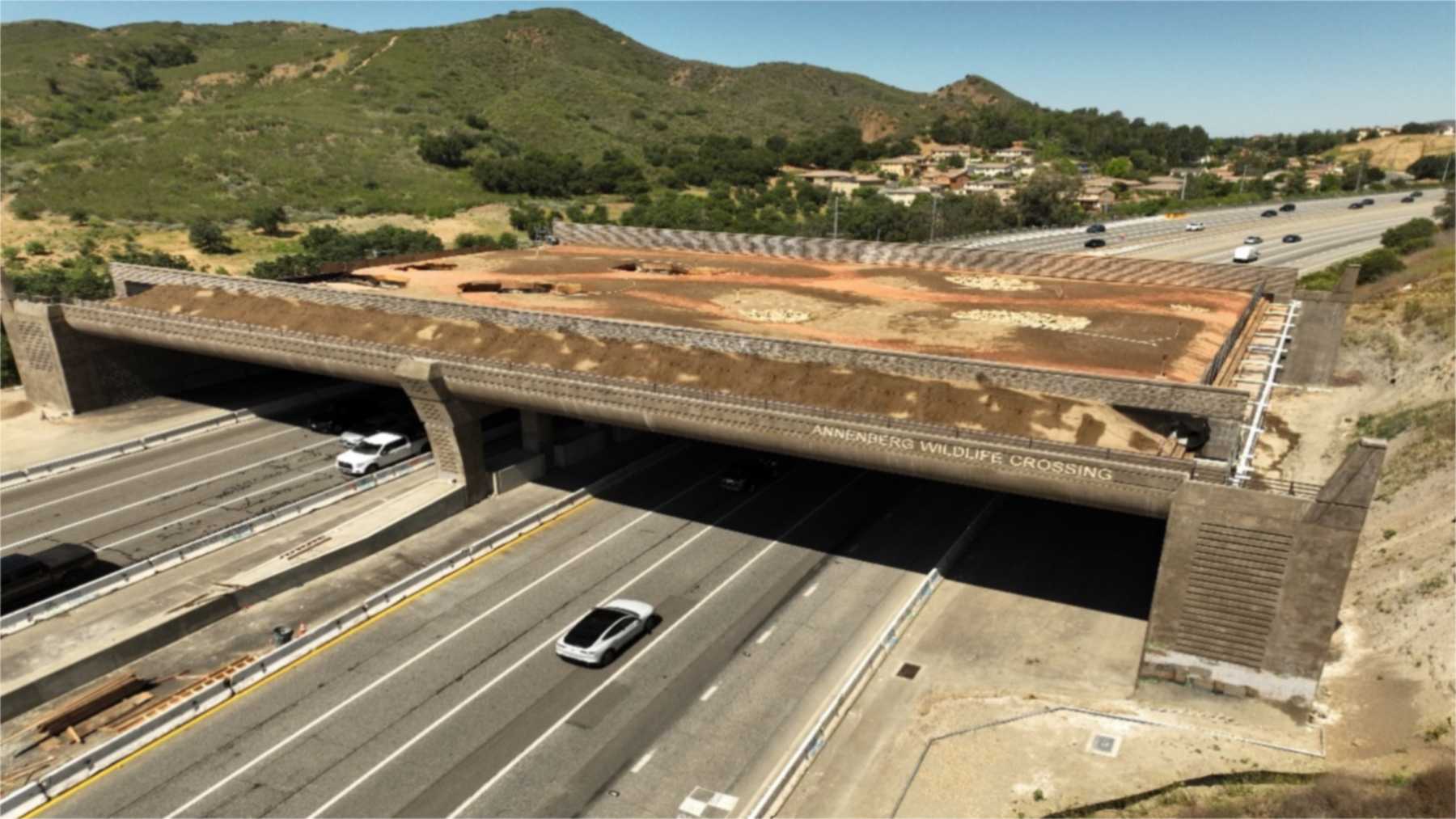
The Wallis Annenberg Wildlife Crossing in Agoura Hills is scheduled to open on December 2, 2026. The infrastructure will cross Highway 101 and the adjacent Agoura Road to reconnect habitats separated by traffic. Promoters describe it as the largest wildlife crossing of its kind in the world.
The Wallis Annenberg Wildlife Crossing Figures
| Item | Value |
|---|---|
| Start of construction | April 22, 2022 |
| Opening announced | December 2, 2026, about 4 years and 7 months later (self-calculated) |
| Lanes it crosses | 8 in traffic and 2 in emergencies |
| Estimated cost | $114 million |
| Contribution from Wallis Annenberg and foundation | $26 million, about 23% (self-calculated) |
| P-22’s territory | About 23 km² |
| Typical territory of a male in the region | About 390 km², about 17 times larger (self-calculated) |
23 Square Kilometers Versus the Usual 390
In March 2012, the United States National Park Service (NPS) fitted P-22 with a tracking collar. Their research suggests he had most likely crossed the 405 and 101 highways from the western edge of the Santa Monica Mountains. The exact route remains unknown.
What could be measured, however, was his isolation. The NPS regards him as occupying the smallest territory ever recorded for an adult male puma, while a male in the region typically covers around 390 square kilometers. The difference between his 23 square kilometers and the usual area helps illustrate how exceptional his situation was. In other words, the usual territory for a male is roughly 17 times larger.
P-22 found food and hunted primarily wild prey, such as deer and coyotes. But surviving did not solve all of his needs: he did not have any known offspring and it was very difficult for him to find a female within that park. His refuge also functioned as a barrier.
Inbreeding and Very Low Genetic Diversity
What happens when a highway prevents animals from meeting? In the Santa Monica Mountains, researchers have documented mating among close relatives and very low genetic diversity. Over time, this lack of exchange can harm reproduction and the survival of the population.
The new corridor aims to make it easier for pumas to move between natural areas and breed with individuals from other groups. It will also allow younger animals to disperse in search of territory. It is a vital connection for the future of the population, beyond simply avoiding occasional vehicle collisions.
Eight Lanes, Two Shoulders and More Than 50 Native Species
Construction began on April 22, 2022, coinciding with Earth Day. Caltrans, the California Department of Transportation, announced in June 2025 the start of the final phase, aimed at extending the crossing over Agoura Road and restoring the surrounding land.
The design incorporates earth, native vegetation, rocks and vegetated sound barriers. Caltrans announced planting more than 50 native species to restore habitat on the bridge and its approaches. The aim is for animals to find continuity with the mountains even as cars continue to travel beneath.
The oft-quoted description of a ten-lane crossing needs a small nuance. According to project documentation, there are eight lanes in use and two lanes for emergencies. Moreover, project managers warn that some landscaping and finishing work will continue after the opening.
$114 Million and a Photo Beside the Hollywood Sign
The image of P-22 beside the Hollywood Sign, photographed by Steve Winter, gave a face to the issue of urban wildlife. “The Wallis Annenberg Wildlife Crossing would not have been possible without P-22,” wrote Beth Pratt of the National Wildlife Federation after his death. His story brought this need for connectivity to people around the world.
The project brings together public funding and private donations. The latest project update places the cost at $114 million, though some line items are still awaiting a final valuation. Wallis Annenberg and her foundation contributed a total of $26 million, covering about 23% of the estimated cost.
That effort rests on decades of land protection and collaboration among administrations, scientists and conservation organizations. P-22 became a decisive symbol to mobilize support for a project requiring both protected land and engineering and financing.
The Test Will Be in the Genes of the Next Pumas
P-22 was euthanized on December 17, 2022, at about twelve years old, after severe injuries consistent with a vehicle collision and chronic illnesses. Among them was irreversible kidney disease. He did not live to see the crossing completed.
Evaluation of outcomes will go beyond the visual crossing of animals. The NPS plans to compare genetic data from before and after construction to determine whether gene flow between populations improves. The effects on future generations will require time.
The opening will be accompanied by a commitment to long-term research and habitat restoration. The opening announcement, dated August 20, 2026, has been released by the National Wildlife Federation and The Wildlife Crossing Fund on Save LA Cougars.
Image: Caltrans