
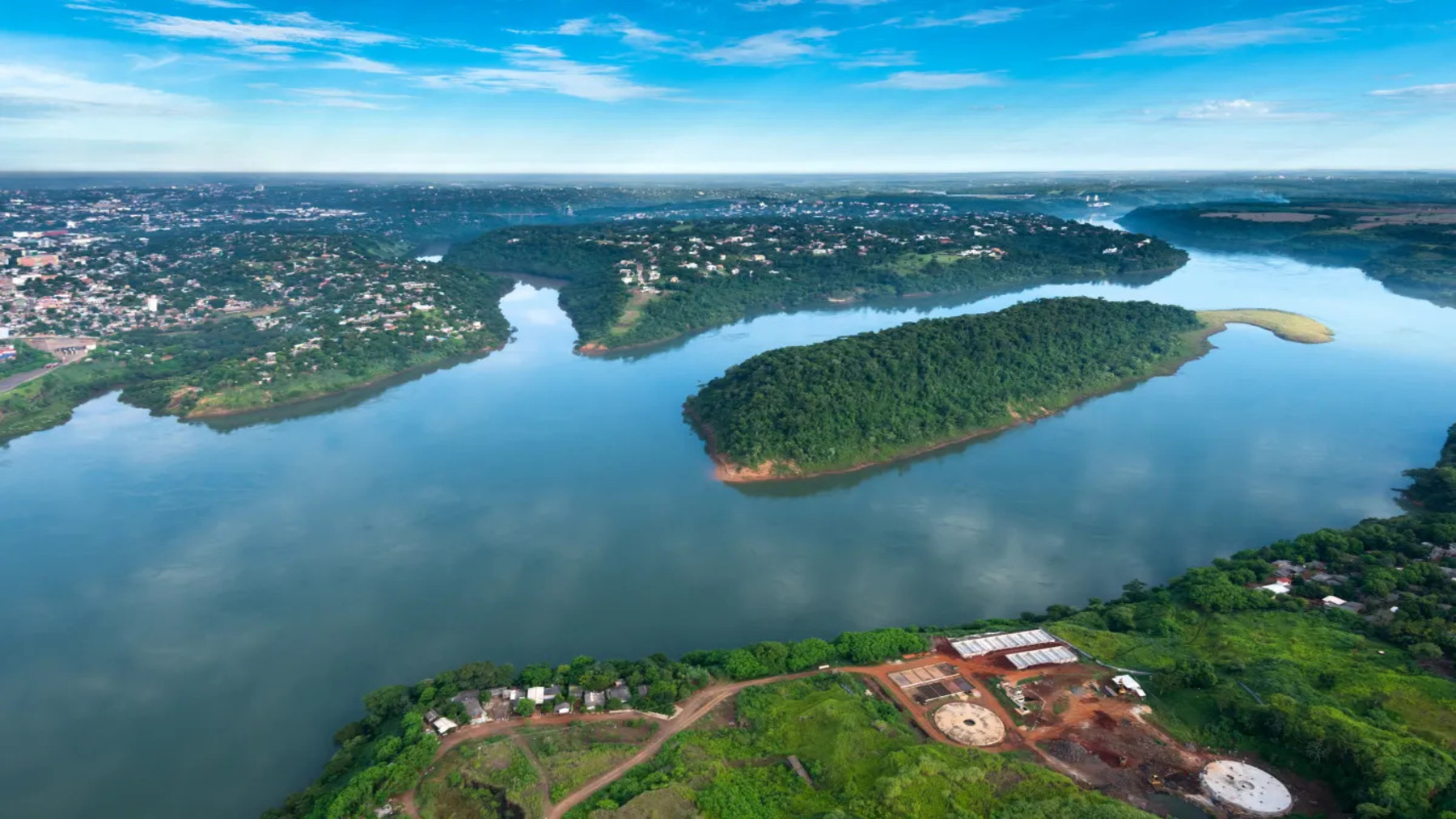
Jaguar Rivers is a project that draws attention to the fact that a river does not understand borders, and wildlife doesn’t either.
An initiative that seeks to restore the connections between wetlands, forests, and other habitats so that animal species do not become isolated between roads, crops or transformed areas.
Jaguar Rivers brings together organizations from Argentina, Bolivia, Brazil and Paraguay with a common goal: to restore ecosystems and connect territories along the Paraná basin, and with this idea it works to protect isolated spaces.
The project, promoted by Rewilding Argentina, Onçafari, Nativa and Fundación Moisés Bertoni, combines experience in nature restoration, wildlife conservation, and work with local communities.
With this text we will explore how Jaguar Rivers intends to recover those connections, what threats affect the basin’s ecosystems, and what role rivers can play as natural corridors. A look at a conservation strategy, undoubtedly.
What is behind Jaguar Rivers?
Four environmental organizations from Argentina, Bolivia, Brazil and Paraguay have joined forces to launch Jaguar Rivers (Ríos del Yaguareté), a transnational initiative that seeks to restore, protect, and reconnect the Paraná River basin’s ecosystems, on which more than 100 million people depend.
The project aims to create a network of protected areas or “arks” of wildlife, intermediate sites that facilitate the movement of fauna and zones of “integrated landscapes,” where conservation coexists with various productive activities, according to a statement from the Rewilding Foundation released this Friday.
Rewilding drives this initiative together with the organizations Onçafari (Brazil), Nativa (Bolivia) and Fundación Moisés Bertoni (Paraguay), as well as Kris Tompkins, president of Tompkins Conservation.
According to the statement, the basin faces threats such as unregulated water use, canalizations, pollution and dams, which affect flood regimes and the connectivity of ecosystems.
Adding to these threats is the deterioration of native forests associated with the basin. The text notes that the Atlantic Forest, which includes the Argentine Misiones Jungle, has been reduced by 90% in recent years, while in Bolivia 10 million hectares of forest were burned in 2024.
“Latin America is the region with the greatest biodiversity decline in the world: native wildlife populations have plummeted by 94% in the last fifty years,” says Sofía Heinonen, director of the Rewilding Argentina Foundation, who warns that “the most severe impact was suffered by wildlife.”
Kris Tompkins, for her part, notes that Jaguar Rivers “highlights the need to act at a larger scale before it is too late” to address the climate and biodiversity crisis.
The participating organizations project a twenty-year horizon to develop a network of restored and connected natural areas across the four countries, with self-sustaining populations of wildlife, driven by both natural movements of species and translocation actions.
“Jaguar Rivers inaugurates a renewed paradigm for the region’s environmental future by consolidating the Paraná basin as a vital network of reconnected ecosystems that guarantee a wilder, more resilient and prosperous continent for present and future generations,” they state.