
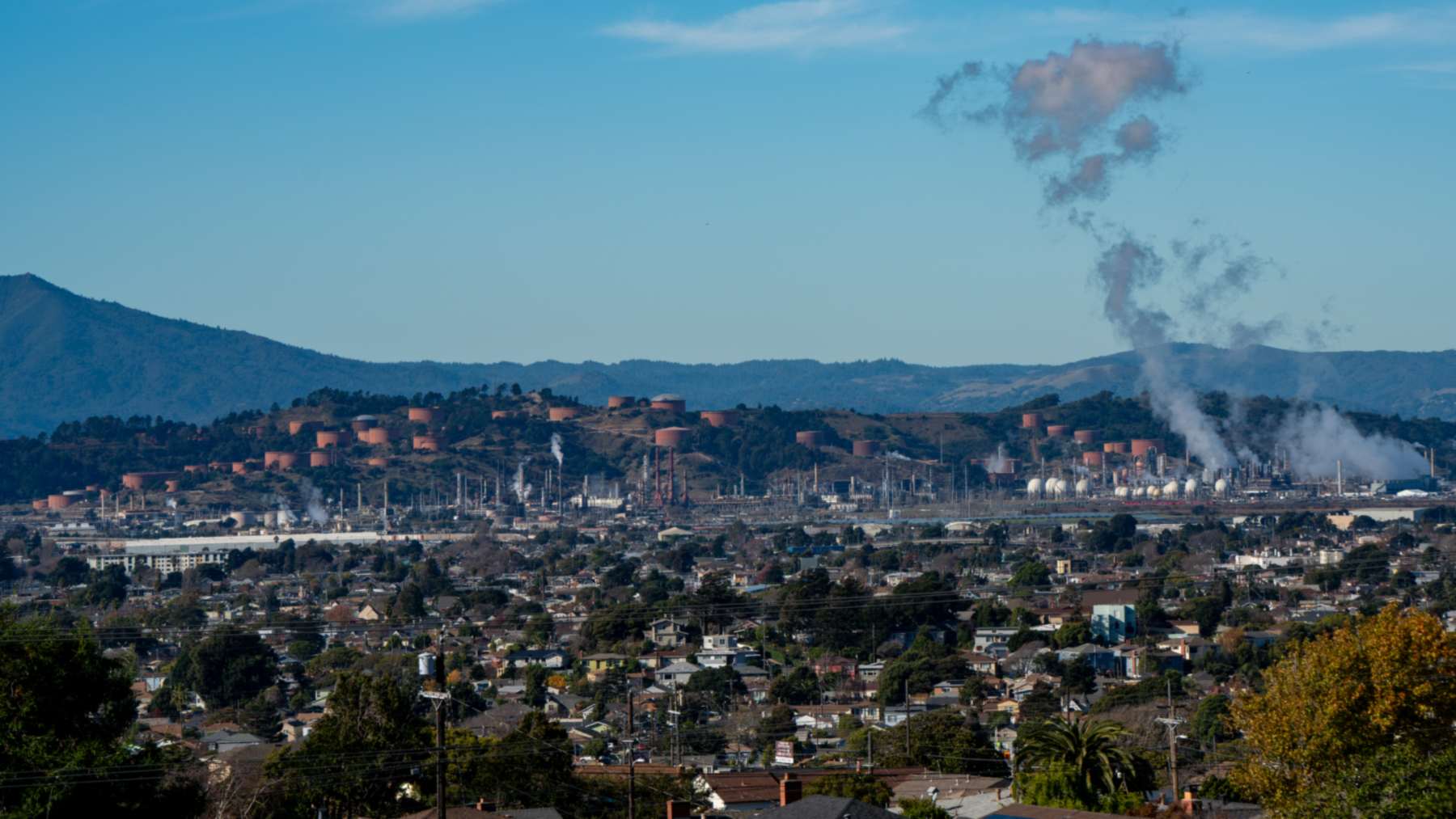
Between 1854 and 2024, the world’s 178 largest producers of oil, gas, coal, and cement released more than 1.2 trillion metric tons of carbon dioxide into the atmosphere. A study from the University of Washington now calculates that those past emissions will continue to warm the planet for centuries, regardless of the path future emissions take.
According to their simulations, the carbon those companies had already emitted by 2025 accounted for about 0.66°C of global warming. By the year 2500, it would still contribute between 0.31°C and 0.45°C, depending on the scenario.
Who Signed the Study and What Question
The work was led by Dargan Frierson, associate professor of Atmospheric Sciences and Climate at the University of Washington, together with Lauren Henrie, former Environmental Science and Resource Management student at the same university. It was published on September 23, 2026.
«We know fossil-fuel emissions have caused a lot of warming, and we are seeing its effects, but the question is: how long will that warming last into the future?», Frierson said in the university’s press release.
The authors identify a gap in the scientific literature. «Previous studies on climate accountability have focused almost exclusively on the past», they write in the paper.
Two Worlds Simulated Through the Year 2500
The team used FaIR, a simplified and open-source climate model that converts emissions into concentrations of gases, into radiative forcing and, in the end, into temperature. Radiative forcing is the energy imbalance, measured in watts per square meter, that a gas creates by trapping heat.
They ran 841 variants of the model through the year 2500 in four IPCC-used scenarios, from one with low emissions (SSP1-2.6) to another very high (SSP5-8.5). They then repeated each simulation by removing the CO2 and methane emissions recorded between 1854 and 2024 in the Carbon Majors database, in its 2026 update.
The difference between the real world and that world without the companies is the warming that can be attributed to them. The database sums what the companies emit themselves and what is released by burning the fuel they extract and sell, i.e. Scope 1 and 3.
More Than Half a Degree That Persists for Centuries
These 178 entities emitted about 30 billion metric tons of CO2 in 2024. In 2025, what they had emitted left roughly 80 ppm of CO2 above preindustrial levels in the atmosphere, about 623 billion metric tons, or 48% of the total. The remainder was absorbed by the oceans, soils, and vegetation—the carbon sinks.
The warming attributable peaks around 2024, with more than 0.6°C in all scenarios, and then declines slowly. In 2500, with low emissions, 0.45°C remains, 68% of what they caused in 2025. In the highest-emission scenario, 0.31°C remains, 49%.
A portion of the CO2 does not dissipate on human timescales. In the model, about 35 ppm remains in a reservoir that never empties, which the authors describe as «an anomaly that persists forever».
«We expect the climate to continue warming until we stop emitting fossil fuels,» said Frierson. «The only stable future is one in which no fossil fuel is burned.»
They Weigh More in a World That Cuts Emissions
One of the results runs counter to intuition. In the high-emissions scenario, the extra CO2 left by the Carbon Majors in 2500 is more than three times larger than in the low-emissions scenario, yet it warms less.
This happens because the CO2 effect grows almost logarithmically: the more there is already in the air, the less warming every added ton produces. With roughly 1600 ppm of background CO2, 120 ppm more yields less than 0.5 watts per square meter, while with roughly 360 ppm of background, 40 ppm more exceeds 0.6.
Thus, by 2500 those historical emissions would account for about 30% of total warming in a world that cuts, compared to about 5% in one that keeps burning unabated. «The amount of warming can be calculated and is relatively independent of future emissions,» summarized Frierson.
With methane, which lasts about a decade in the air, the story changes. The leaks from these companies account for about 30% of global methane emissions and added roughly 450 parts per billion, but that excess fades away within a few decades.
Half Was Emitted After 1986
According to Gizmodo, half of the Carbon Majors’ emissions occurred after 1986, when the relationship between greenhouse gases and warming was already established. Frierson called it «incredible». «For me, that shows we did not have to go down this path,» he told that outlet.
The distribution, moreover, is becoming increasingly concentrated. According to the Carbon Majors report InfluenceMap published in January 2026, only 32 companies generated more than half of the world’s fossil CO2 in 2024, and the 178 entities in the database account for 70% of fossil CO2 emitted since the Industrial Revolution.
«Each year, global emissions become more concentrated in an ever-smaller group of large producers, while overall production keeps growing,» said Emmett Connaire, senior analyst at InfluenceMap, in a press release picked up by Inside Climate News.
A Case for the Courts
Attribution is the branch of science that measures how much climate change has weighed into a particular phenomenon, such as heat-wave intensity in Europe. Data from Carbon Majors already support several of those studies. In 2025, a team led by Yann Quilcaille, of ETH Zurich, linked in Nature more than 200 heat waves from 2000 to 2023 to the emissions of 180 large fossil-fuel producers and cement manufacturers.
«These results stress that extreme heat waves are not ‘natural’ disasters: they are fed directly by the emissions of a relatively small number of powerful actors,» Quilcaille said in the Vrije Universiteit Brussel’s press release.
That same year, Justin Mankin, associate professor of Geography at Dartmouth College, along with Christopher Callahan, introduced a method to calculate economic damages on a company-by-company basis. «We contend that the scientific case for climate accountability is closed, even if the future of these cases remains an open question,» Mankin said in Dartmouth’s press release.
Frierson takes that logic further, in a line that connects with lawsuits such as a Peruvian farmer’s suit against a German company. «If there are court decisions about responsibility, this is not only about now; it will continue for many, many years in the future,» he stated. In his view, future production «will aggravate climate disasters for decades to come,» so «new legal battles over who is responsible for many years to come are to be expected».
What the Study Still Does Not Resolve
The authors acknowledge that FaIR is a simplified model and that in the two higher-emission scenarios it operates «well outside its tune range». They call for repeating the experiments with Earth-system models, far more complex, to refine the figures.
They also note that they have not discounted what these companies have continued to emit since 2025, so their figures are a lower bound. Emissions after 2024 «already invalidate this as a projection of the future and, therefore, underestimate the effect of the Carbon Majors», they write, adding that the main caveat is that those temperature changes «have not yet occurred».
The legal path is not fast either. Michael Gerrard, director of the Sabin Center for Climate Change Law at Columbia University, commented in 2025 to Mongabay on Callahan and Mankin’s work. At the time there were 34 lawsuits by states and cities against fossil-fuel companies stalled on questions such as whether they should be heard in federal or state courts. «If any of the cases clears these legal questions and reaches the merits, the study could be of great help to the plaintiffs,» he said.
The full study has been published in PLOS Climate.
«I think a lot of people don’t realize that essentially we have to stop burning fossil fuels for warming to stop,» Frierson told Gizmodo. «Emissions have been setting records and are not on a downward trajectory.»
Imagen: Bastique / Wikimedia Commons (CC BY-SA 4.0)