
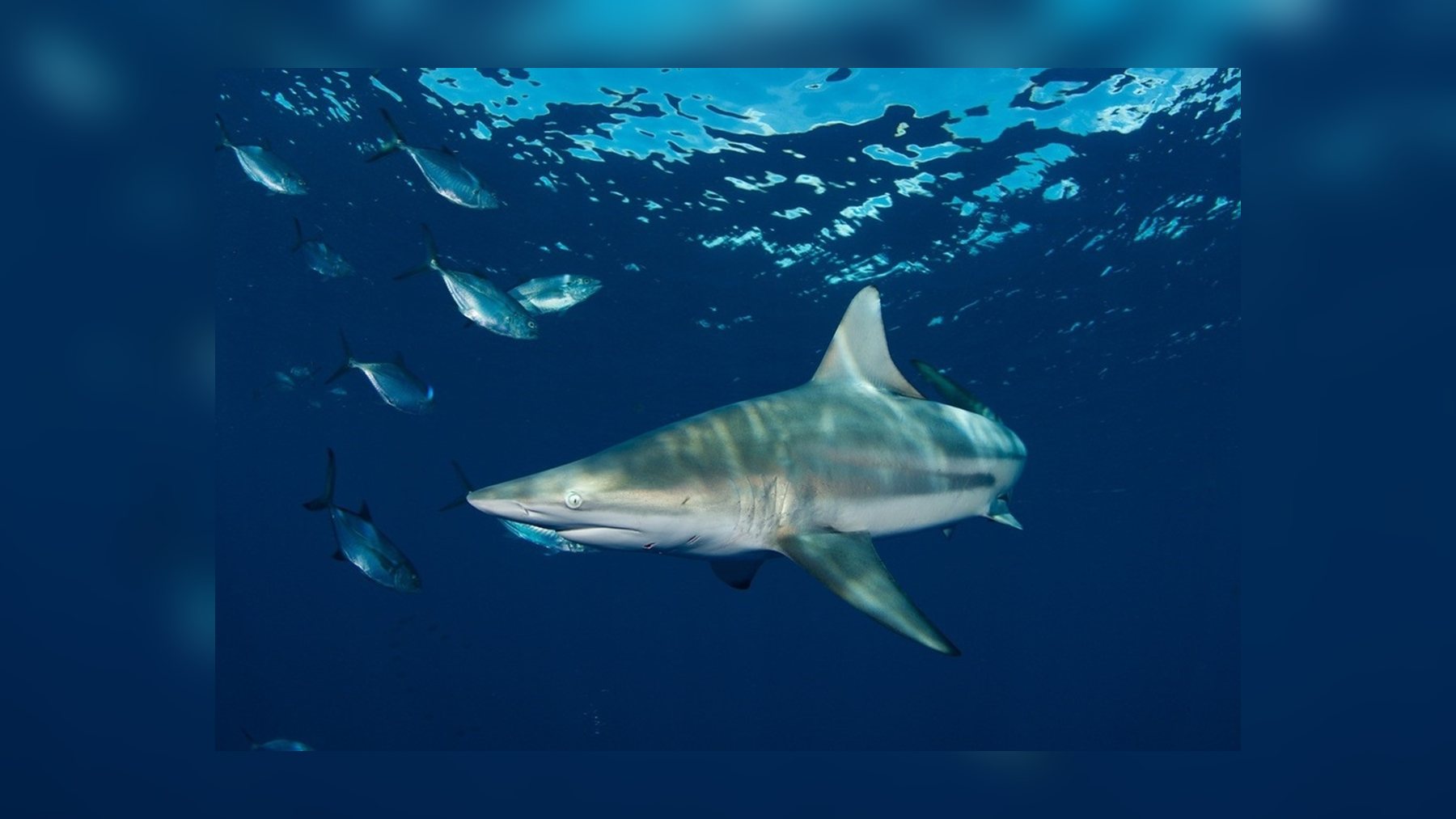
Every winter, thousands of blacktip sharks gather in the clear, shallow waters off Palm Beach, Florida. There, a team at Florida Atlantic University moored a boat, let a submerged speaker drift, and deployed a drone to film from the air what the animals did as the sound began to play.
Most of the time they did the same: a sharp turn and a rapid dash to get away from the speaker. The shark that reacted the farthest was 74 meters from the speaker—a distance that, according to FAU, far surpasses what has been demonstrated so far in freely swimming sharks.
The work was led by Stephen Kajiura, a professor of Biological Sciences at Florida Atlantic University’s Charles E. Schmidt College of Science. The first author is Caroline Sullivan, who conducted the study as part of her master’s degree, and the work is also credited to Edmund Gerstein, one of the principal investigators at the same college.
A Drifting Speaker and a Drone in the Air
The experiments were conducted near the inlets of Jupiter, Palm Beach, and Pompano Beach, with the boat anchored in 2 to 5 meters of depth and the engine off. The speaker hung one meter below the surface, and the current carried it away from the stern to about 13–19 meters, so the boat would influence it as little as possible.
The drone flew at about 40–50 meters altitude with its camera looking downward. The researchers used the boat’s length, 6.73 meters, as a rule to measure in each frame how far away each shark was.
“Their abundance and the ease of accessing them allowed us to observe them from above without disturbing their natural behavior, while we presented controlled submarine sounds,” explains Kajiura in FAU’s press release.
Three types of pulsed low-frequency noise were played, in bands from 100 to 200 Hz, 200 to 400 Hz, and 400 to 800 Hz. As a control, they used a 10,000 Hz sound, which is outside what sharks can hear, and they always played it before the low-frequency sound.
The volume was intentionally high, about 80 decibels above the lowest documented background noise. “In this study we deliberately presented sharks with a repulsive acoustic stimulus designed to provoke an immediate and clear response regardless of their motivational state,” the authors write.
No Shark Responded to the Control Sound
In the 209 trials with the control sound, no shark changed course. With the low-frequency sounds, sharks responded 81.9% of the time to the 100–200 Hz band, 87% to the 200–400 Hz band, and 71.1% to the 400–800 Hz band.
From the air, the reaction was clearly visible. The shark swung abruptly between 20 and 160 degrees to move away from the speaker and then swam away quickly.
“We didn’t know how this would work. We didn’t know if the sharks would respond,” Sullivan told Discover Wildlife. “Getting the data and having so much confidence in our experimental protocol was very exciting,” she added.
Reactions Up to 74 Meters from the Speaker
The 74 meters is the individual record, achieved with the deepest band. The mean response distance was 40.7 meters for sounds in the 100–200 Hz range, 41 meters for 200–400 Hz, and 30 meters for 400–800 Hz.
The deeper sounds also required less volume. The 100–200 Hz sound needed only about 16 decibels above background noise, while the 400–800 Hz needed about 45.
The Near Field and the Far Field
Near the source, in what is called the near field, the sound is mainly particle motion, i.e., the water oscillating back and forth. Beyond about three wavelengths, the far field begins, where the pressure wave dominates.
Osteichthian fish detect that pressure with the swim bladder, a gas pouch that converts it into vibrations for the inner ear. Sharks and rays do not have it, and it had been assumed they only heard up close, just as it was believed that other capabilities were exclusive to osteichthian fishes.
With the most prudent calculations, the far field began at 45 meters for 100 Hz, at 22.5 meters for 200 Hz, and at 11.3 meters for 400 Hz. 71.5% of the 165 responses were produced beyond that line.
“What makes this finding particularly interesting is that sharks responded to sounds beyond the acoustic near field, where the sound behaves differently than it does near the source,” says Kajiura in the university’s press release. “This suggests they detect the particle motion associated with sound even at considerable distances from the source, something we had not been able to demonstrate in free-ranging sharks until now.”
The Neglected Macula, the Leading Suspect
The authors point to a little-known part of the inner ear, the neglected macula. It is a region of sensory cells that does not carry the tiny calcium carbonate crystals found in other parts of the ear and is highly sensitive to vibrations.
Among the relatives of the blacktip shark that have been studied, all from the genus Carcharhinus, that macula contains many cells. The silky shark has about 260,000, the greatest number described in a vertebrate, though for the blacktip shark it has not yet been counted.
“We think that’s where the neglected macula comes into play,” Kajiura told Discover Wildlife. And how do you prove that? “I still have to figure that out,” he admits.
Why Do It at Sea and Not in a Tank
“Conducting hearing experiments in a tank causes sound to bounce off the walls, producing complex and confusing signals; it’s like being in a house of mirrors,” Sullivan explains. “That’s why it is so important to conduct this kind of experiment in the ocean, with wild sharks, to obtain a natural response.”
Palm Beach was the ideal site for that. “There are literally tens of thousands of sharks within arm’s reach of our coast,” Kajiura said in 2016 to local television WPEC, statements cited by CNN. “You could throw a stone and literally hit a shark. They are this close.”
Drones are already used to monitor sharks, for example to prevent attacks on Australia’s beaches. Here, according to the authors, at 40–50 meters of altitude the sharks could not detect the device.
What the Study Does Not Demonstrate
The team measured sound pressure with hydrophones, underwater microphones, but not the particle movement that sharks are believed to sense. “Ideally we would have also measured particle movement, but it wasn’t practical under field conditions,” the authors acknowledge.
Part of the lower-frequency band could also bleed below 100 Hz, which lengthens the near field. Therefore, they write, some responses attributed to the far field “could be due to particle movement that extended beyond what was modeled.” Many responses to the 400–800 Hz band cannot be explained that way.
Everything took place in shallow waters with a sandy bottom, where the low tones fade sooner. The sound was designed to provoke escape, not to measure the shark’s hearing, so the decibels that elicited responses do not correspond to the minimum they can hear. Natural ocean sounds were not tested either.
The study did not address ship noise, although the sea is becoming noisier and in Spain 90% of those surveyed by IFAW call for action against underwater noise. Other animals depend on sound even more directly, such as dolphins, which identify objects solely by sound.
“Therefore, it should not be surprising to discover that sharks are capable of orienting toward sounds in the far-field acoustic. However, the mechanism remains unclear,” they conclude.
The full study has been published in Integrative Organismal Biology.
“The ocean is an acoustic environment, and it’s clear that sharks are tuned to it in ways we are only beginning to understand,” summarizes Kajiura. “The next question is how their sensory system enables them to detect and interpret these distant sounds.”
Image: Stephen Kajiura / Florida Atlantic University