
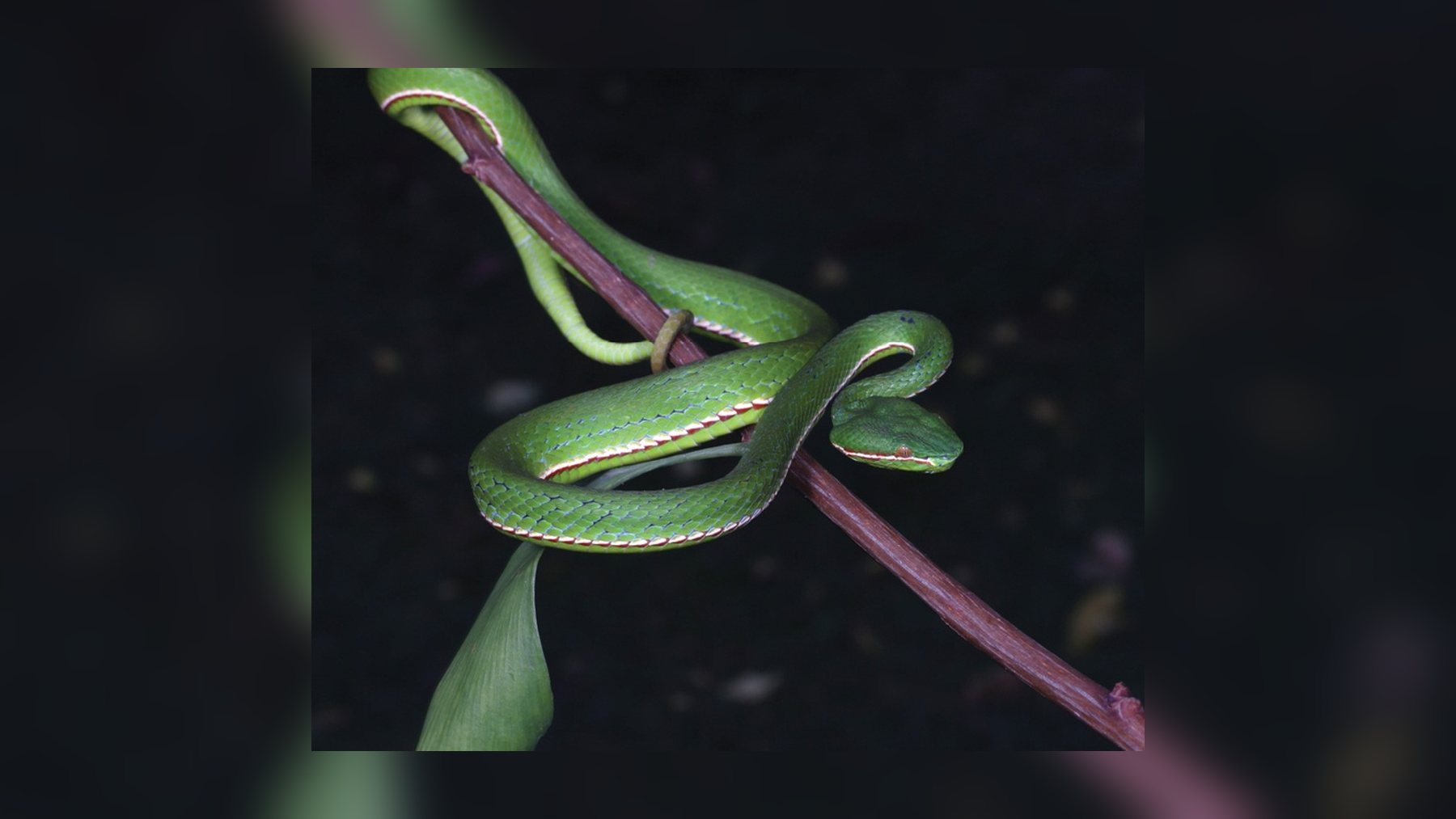
At 10:15 p.m. on September 9, 2021, a roughly 60-centimeter green viper from Mount Emei in Sichuan Province bit Gang Wang on the ring finger of his right hand. When he arrived at Leshan People’s Hospital at 12:01 a.m. the following day, the swelling had already risen to the elbow.
That serpent had not yet acquired an official name. In January 2026, Wang and ten other authors described it as Trimeresurus lii, the Huaxi green viper, a new species that for decades had been confused with a closely related snake widely distributed across China.
The research was led by Bo Cai of the Chengdu Institute of Biology, which is part of the Chinese Academy of Sciences, with Li Ding of the same center listed as the corresponding author. Wang is affiliated with Chengdu Normal University.
A Bite Documented with Hours and Photos
The case constitutes a section of the article dedicated to symptoms and treatment. The bite produced a single wound that bled immediately, and within minutes the swelling progressed from the finger to the entire hand, accompanied by “severe dull pain, sharp pain, and numbness of the affected finger,” according to the report.
Photos taken by Wang that night show the finger swollen 11 minutes after the bite and the hand by the 13th minute.
In the hospital, drawing blood proved difficult. Blood could not be obtained from the dorsal veins, so they had to access the femoral vein, the large vein in the groin. He was somewhat dizzy and his blood pressure was low.
They administered a polyvalent antivenom, which on the market is sold for two other snakes, Agkistrodon halys and Agkistrodon acutus, in addition to anti‑inflammatory medication. He was discharged at 5:00 a.m. that very same early morning, after which he experienced a brief spell of lightheadedness with mild nausea and vomiting that cleared within 20 minutes.
Nine Days to Full Recovery
Two days after the antivenom, the hand remained equally swollen, and the swelling had already extended above the elbow. The downward trend began on the third day; by September 14 there was only residual swelling at the elbow, and by September 18 Wang had fully recovered.
The article adds a detail that deserves careful reading: “G. W. perceived a marked decline in his immune function over the following year,” the authors note, and they do not provide analyses to substantiate this claim.
Identifying the Snake Helps Treat the Bite
Correctly identifying the species matters in emergencies too. Uwe Fritz, a reptile expert at the Senckenberg Natural History Collections in Dresden, explained in 2022 regarding other Andean vipers: “The first step in effectively treating snake bites is to identify the exact snake that caused the envenomation.”
“That also facilitates the manufacture and administration of the proper antiserum, i.e., the antidote,” he added in a Senckenberg release. “Knowing the biology and habitat of a specific species reduces the risk of being bitten.”
The World Health Organization estimates that every year between 81,410 and 137,880 people die from snake bites worldwide.
With snakes, the danger drops substantially if they are left alone. In Hong Kong, the bamboo viper, another green species of the Trimeresurus genus, accounts for nearly 90% of bites, according to 2018 reporting by Hong Kong Free Press, where emergency physician Jeffrey Fung of Tuen Mun Hospital noted that death from a snake bite is rare there because medical care is readily accessible. “If you leave snakes alone, it is extremely unlikely that they will bite you,” said naturalist Robert Ferguson in the same piece.
Decades with the Name of Another Species
The western Sichuan green vipers had long been classified as Trimeresurus stejnegeri, the most widespread species in the genus across China, from Taiwan to northern Vietnam. The authors contend that those populations “have historically been identified as T. stejnegeri based solely on morphological characteristics,” meaning their appearance alone.
A 2016 study had sequenced 171 samples from 47 localities in China, but none from western Sichuan. Therefore, they write, the status of these populations “remains unverified by molecular evidence to date.”
Between 2019 and 2025, Cai’s team collected specimens in the field, and Wang did so in 2021. With 20 new sequences and 222 drawn from public databases, representing 36 Trimeresurus species, they analyzed three mitochondrial genes, which are inherited exclusively through the maternal line.
The phylogenetic trees placed the Sichuan snakes on a distinct branch, closely related to Trimeresurus loong, described in Kunming (Yunnan) in 2025. The minimum genetic distances to any relative were 6.50% in the cytb gene and 5.77% in the ND4 gene, both compared to T. loong.
A portion of the specimens used for the description had been in collections for decades: four were gathered on Mount Emei in 1956 and three more in 1963. This is not the first instance of such a finding, as museum DNA has already revealed several Himalaya vipers previously mistaken for a single species.
Amber Eyes, Red-and-White Stripe, and Smooth Scales
The researchers examined 15 specimens, 11 males and 4 females. The species is distinguished by a combination of traits, including a leaf-green body without bands or spots and smooth scales on the temples and the back of the head, where T. stejnegeri bears a keellike ridge instead.
Males have amber irises and a red-and-white stripe behind the eye that runs to the second scale of the upper lip. Females display yellow-orange eyes and a yellow lateral stripe. The largest male measured 675 millimeters from snout to vent, while the largest female reached 795 millimeters.
They inhabit elevations roughly between 1,100 and 1,500 meters on Xiling Snow Mountain, Yuping Mountain, and Mount Emei, within China’s Western Rainfall Zone. They are predominantly nocturnal and typically rest 2 to 5 meters above the ground, among bamboo, shrubs, and rocks beside streams.
A female kept in captivity for a time gave birth to eight offspring in mid-August, which the authors interpret as confirmation that the species gives live birth rather than laying eggs.
A Name in Honor of Laozi
Bo Cai explained the choice of name in remarks cited by Discover Wildlife in April 2026. “The specific epithet lii honors Li Er, the ancient Chinese philosopher better known as Laozi,” he stated.
“His teachings emphasize harmonious coexistence between humans and nature,” Cai continued, “a principle that fits perfectly with the conservation mission of the Giant Panda National Park, where the species was discovered.” The holotype, the specimen that anchors the species, was collected in Xiling at an elevation of 1,167 meters within that park.
From this, the authors derive a lesson for the park, crediting it with a “dual role as a refuge for charismatic megafauna and a cradle of a hidden diversity of reptiles and amphibians.” It serves as a reminder of why snakes matter to ecosystems.
What the Study Still Does Not Demonstrate
Wang’s case is a single instance, described in an article authored by the patient himself, and it does not show how a typical bite from this species progresses nor measure the effectiveness of the antivenom he received, which was labeled for other snakes.
The genetic analysis rests on three mitochondrial genes. The authors acknowledge that comprehensive nuclear genomic analyses “would undoubtedly refine” the assessment and call for broader sampling, “especially of nuclear markers,” though they note there are few publicly available data for this group and that tissue from rare specimens is “very limited.”
The map is not closed either. There are photos suggesting presence in Qingchuan County and in Longcanggou Forest Park, though not confirmed, and older records from Wen County in Gansu lack sufficient documentation, making “it impossible to determine” whether they belong to this species, according to the paper.
The full study has been published in Zoosystematics and Evolution.
Pensoft, the publisher of the journal, introduced the discovery in April 2026 with a simple idea: by protecting large stretches of habitat for emblematic species like the panda, the park also shields reptiles and amphibians far less known.
Image: Bo Cai / Cai et al. (2026), Zoosystematics and Evolution (CC BY 4.0)