
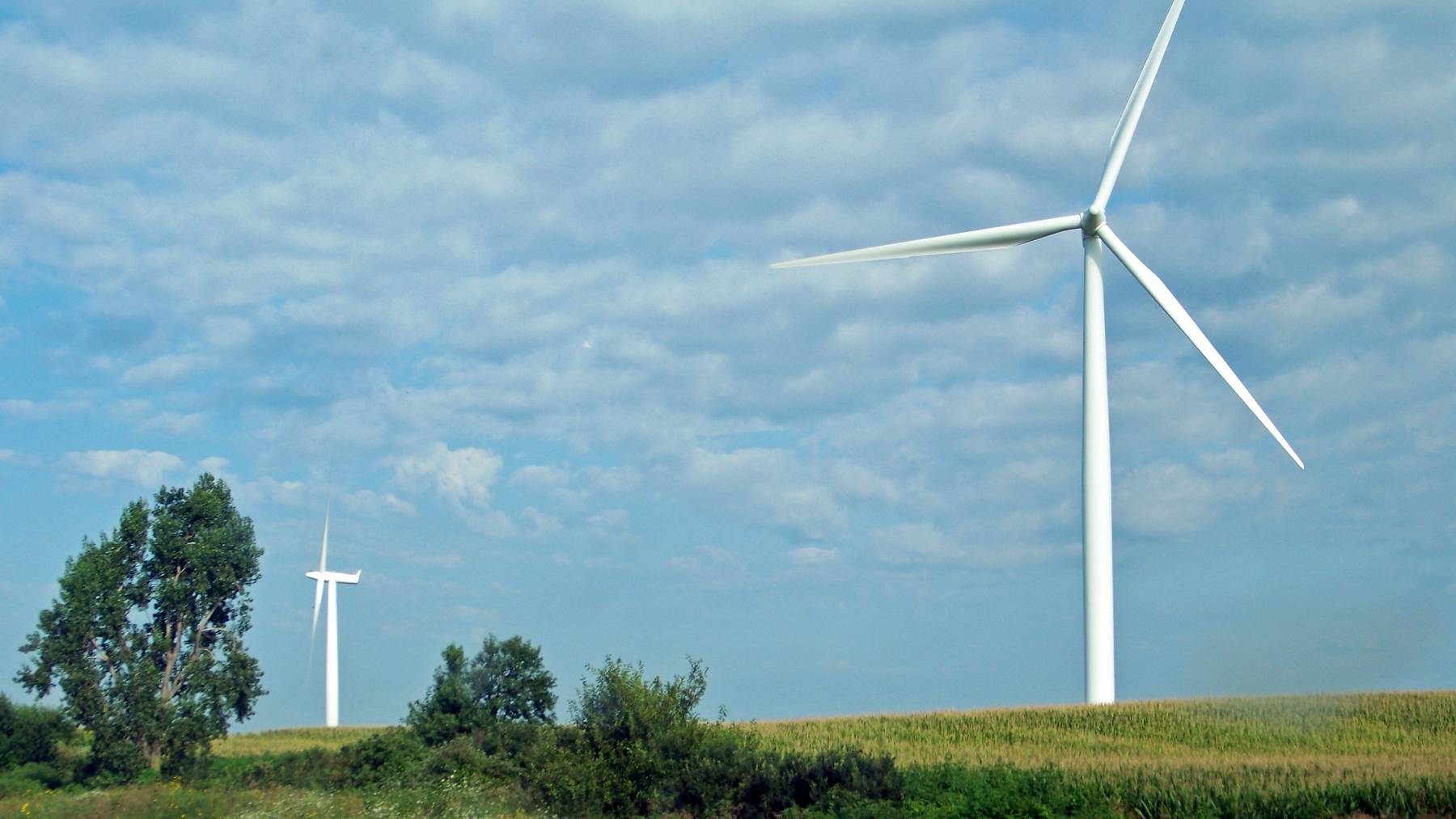
In August 2018, Eileen Nielsen appeared before the Lincoln County commission in Minnesota to complain about the damage left on her property by a nearby wind farm project: broken drainage tiles and two sinkholes. “They’re so deep you can read the high‑voltage tape from buried cables,” she said. “Our tenant can’t even harvest because of the risk of electrocution.”
A Center for Rural Affairs case study focusing on Adair County, Iowa, updated in July 2025, notes that two of the three farmers interviewed sustained drainage and crop damage during the wind-turbine construction, for which the developer compensated them afterward. That kind of damage has a particular quirk: a crushed tube can continue to function at partial capacity for years, until a year with heavy rains leaves water stagnating in the middle of a field.
What Adair’s Farmers Reported
Adair is Iowa’s county with the most wind turbines: more than 500, representing 8% of the state’s total, with a capacity of 1,102 megawatts. All the major projects are developed by MidAmerican Energy, and as is customary in Iowa, the land is leased voluntarily by landowners—a model that even convinced an Illinois farmer who ended up viewing turbine leases as his retirement plan.
Ralph Lents and Sara Shepherd, each owning a turbine on their property, recounted that the construction damaged the drainage on their plots. “Property owners frequently suffer drainage damage due to soil compaction caused by heavy machinery during turbine construction,” write the study’s authors, adding that under the lease, the developer is typically responsible for those damages.
“It’s a decent additional income. It won’t turn you into a farmer’s millionaire, but you can use it for some repairs,” said Lents, who negotiated the location of the access road to minimize disruption to his operation. Shepherd summed it up: “The check helps, but in the end, a single turbine isn’t going to save or ruin the whole operation.”
Underground Drains That Keep the Field Dry
Across the American Midwest, many corn and soybean fields sit atop a network of perforated drains—made of plastic or fired clay—that run beneath the soil to collect excess moisture and channel it into a ditch or stream.
According to the North Dakota State University extension guide, signed by agricultural engineer Tom Scherer and agronomist Hans Kandel, a poorly functioning drainage system “can delay spring tasks by days to weeks.” Moreover, driving heavy equipment on overly wet soil compacts it, leaves roots stunted and lacking oxygen, and the amount of yield lost depends on the crop, soil, and how much it rains that year, so there isn’t a single universal figure.
Typically, the pipes are buried at depths ranging from about 0.9 to 1.5 meters (roughly 3 to 5 feet) and spaced roughly 11 to 30 meters apart, depending on the engineer Ron Krizan.
Cables, Roads, and Cranes Cross the Network
Krizan, a licensed professional engineer, used two Wind Systems columns to discuss this issue in late 2011 and early 2012. His starting point was clear: “Most drains, if not all, are poorly mapped and cannot be identified until you encounter them on the ground.”
A wind farm needs trenches for the cables that connect turbines, roads for trucks, and corridors for cranes. “With cranes weighing more than 500 tons, it’s safe to assume that most drains encountered during construction will be damaged and will require some form of repair,” Krizan wrote. In the U.S. they typically measure tonnage in short tons, about 450 metric tons.
The method of laying also matters. “When the cable is laid with a plow, the operator can’t tell whether a buried drain has been damaged until problems show up on the surface,” he warned. That’s why he recommended digging a trench and asking the landowners first, since they know their pipes better than anyone.
Minnesota’s experience echoed this. Robert Olsen, Lincoln County’s environmental administrator, told the same meeting that the promoter planned to trench with local contractors to repair, “but halfway through the project they switched to pulling the lines with a plow, and there’s no way to know if you’ve cut something,” as reported by the Marshall Independent. Richard Nielsen, who attended the meeting, went further: “I’d like the wind turbines shut down until this is resolved.”
Why Damage Takes Years to Show Up
In his second column, Krizan explained there are two telltale signs: sinkholes, ranging from 5 centimeters to more than 1.2 meters across, opening where soil is drawn into a broken clay pipe, and the more common case of a crushed tube that gradually allows less water to pass.
“It isn’t unusual for a partially crushed drain to eventually fill with sediment and stop working altogether three to five years after the initial damage,” he wrote. He added that the damage isn’t noticeable “in particularly dry years or in years with well-distributed rainfall,” because these drains are designed to evacuate water from heavy rainfall events.
Krizan also cautioned that “often the wettest point isn’t where the drain is actually broken,” but rather where water has built up enough pressure to surface. His advice to builders: “If a farmer indicates a broken drain in the area, it’s usually best to assume they’re right.”
Ten Years Later, Repairs in Iowa Were Still Under Way
In December 2019, the Hardin County drainage districts discussed what to require for a new wind farm. According to the meeting minutes, Lee Gallentine of Clapsaddle-Garber Associates explained that in Bradford, a neighboring Franklin County project, the contractors were repairing drains on the fly, and a decade later they were still fixing things because they hadn’t realized the damage occurred during construction.
At the same meeting, farmer Jason Marten spoke of working near Garden City with two turbines and of waterlogged conditions around the bases. County supervisor BJ Hoffman noted that several industry experts assumed all pipes were plastic when many were fired-clay, and a contractor asked whether a pipe with only 10 centimeters of soil above it could withstand heavy machinery. Likely not, he replied.
Repairing Properly Requires Mapping and Follow-Up
In Illinois, the state Department of Agriculture negotiates with companies on mitigation agreements for agricultural impacts before wind farms, oil pipelines, and power lines begin, to ensure affected lands regain their pre-construction capacity. Public documents include schemes for how to repair a drainage system.
Krizan advised recording every repair with GPS coordinates and photos, plotting them on a map, handing copies to the landowner, and keeping a copy on file, because you may need to continue repairing those drains for years after construction ends.
The University of Wisconsin Extension Service recommends annual drainage checks—early spring during thaw or after heavy rains. It warns that records are often incomplete or absent, especially on older farms. Monitoring the path of water also prompted an Ohio farmer to change his cropping methods after seeing how rain created new ruts across his fields.
What These Cases Do Not Prove
These are testimonies from a handful of counties, not a comprehensive survey. The Adair County study is based on interviews with three farmers, and none of the sources calculates how many Midwest farms currently have damaged yet unrepaired drainage systems. The report also does not say whether the compensations restored to those fields the drainage they once had.
Krizan’s columns date from 2011 and 2012, and the Hardin County minutes summarize what was discussed, without direct verbatim quotes. Moreover, Illinois has similar agreements for oil pipelines, gas pipelines, power lines, and solar plants, so the risk is not exclusive to wind farms—a nuance worth bearing in mind when evaluating wind energy myths.
The Adair County report comes from the Center for Rural Affairs, with its latest version published in July 2025.
In the closing lines of his second column, Krizan left it at this: “Damaging drains in agricultural areas may be inevitable, but anticipating problems and carrying out proper repairs is undoubtedly the best remedy, aside from choosing not to touch them at all.”
Image: Mary Ellen St. John / James St. John / Wikimedia Commons (CC BY 2.0)