
On Thursday, October 1, with renewables in Greece at days of very high production, the Greek transmission system operator ADMIE (IPTO in English) published three very brief notices on its website. It announced that it would reduce the capacity of the lines linking the country with Bulgaria, Albania and North Macedonia from Saturday, 7:00 to 19:00 (Central European Time), a window that covers the daylight hours.
Those same days the wind blew hard and renewables reached 78% of all electricity booked in the day-ahead market for Friday, October 2, according to the results of the Hellenic Energy Exchange (HEnEx). Natural gas accounted for 13.2% and imports 2.5%.
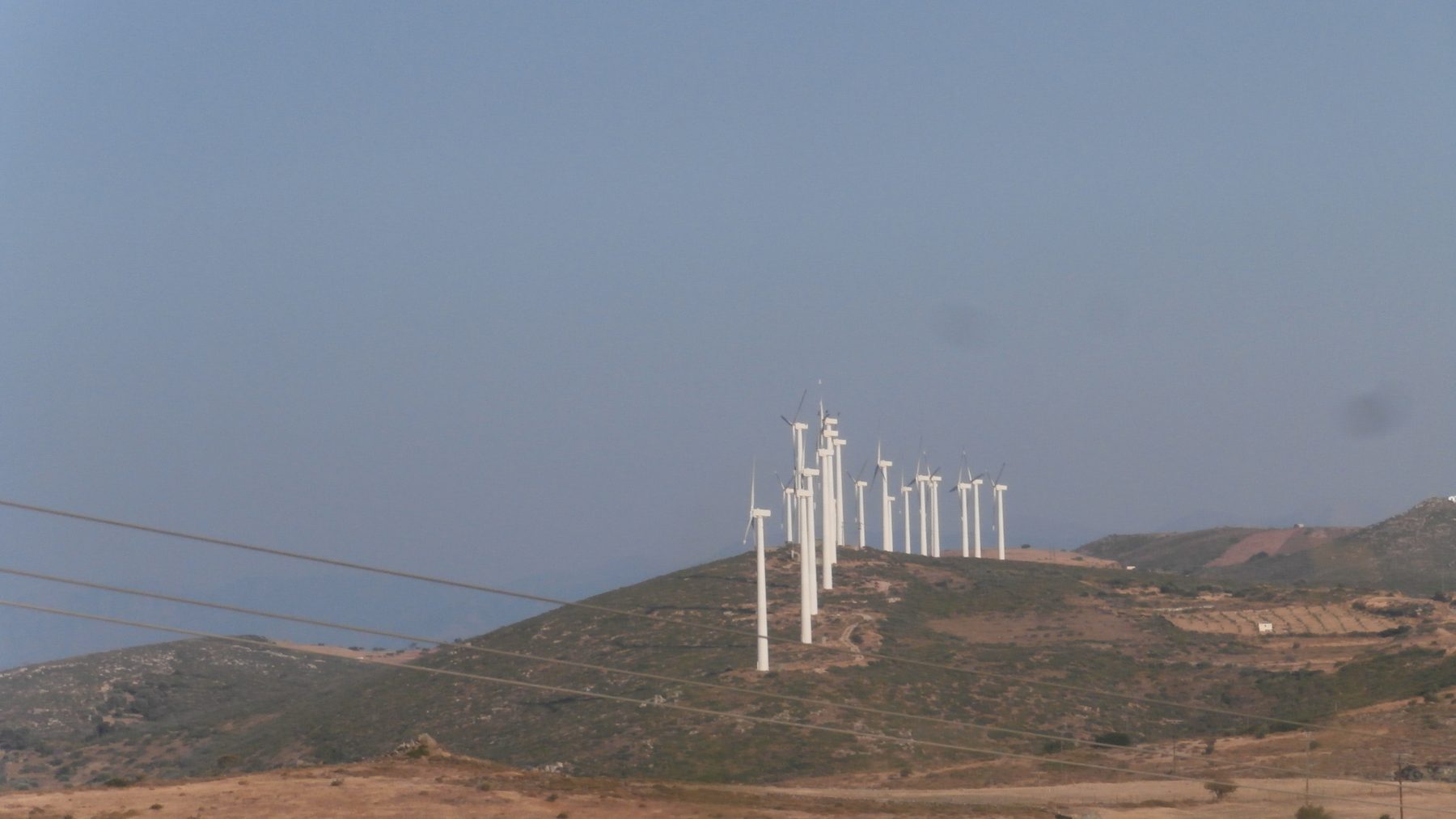
The Wind Fueled Green Generation
According to the Balkan Green Energy News portal, which reported on October 2, the wind had been blowing strongly for several days and, combined with the rest of the green sources, left an unusually high amount of renewables in the system.
ADMIE’s own forecasts give an idea of the surplus. For Saturday, October 3, ADMIE expected an average of 12,724 MW of renewables in the central hour of the day, compared with a demand of around 5,630 MW in that same hour, which is less than half.
ADMIE’s daily energy balance, with data already measured, shows that on October 2 renewables provided 68.5% of the electricity injected into the transmission network, and that on October 3 the lignite plants produced not a single megawatt hour.
What that 78% Represents
The day-ahead market is the auction in which it is decided, the day before, how much electricity will be produced and at what price in each quarter-hour of the following day. The 78% is the renewable portion of all the energy sold in it, including the portion that was set to be exported, so it does not equal domestic consumption.
In fact, the renewable energy scheduled for October 2, about 138,026 MWh including Crete, exceeded the internal demand bought in that same auction, which was 132,658 MWh. The market also scheduled 42,104 MWh of exports to Bulgaria, North Macedonia, Albania, Turkey and Italy.
Three Lines Curtailment on the First Weekend of October
ADMIE’s notices set new limits on net transfer capacity, which is the maximum amount of electricity that can cross a border without risking the grid. With Bulgaria, the cap stood at 500 MW for exports and 700 MW for imports on October 3 and 4.
With Albania, the capacity dropped to 100 MW outbound and 450 MW inbound, and with North Macedonia, to 350 MW and 450 MW, in both cases from October 3 to 6. To put it in perspective, on the 2nd the market scheduled 700 MW of exports to Bulgaria in the central hours of the day and rose to nearly 1,050 MW in a night-time quarter-hour.
The operator justifies the cuts with Albania and North Macedonia by the need to “guarantee that the operation stays within safety limits.” The Bulgarian cut is attributed to the “urgent maintenance” of the 400 kV line linking Skopje with Uroševac, in Kosovo. A similar cut had already occurred with Albania and North Macedonia on September 25 and 26.
Renewable Production Curtailments Multiply
When there is more electricity than the grid can absorb or export, the operator orders solar and wind farms to reduce their production, something in the sector is called curtailment and which explains why sometimes wind turbines stand idle with sufficient wind. By October 3, Balkan Green Energy News warned that “significant curtailments” would have to occur.
The problem predates these events. Pantelis Biskas, a professor in the Electrical and Computer Engineering Department at Aristotle University of Thessaloniki, calculated at a solar association seminar (Pospief) that Greece will have to cut between 3.3 and 3.7 TWh of renewables in 2026, compared with about 2 TWh in 2025 and 900 GWh in 2024, according to pv magazine.
Spain faces a similar situation, and in June the grid left unused more than 1.1 million megawatt-hours of renewables.
In Greece, small producers are the ones who feel it most. “This situation is the new normal,” said Petros Tsikouras, secretary of organization of Pospief, in May to pv magazine, estimating a 62% loss of revenue for small solar parks in March and 70% in April.
Tsikouras attributes it to political decisions. “In the last six years, the government pushed a massive and excessive granting of licenses to renewable energy projects, up to 25 GW, in a system that consumes between 4 and 11 GW per day,” he said.
Greece, Cheaper than Bulgaria, Germany and Italy
The average daily market price in Greece for October 2 was 120.5 euros per MWh, according to HEnEx, the lowest in Europe that day according to Balkan Green Energy News, compared with 138 euros in Bulgaria, 200 in Germany and 216 in Italy.
In spring, with similar renewable peaks, it had fallen to around 50 euros, and the middle explains the gas, now more expensive. It is a dilemma also seen in Spain, where the record photovoltaic output threatens its profitability.
Government and Operator Bet on Batteries and Interconnections
Konstantinos Tsirekis, director of Strategy and System Planning at ADMIE, spoke at a Pospief event that the country had 17.9 GW of renewables installed by the end of February, while the peak demand in the country runs around 11 GW, according to pv magazine.
“Greece is the third country in the world for electricity generated from solar power and the ninth for wind,” said the Minister of Environment and Energy, Stavros Papastavrou, in an interview on Action24 cited by To Vima on May 1. “Now we are racing with storage, which is important for the stability of the system,” he added.
In July, ADMIE’s CEO Manos Manousakis explained at a roundtable hosted by The Economist that Greece had 530 MW of storage in operation and expected to reach 1 GW by the end of the year. Speaking about the cables linking the islands to the mainland and a second link with Italy, he added: “Electrical interconnections are the only path for Greece, and it is right that we move forward so quickly,” according to Naftemporiki. “Without them, the cost of electricity would be higher.”
Ioannis Margaris, ADMIE vice president and CEO of Technology, System Development and Strategy, had already warned in March 2025, speaking about projects awaiting connection to the grid: “The rate at which grid connection offers are issued has slowed; there is no magic solution and there is no technical possibility to connect all the projects waiting in the queue and, at the same time, operate the system safely,” he said at the 6th Power & Gas Forum, according to newmoney.
What the Notices Do Not Say
ADMIE notices do not mention renewables, as they talk about safety limits and, in the Bulgarian case, maintenance on a line between North Macedonia and Kosovo. The connection to the green peak is set by Balkan Green Energy News, and although the curtailment hours coincide with the maximum solar production, the operator has not confirmed it.
That outlet also places maintenance on the line with North Macedonia, while the official notices tie it to Bulgaria. The 78% is a day-ahead schedule, and the official October curtailment data are not yet known, because ADMIE’s latest monthly report is from August.
ADMIE notices about interconnection capacity were published on October 1, 2026 on the operator’s website, and the day-ahead market results on HEnEx.
The ten-year plan that ADMIE submitted for consultation in September foresees investing 9,000 million euros between 2027 and 2036 and connecting more than 10 GW of renewables, according to Balkan Green Energy News.
Image: C Messier / Wikimedia Commons (CC BY 3.0)
