
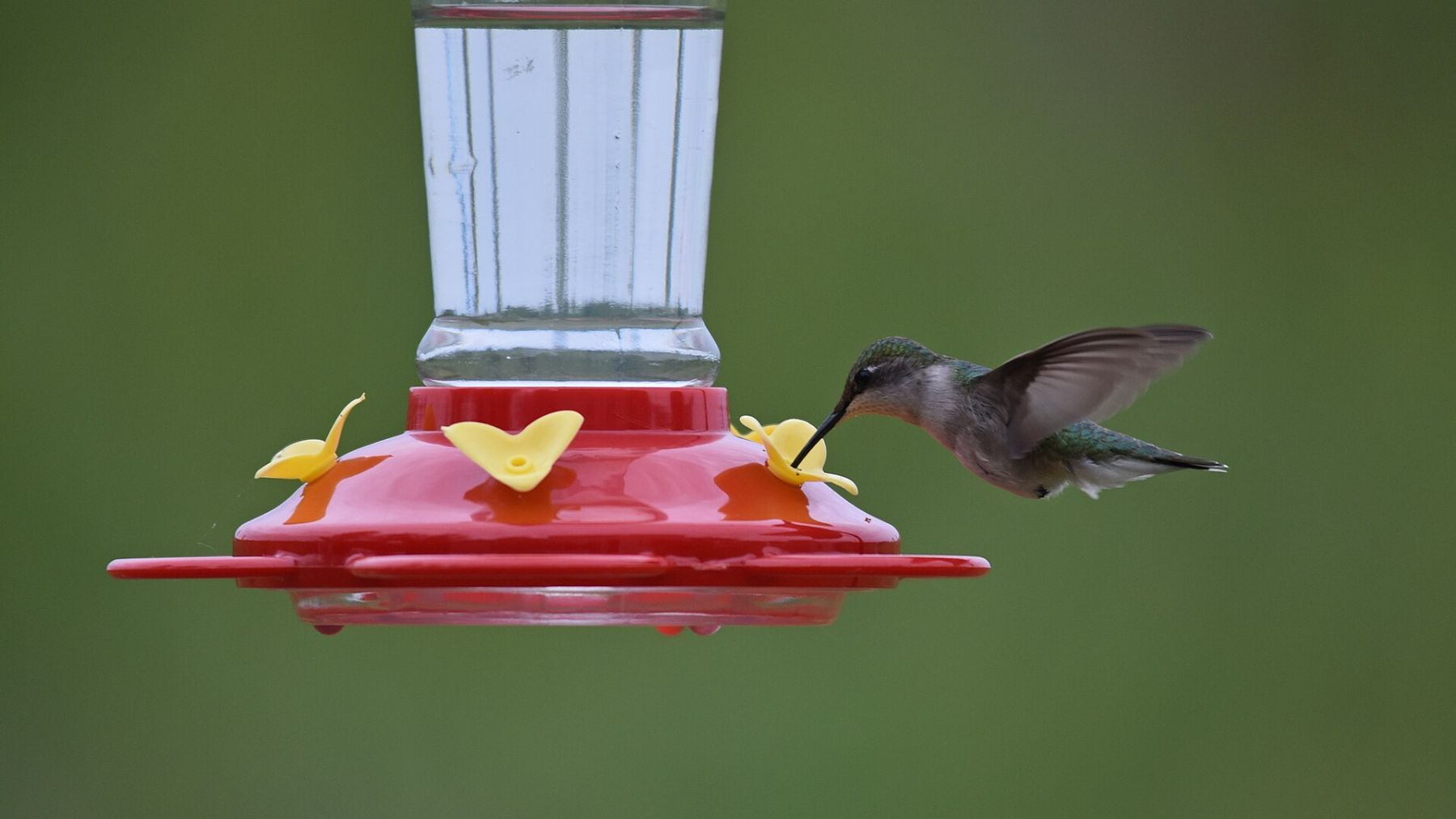
A hummingbird drinks at a feeder and, as soon as another approaches, it pounces after it amid chirps, dives, and displays of feathers that last only a few seconds. Hummingbirds chase one another to defend the nectar, and the Cornell Lab of Ornithology proposes a simple solution to reduce those battles: place several small feeders rather than one large one.
«In aggregate, you’ll feed many more hummingbirds by putting four tiny one-mouth feeders than one giant eight-mouth feeder,» the lab writes on its All About Birds website. If they are separated, it adds, the birds won’t have to see each other, which is precisely what triggers their territoriality.
These tips are designed for American gardens that attract wildlife, because hummingbirds naturally inhabit only that continent, and they help explain why a container of sugary water becomes such a hotly contested resource.
Flowers take time to replenish nectar
The ornithologist and writer Scott Weidensaul, who has studied and banded hummingbirds, told Audubon magazine that the origin of that aggressiveness lies in their dependence on nectar. «They burn energy in such extraordinary quantities,» he said, and he recalled that some species, such as the blue-throated hummingbird, can exceed 1,200 heartbeats per minute.
«I can’t imagine they could sustain the energy expenditure they have without that sugar water,» Weidensaul added. The problem is that nectar is scarce, since each flower offers a limited amount of sugar and needs time to produce it again.
«Out there there are a limited number of flowers,» the ornithologist summarized. «It makes a lot of sense to figure out a way to own that resource for yourself.» For a hummingbird, that means defending its territory with ferocity against any intruder.
An instinct that does not distinguish the feeder from a flower
The Cornell Lab explains it similarly. Hummingbirds «cannot afford to share flowers in times when many are not open, because they may have to travel very far when the nectar runs out,» and that aggression «is so ingrained that they cannot understand that feeders are different».
Weidensaul places it on the evolutionary time scale. «Five hundred or six hundred years ago there were no large expanses of ornamental flowers, and certainly there were no feeders for hummingbirds,» he said. «They have millions of years of evolution telling them: ‘I have to fight to protect this source of food’».
The dominant male watches a radius of about 15 meters
Doug Hitchcox, a naturalist with Maine Audubon, told the Bangor Daily News that this behavior catches people’s attention. «They’re the smallest birds of all, but they seem to have the strongest character,» he said. «In reality, it all boils down to food.»
According to Hitchcox, the male ruby-throated hummingbird defends a perimeter of roughly 15 meters around the center of its feeding site, and that circle tightens the more food there is inside. Physical fights are rare because, in his words, they are very fragile creatures and coming to contact «is the last resort, but it happens.»
Those who suffer the most are the others. «That can make it difficult for hummingbirds that aren’t the dominant male or for young birds simply trying to find a place to eat,» the naturalist explained. «They find a good feast, but as soon as they do, the dominant male drives them away.»
Four small feeders out of sight
In its guide to feeding hummingbirds, Cornell insists that «more feeders are better than bigger feeders». Since these birds are highly territorial, four tiny one-mouth containers distributed around the house will attract and keep more hummingbirds than one large eight-mouth feeder.
Audubon recommends the same in its guide to creating a yard-friendly to hummingbirds, where it advises hanging several feeders far enough apart so the birds cannot see each other, thus preventing a single feeder from dominating the others. According to Audubon’s article, hanging them around the far side of a corner of the house helps break that line of sight.
Weidensaul also mentions the opposite strategy, which is to cluster many feeders at a single point. «If you put a bunch of feeders in one spot and a lot of hummingbirds arrive, there comes a moment when no one can shoo them all away and, simply, they give up,» he told Audubon.
Sugary water in the shade and changed every two or three days
More feeders imply more cleaning. Cornell notes that sugary water fosters bacteria and mold and that sugar ferments, so the mixture should not be left out for more than two or three days and should be replaced daily when it is hot.
That is why it recommends choosing feeders that are easy to disassemble, with a filling opening wide enough to fit a bottle brush. «The easier it is to clean a hummingbird feeder, the more likely you are to do it often and well,» writes the lab, which also asks to avoid direct sun because it quickly spoils the mixture.
Audubon adds that if the nectar looks cloudy, you should clean the feeder immediately, regardless of how long it has been hanging. In its FAQ it also discourages dish soap, because it can leave harmful residues, and suggests hot water with hydrogen peroxide or a mild vinegar solution.
The recipe recommended by both organizations is a simple one part refined white sugar to four parts water, i.e., about a quarter cup of sugar (roughly 50 grams) to one cup of water (about 240 milliliters), so that sugar accounts for one fifth of the mixture. Audubon suggests bringing it to a boil and letting it cool before filling the feeder.
Audubon discourages honey, brown sugar, molasses, and artificial sweeteners, and there is no need to add red dye. «At the end of the day, flower nectar is clear,» notes Cornell, explaining that it is the red pieces of the feeder itself that attract the birds.
Native flowers and insects the feeder doesn’t provide
Audubon’s article explains that hummingbirds defend larger territories when there are few flowers, so planting native species helps create a more tolerant environment. Weidensaul adds that those plants support the insects and spiders that complete their diet, and that «having that structural complexity and that diversity of plant species will supply much more food for hummingbirds, aside from what comes from the feeder».
Audubon’s guide recommends red or orange tubular flowers and species with different bloom times, and urges removing pesticides, because arthropods are a significant part of the adults’ diet and the nestlings feed almost exclusively on them. The heavy use of pesticides is also cited among the causes of declines in birds and butterflies in Europe.
Audubon itself calculates that, to maintain their metabolism, a hummingbird must eat every 10 to 15 minutes and visit between 1,000 and 2,000 flowers per day. A garden with native flowers also serves as a pantry for other migratory pollinators, such as monarch butterflies that travel to Mexico.
Marked windows to avoid collisions
The International Hummingbird Society reminds us that collisions with windows are more common during migration, when birds visit places they do not know and confuse the reflection of trees, plants or sky with open space. That is why it advises hanging feeders more than 7.6 meters from glass or right beside it.
If windows are marked, lines or figures should be at least about 6 millimeters wide, in light colors or high contrast, and should not be more than 5 centimeters horizontally or 10 vertically. Exterior screens, mounted at least about 2.5 centimeters from the glass, remove problematic reflections.
What these guidelines do not guarantee
Cornell’s recommendation is a practical guideline based on the territorial behavior of these birds, and it does not come with a cifras-experiment that measures how many chases are avoided with four feeders versus one. There is not a single strategy, because Audubon admits both separating feeders and clustering them.
«There’s no way to wholly nullify the protective instinct of a hummingbird,» acknowledges Audubon’s article, which only speaks of fostering greater tolerance. Adult males are often the most vehement, but birds of all ages, sexes, and species defend the food, so it’s likely that some pursuit will continue.
The guidelines come from the Cornell Lab of Ornithology’s All About Birds guide and from Benjamin Hack’s report published in Audubon magazine on August 21, 2024, complemented by statements from Doug Hitchcox to the Bangor Daily News on August 9, 2021.
Image: USFWS Midwest (public domain)
