
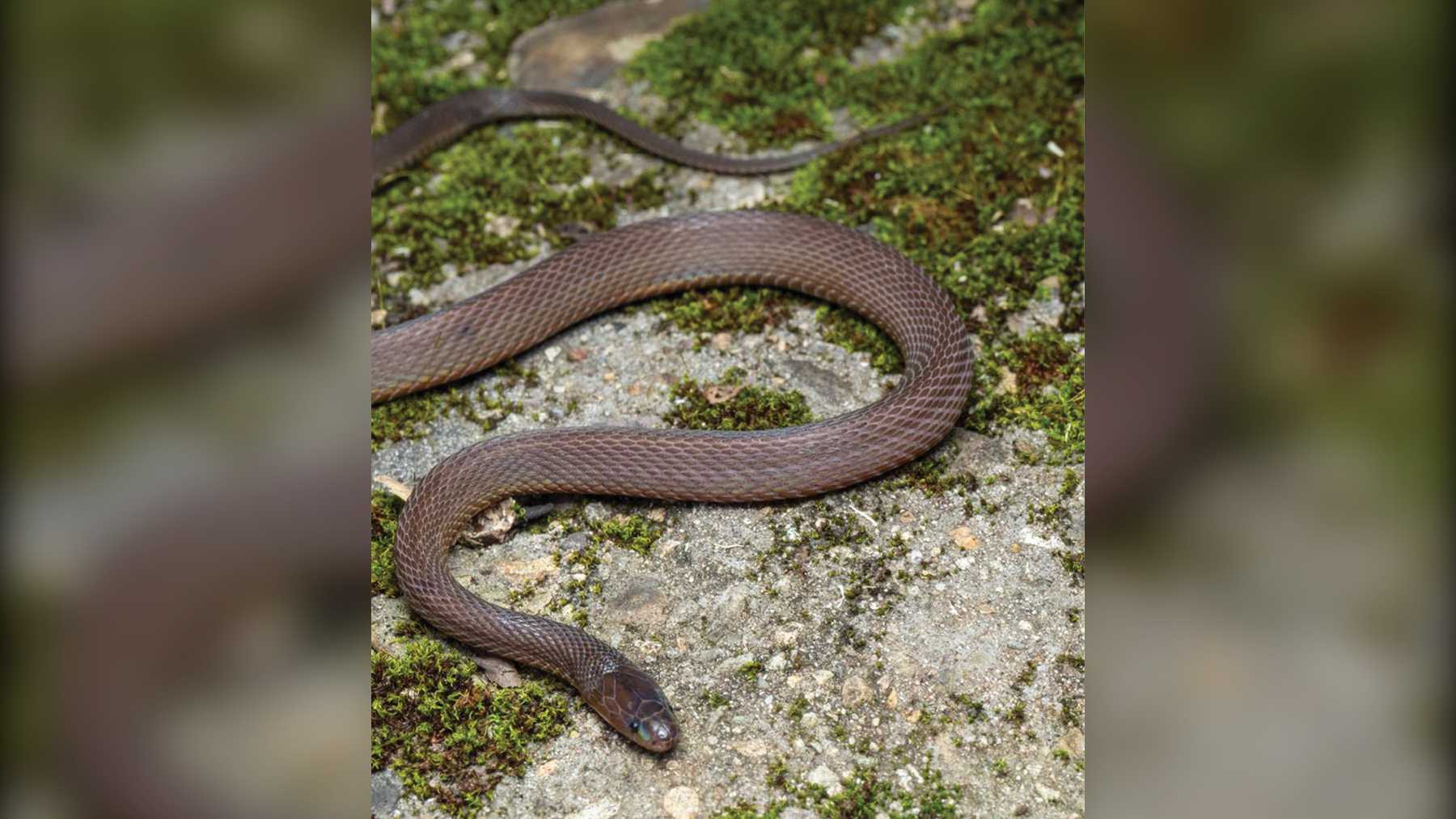
On the night of August 17, 2025, Hu Jiahao was making his way down in the dark along a road in the Kuocang Mountains, in Zhejiang Province, China, when a slender, brown snake crossed his path. He had been searching for it for some time, and that female ultimately became the reference specimen of a newly described snake species, Achalinus mirabilis.
The ECNS agency presented him as a 17-year-old high school student who had spent more than 40 nights trekking the mountain. He studies at Lingjiang School in Linhai, and his name appears as the second author of the study describing the animal, published on March 2, 2026.
A carcass on the road gave the first clue
The story began on October 18, 2024. Zhou Jiajun, a technician at Zhejiang’s Forest Resources Monitoring Center, and hobbyist Chen Haojun found in Kuocang a road-killed snake whose coloration did not match any known species in the area.
The lead author of the paper, Xu Yuhao, a master’s student in reptile taxonomy at Qinghai University, later wrote on social media that crushed remains were not sufficient to describe a new species and that the scope of the project and the budget did not allow them to linger longer in that area.
Hu, a local amphibian and reptile enthusiast who already knew Zhou online, offered to search for additional specimens. In the summer of 2025, after finishing his studies, he loaded his photography and protective equipment and made nearly 100 kilometers round trip into the mountains, according to ECNS.
All appeared on clear nights
For a time he found nothing. “At first I thought these snakes would come out more after rain, so I scoured the area during rain or right after,” Hu explained in an interview with The Beijing News in March 2026, translated from Chinese.
“But in the field I saw that, with rain, not many snakes came out, and all the snakes of this species were found on clear nights,” he added. The study confirms this: all living individuals and those recently struck by vehicles appeared at night under clear skies, on mountain roads near villages, bamboo forests, and well-preserved subtropical broadleaf forests.
From the first encounter, in the Youxi municipality, he recalled a dark shadow that flashed by in a single moment. The dorsal scales did not resemble those of the congeneric species that lives there, and he suspected it was the very snake the team had been seeking.
Five of the six specimens were found by him
That female became the holotype, the specimen to which the species’ name is officially linked. It measures 33.2 centimeters from the snout to the cloaca and 40.4 centimeters with the tail, and it was collected at an altitude of 202 meters.
In the following weeks Hu collected four more: a highly fragmented carcass on August 24, a female run over and a young male on September 26, and an adult male on October 17. With the 2024 carcass, the team studied six snakes, five of them found by him.
Xu Jinan, an engineer and the project lead at the Zhejiang Forest Center, described the student as a “crucial indispensable force” for identifying the species, because he supplied the specimens that filled the most important gap in the research, according to ECNS.
DNA and scales distinguish the new snake from its relative
The work is signed by Xu Yuhao and eleven other authors, with Peng Lifang of Qinghai University, Wang Yingyong of Sun Yat-sen University, and Xu Jinan listed as contact authors.
Achalinus is a genus of small, non-venomous snakes with subterranean or semi-subterranean lifestyles in eastern and southeastern Asia, featuring non-overlapping dorsal scales. The closest living relative of the new species appears to be Achalinus jinggangensis, and between the two there is a genetic distance of about 9.5% to 10.9% in a segment of the mitochondrial COI gene used to compare species.
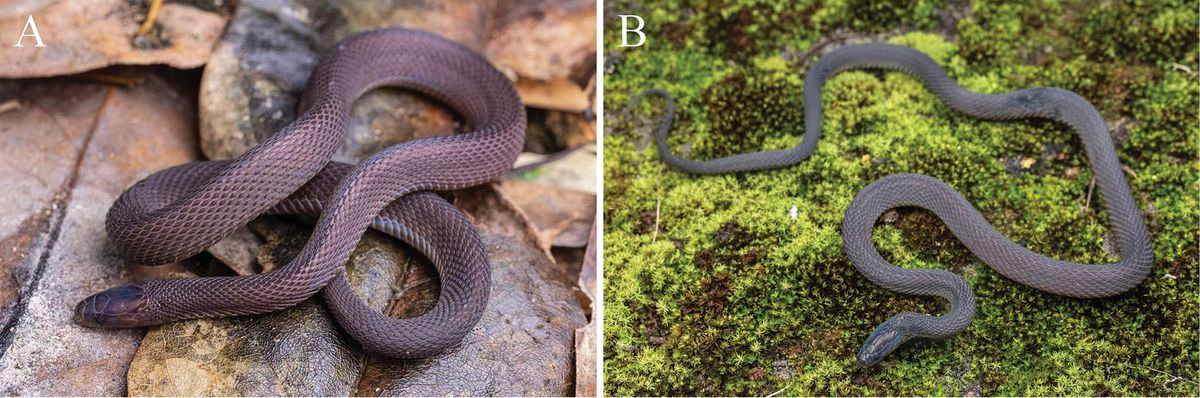
The new species is distinctive at a glance by the outer row of dorsal scales that are clearly keeled, by having more ventral scales in both sexes, and by its coloration—brown above and a uniform light brown below—whereas its relative is black.
The name mirabilis means “wonderful” or “notable” in Latin. The authors explain that it alludes to both its morphology and the fact that it was “unexpected” to find a previously undescribed species in Taizhou, “a region that is highly urbanized and economically developed.” With this species, the genus reaches 30 recognized species.
The student also wrote and prepared figures
After the study there were online questions about whether a high school student could sign off on such a paper. Hu replied to The Beijing News that the work was largely fieldwork and sampling, but that he also drafted part of the initial manuscript and designed several figures.
“His habits are very different from those of other common snakes, and resemble those of an earthworm, so careful, long-term monitoring is necessary, and luck also plays a part in the search,” he said. “I recorded every datum,” he added, and he says he keeps the original RAW files of all his photos.
Xu Yuhao wrote that Hu, having contributed sufficiently to the discovery and to the improvement of the article, became the second author “with the approval of all authors.” The photographs of the living holotype that appear in the study are his.
Earlier he had already participated, with technicians from the forest center, in the discovery of China’s first recorded albino bat, as he told the newspaper. “I never thought of giving up, because I was already enjoying it,” he said about the nights on the mountain.
Data are lacking to determine if it is threatened
So far it is known only from the Youxi and Kuocang municipalities, at elevations between 163 and 879 meters, with an estimated distribution extent of about 33.1 square kilometers. The authors have classified it as “Data Deficient” due to insufficient sampling and call for new surveys to determine its real distribution.
The study also acknowledges that the relationship with A. jinggangensis “lacks statistical support,” so its precise placement within the genus could change with more data. And the five specimens from 2025 were collected by a single individual in a few localities within a small area, and the authors themselves admit that field sampling is incomplete.
Other recent findings range from Sichuan’s green viper that turned out to be a new species to four new frog species in the Peruvian Amazon, or the orange-lipped monkey discovered in a Congo jungle.
The full study has been published in Zoosystematics and Evolution.
Hu told the newspaper that he now wants to improve his grades to enter university and pursue biology more closely.
Photo: J.H. Hu / Xu et al. (2026), Zoosystematics and Evolution (CC BY 4.0)
