
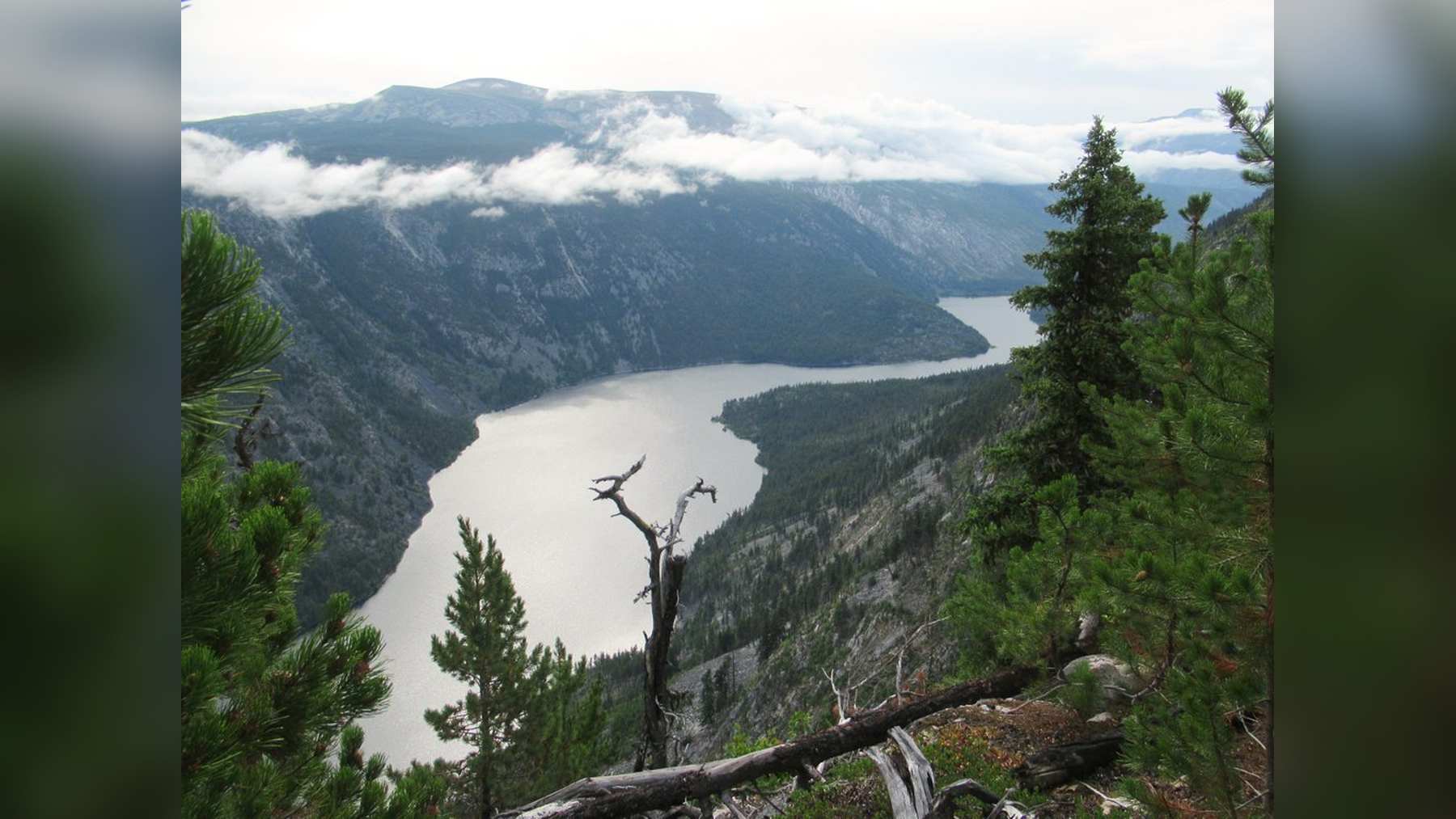
In the winter of 1912, a young man named Ralph Edwards arrived at a lake in the British Columbia mountains and found no signs of life, so he named it Lonesome Lake, “the solitary lake.” There he lived for more than five decades, and his family fed the trumpeter swans that sheltered there during the winters when the species hovered on the edge of extinction.
The winter flock grew from about thirty birds to around six hundred by the 1960s, according to the BC Parks Foundation, which in 2021 purchased the old farm to incorporate it into Tweedsmuir Provincial Park. The origin of the name was explained by Edwards himself in a 1972 television interview that is included in the province’s official placename registry.
A Settler 64 Kilometers from the Nearest Settlement
In 1913, Edwards received a 153-acre parcel, about 62 hectares, as part of a public colonization program. The property lay roughly 40 miles, about 64 kilometers, from the nearest settlement, according to the foundation’s campaign page.
Lonesome Lake sits 69 kilometers southeast of Bella Coola, at the foot of Hunlen Falls, a drop of 260 meters. Today it is encompassed by Tweedsmuir Park, the province’s largest, spanning nearly a million hectares.
The foundation notes that Edwards spent almost a decade alone, clearing land and building a house, with a break to serve in World War I. He later married Ethel, and they had three children who grew up on a farm that produced everything from shoes to electricity, powered by a river-driven generator.
Grain on Horseback for the Swans
The trumpeter swan is the heaviest flying bird in North America, with males averaging over 11.8 kilograms. Plume hunting had pushed the species to a critical point, and the foundation states that there were perhaps around 100 individuals left worldwide, with nearly a third wintering at this lake.
The birds fed along river stretches that did not freeze, and when the ice covered them they were left without food, something that still happens elsewhere, as illustrated by cases of trumpeter swans trapped and without nourishment in an unfrozen stretch of river.
According to the foundation, in 1925 the Canadian government asked Edwards to feed the swans during winter. The family hauled grain into the valley on horseback, and The Globe and Mail described in 2004 sacks of barley weighing 45 kilograms.
As years passed, the task passed to his younger daughter, Trudy. The publisher of her memoirs, Hancock House, explains that her father charged her with it in 1939, when she was ten, and that she continued it through 1989.
From About Thirty Birds to 600
“The Lonesome Lake property is very important because this is where trumpeter swans were saved from extinction in British Columbia, and actually in the world, in the 1920s, 1930s, and 1940s,” said Ric Careless, vice president of the foundation’s board, to CBC News in April 2021.
Those swans had become so accustomed to the family that they were the only ones tame enough to capture when Canada pledged to present trumpeter swans to the then Princess Elizabeth, the future Elizabeth II, on her 1951 tour. In 1952, with the help of Ralph and Trudy, five were captured and flown by plane to England, according to the foundation.
The story reached the public in 1957 with Crusoe of Lonesome Lake, the biography written by Leland Stowe. The placename registry credits Ralph and Ethel Edwards with doing more than anyone to save the species, and in 1972 he received the Order of Canada for that work. He died in 1977, at the age of 86.
The Fire That Erased the Farm in 2004
In July 2004, a forest fire creeping through the southern part of Tweedsmuir suddenly intensified and reached the property. “The original farm has disappeared; it burned completely down to the foundations,” Terry Brandt, a former bush pilot now retired and a friend of John Edwards, Ralph’s son who lived there alone at 77, told The Globe and Mail.
Brandt explained that John was airlifted out by helicopter as the fire drew near, and that the nearby farm that Trudy had built also burned. “There’s nothing left. All the buildings were among the tall trees,” he added.
The Purchase of the Farm for the Park
When Ralph’s granddaughter, Susan Turner, put the southernmost parcel of the lake up for sale, the foundation launched a campaign to raise 695,000 Canadian dollars by May 1, 2021. Careless feared that a buyer would turn it into a fishing tourist destination, with helicopters and seaplanes disturbing the swans, the grizzly bears, and the fish. “It would have been a huge loss,” he told CBC News.
More than 100 donors contributed close to 700,000 dollars in four weeks. “It was incredible how many people wrote to say that as children they had heard the trumpeter swan story and that it had always inspired them,” explained Andy Day, the foundation’s executive director, to Black Press Media.
As with Enos Mills and the Rocky Mountain National Park, the life of a settler has become tied to a protected space, in this case a salmon and trout migration and a grizzly habitat with mature Douglas fir forests.
A Botanist at the Lake in 2025
In the summer of 2025, volunteer botanist Ken Marr, a retired botanist from the Royal BC Museum, arrived by seaplane to carry out the first comprehensive inventory of the estate’s plant life. “There is excitement, there is curiosity; you don’t know what you’ll find; you want to do justice to the place,” he told the foundation.
Among the 193 specimens he collected were two species growing far from their known range, one nearly 450 kilometers north of where it was expected. Marr and his colleague Colleen also spotted dozens of juvenile toads in the damp prairies. “It’s a sign of how alive this valley is,” he commented.
Every morning, a pair of swans, probably descendants of the ones that nearly disappeared, swam at the far end of the lake. “It’s incredible to know that this place is protected forever,” Marr said.
What the Figures Do Not Clarify
The trumpeter swan’s recovery involved many more actors. The United States fully protected the species in 1924, and in 1935, when only 69 individuals were known in the contiguous states, it established the Red Rock Lakes Refuge, according to the Fish and Wildlife Service.
That agency notes that in 1968 the first full aerial census of Alaska counted 2,847 trumpeter swans, a population then barely known. The species never depended solely on Lonesome Lake, although the lake’s flock was pivotal in Canada. The same can be said for other species that almost went extinct, such as the world’s heaviest parrot, which plunged to 51 individuals, whose recovery required multiple fronts to succeed.
Sources do not always agree. CBC spoke of 80 hectares and four swans for the then-Princess Elizabeth, while the foundation cites 62 hectares and five birds; the foundation dates the government commission to 1925 and Trudy’s memoirs’ publication to 1933 as the start of the feeding. The figures of 30 and 600 swans come from the foundation and journalistic reports, not from a published scientific census.
The account of the botanical inventory was published on December 17, 2025, on the BC Parks Foundation website.
Marr acknowledges that there is another shore to explore and an old cultivated clearing to review, so the lake that saved the swans still holds species waiting to be cataloged.
Imagen: David Stanley / Wikimedia Commons (CC BY 2.0)
