
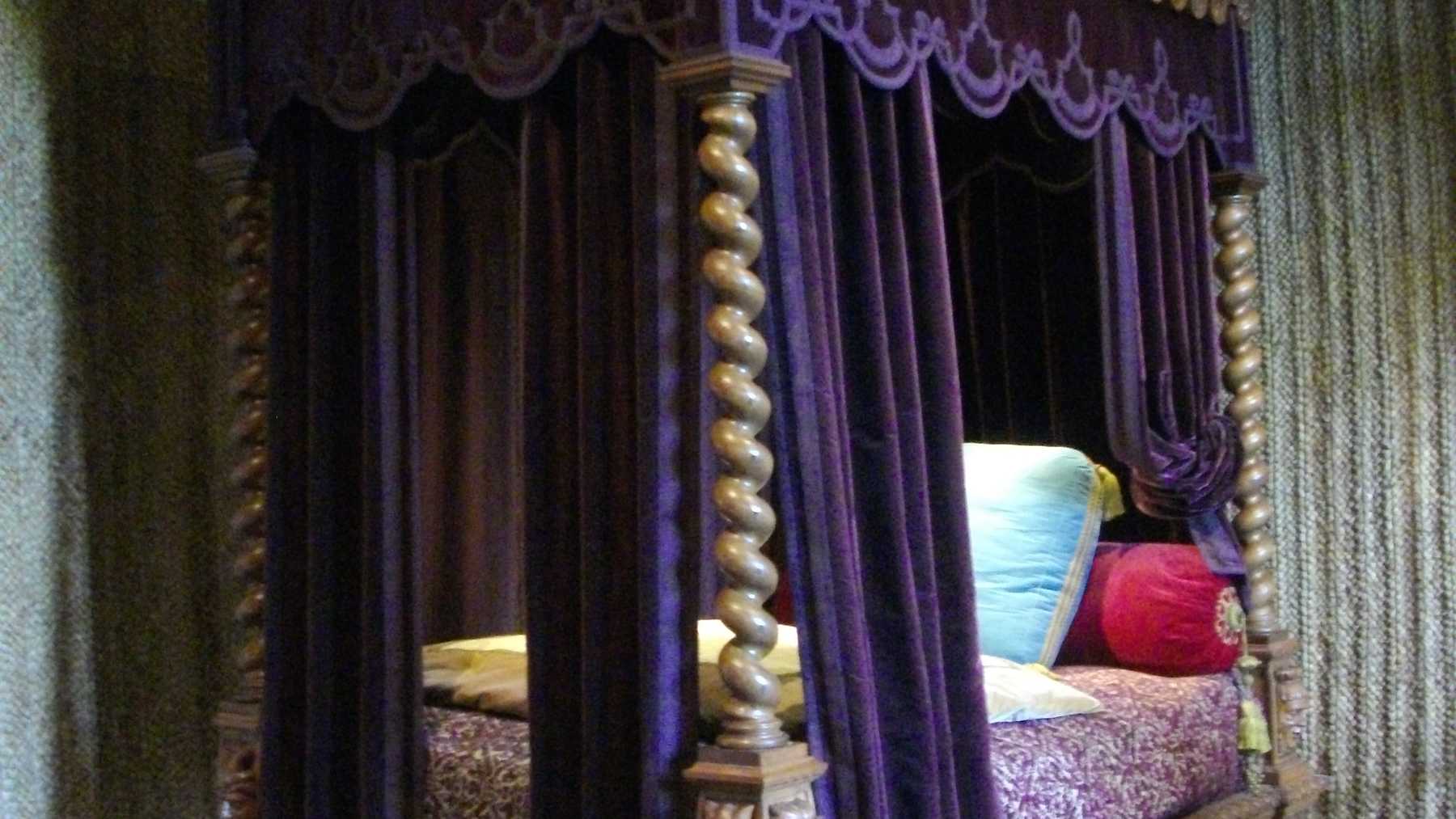
In the William Root House in Marietta, Georgia, the museum that operates the house preserves a routine that repeated each summer in the 19th century, before air conditioning. “Rugs were rolled up and replaced with bamboo mats to protect the floors from dirt and dust,” explains the Cobb Landmarks & Historical Society on its website.
That textile shift was part of a way of living the house according to the season. Today, architects explain the portion that has a physical basis with a concrete concept, thermal inertia, and a simulation from the University of Extremadura assigns figures to the stone houses of the Jerte Valley.
A custom that arrived with the heat
The idea is simple. When summer arrived, thick wool carpets were rolled away and the floor was left exposed or covered with a light mat made of reed, bamboo, or vegetal fiber.
Directo al Paladar, based on a report from the French magazine Le Journal des Femmes, notes that in France it was common to remove winter carpets for a large part of the 20th century. The same article warns that the mat alone does not lower the temperature and that what cools the room is mainly the floor underneath.
That distinction between what you feel underfoot and what the thermometer reads is the key to the whole story.
The reed mats of French castles
Mats have been inside homes for centuries. In 2018, Dominique Hervier reviewed in Bulletin Monumental an article by Magali Bélime-Droguet about braided reed mats in French houses and castles.
According to the review, their use seems widespread from the Middle Ages to the 18th century, in places such as the Louvre, Saint-Germain-en-Laye, and Fontainebleau, both on floors and on walls. Of the material, only a fragment survives, from the English Hampton Court Palace, and the rest of the evidence comes from notarial acts and old dictionaries.
Its use was justified by a prophylactic role, reinforced with rosemary and juniper sprinkled on the floor, and the author also mentions “the comfort these braided mats could offer in poorly heated castles,” as Hervier summarizes. In other words, they served to clean and to warm, not to refresh.
The Azay-le-Rideau Castle, in the Loire Valley, rebuilt in its Renaissance room with walls lined by reed. The Centre des Monuments Nationaux explains on its website that in the 16th century the walls of castles were covered with tapestries or reed mats “that insulated the rooms from the cold,” and adds that the smell of reed was attributed with the ability to purify the air.
Why a tile feels cooler than a rug
The sensation underfoot has a simple explanation. A tile and a rug can be at the same temperature, but tile conducts heat much better and takes the heat away from the foot faster, so we perceive it as cooler.
The Mobile Heat Transfer Laboratory of the Mechanical Engineering Department at Virginia Tech in the United States uses precisely that example in its practices. “The rug feels much warmer underfoot than a tile floor,” sums up one of its workshops.
What thermal inertia is
Thermal inertia is the ability of heavy materials, such as stone, concrete, or fired clay, to store heat and release it slowly hours later. A floor of this type absorbs part of the day’s heat and dampens peaks inside the house.
If there is a thick rug on top, the floor exchanges much less heat with the room air. Australia’s government Your Home guide advises, to make the most of thermal-mass floors, “minimize rugs and carpets” and use them, if desired, in sunless zones.
That same mechanism has a downside if the sun comes in full. “The materials that form the building absorb solar radiation during the day and heat up progressively,” said architect Julio A. Romero of Arrevol Arquitectos, in statements to La Vanguardia that Xataka Home covered in August 2026.
The stone houses of the Jerte Valley
In the north of Cáceres, many traditional houses were built this way, with thick stone walls and the ground floor pressed to the earth. The project was led by architects Beatriz Montalbán Pozas and Francisco Serrano, from the University of Extremadura, who simulated the behavior of the Jerte Valley homes, in Cáceres, where some 3,000 traditional houses survive.
To measure the inertia effect, they compared on the computer houses with and without those heavy elements. In the harshest week of summer, with exterior temperatures ranging from 12 to 35 °C, the living room and the staircase of the upper floor rose from 21 °C at 4 a.m. to 27 °C at 4 p.m. in the timber-framed house, while in the stone-walled house they stayed around 24 °C, the average of the day’s exterior temperatures.
The floor also matters. In the ground-floor entrance hall, with stone walls and the floor resting on the earth, the temperature hovered around 19–20 °C. When they simulated those timber-framed walls and also separated the house from the ground on wooden beams, that space rose to 23 °C.
The authors conclude that this strategy is beneficial, “as it stabilizes interior temperatures with respect to outdoor fluctuations, bringing them closer to the daily averages, more pleasant.”
Day shading and cool air at night
Thermal mass only cools if it can release the heat it accumulates. That is why the straw-like mats habit went hand in hand with others, such as closing shutters during the sun hours and opening them when the temperature dropped, the same logic as a bioclimatic house that cools without electricity.
The architect and Passivhaus designer Gisela Trilla explained it in June 2026 in El Español. “It is fundamental to seize that moment, when the air is cool, because that lowers the interior heat load,” she said about nocturnal ventilation.
Trilla also warned of what happens when it is not done. “If you don’t ventilate at night and you don’t lower the temperature of the house, the next day you will have accumulated heat inside,” she warned.
During the day, the important thing is that the sun does not heat that bare floor, and here blinds and awnings of the right color help to reduce heat in the home.
What this custom cannot promise
None of the sources consulted measures how many degrees are gained by rolling up a rug, nor how much is saved on the electricity bill. The Jerte simulation analyzes stone walls and earth floors, and it does not speak of rugs or mats. Moreover, it is a computer model, and the authors themselves recommend validating it with measurements in real homes.
The history also nuance the myth, because the reed mats of the French castles were used to insulate from the cold. A plant-fiber mat is pleasant to walk on, but its natural origin does not make it a cooling system.
In a heat wave with nights that do not cool, that same inertia works against you, because the walls do not fully cool and the house wakes up hotter, as Romero recalled. And in a floor with light-plank flooring there is little mass to take advantage of. In those cases a fan or air conditioning remains necessary, and it is advisable to know the consumption of air conditioners and fans.
What you can do is combine old gestures with new guidelines, because buildings will need to adapt to heat waves in the coming years.
The full study has been published in Informes de la Construcción.
For anyone who wants to try it at home, the first step costs nothing. Just roll up the thick rug, shade the tile or stone floor, and open the windows when outside is cooler than inside.
Image: Fab5669 / Wikimedia Commons (CC BY-SA 4.0)
