
The first time Marlon Brando saw the atoll of Tetiaroa, in the early 1960s, he could only make out on the horizon a “thin pencil of land.” He was in French Polynesia filming Mutiny on the Bounty and, during a break, paid a fisherman to take him there, where he found a place “more beautiful than anything he had expected,” according to Smithsonian magazine.
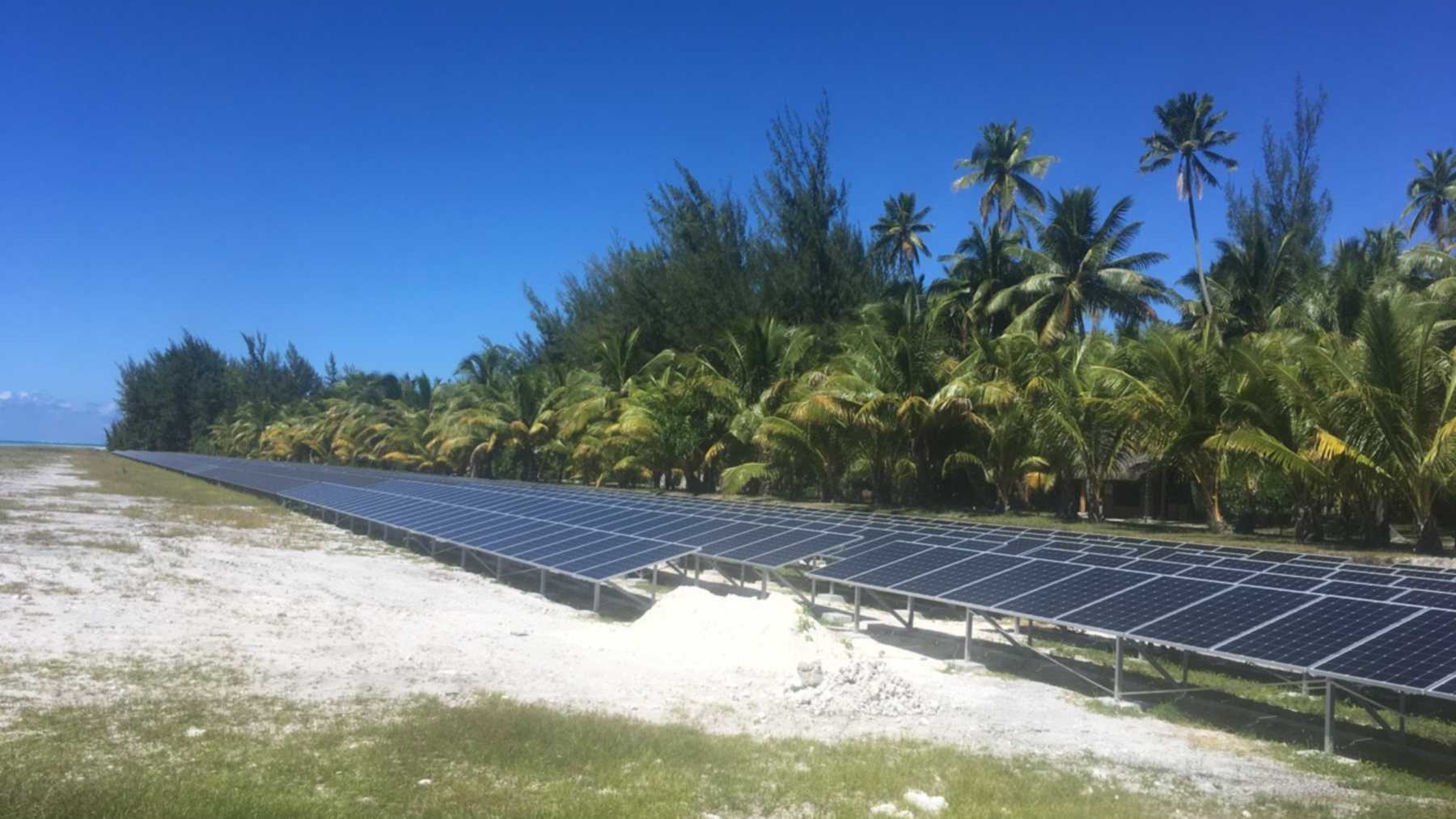
More than six decades later, on the Onetahi islet operates The Brando, a hotel with 35 villas and a private residence that is cooled with seawater pumped from 960 meters deep and that derives about 60% of its energy from more than 4,700 solar panels placed beside the runway.
What the hotel says on its website now can be compared with data. Two researchers from the University of French Polynesia measured the true performance of its refrigeration system and how much money it saves relative to traditional air conditioning.
The atoll Brando wanted to turn into a laboratory
Brando purchased Tetiaroa a few years after that first trip. It lies about 48 kilometers north of Tahiti and consists of a dozen coral motus surrounding a lagoon.
According to his biographer Peter Manso, the actor wanted a place where “intellectuals from all over the world could come, converse and exchange ideas.” His friend Patt Morrison, columnist for the Los Angeles Times, wrote that the plan was for Tetiaroa to be “a tropical hotel that is ecologically responsible, but above all a natural reserve, an outdoor scientific laboratory, an ‘ocean university.’”
Hotelier Richard Bailey, president and CEO of Pacific Beachcomber, worked for years with the actor on the idea and carried it forward after his death. The Brando Family Trust approved in 2009 the project of 35 villas and the hotel opened in 2014, the same day that marked the tenth anniversary of Brando’s death.
The cold arrives from almost a kilometer deep
The system is called SWAC, the English acronym for seawater air conditioning. A pipe laid on the seabed draws water that reaches land at about 5.8 °C on average, and that water cools in a titanium heat exchanger the freshwater loop that runs through the buildings. Then the seawater returns to the ocean.
In Tetiaroa the intake sits at 960 meters depth and the pipe measures 2,618 meters. The circuit that distributes the cold spans about 3.8 kilometers and reaches the villas, the staff residences and the technical buildings, with a nominal cooling capacity of 2.4 megawatts.
“Brando was a man ahead of his time,” Bailey told Interior Design magazine in 2013. “He had heard about the SWAC principle… even in the 1970s and dreamed of making it a reality in Tetiaroa for aquaculture.” Bailey had already tested it in 2006 at his InterContinental Bora Bora hotel.
Cooling buildings in the tropics without blowing up the bill is a problem many cities share, which try much cheaper solutions, such as painting roofs white in Philadelphia.
What the hotel measurements say
The work is authored by Franck Lucas and Kanhan Sanjivy, from the GEPASUD laboratory of the University of French Polynesia. Sanjivy also works for the French Agency for Ecological Transition (ADEME), which funded the study together with the university.
Engineers measure performance with the EER, which indicates how many cooling units are delivered per unit of electricity. The Brando’s SWAC installation yields a global EER of 25.5, while conventional hospital chillers at Taone, in Tahiti, measured in the same study, were at 3.
In terms of consumption, the hotel’s SWAC uses on average 26.7 kilowatts of electricity. The authors calculate that with chillers you would need 113.9 kilowatts and with individual units in each villa 189.9, so the savings range is about 77% and 86%, close to the “up to 90%” claimed on the hotel’s sustainability website.
They also did a money calculation. Electricity in Tetiaroa costs $0.78 per kilowatt hour, according to the provider Énergie de Tetiaroa, and with that price each kilowatt hour of cooling from SWAC costs $0.15 over a 50-year useful life. Compared with a chilled installation, the lifetime savings are estimated at $18.48 million.
“The only direct SWAC industrial installations that work in warm climates are in Polynesia,” the authors write.
Panels by the runway and batteries for the night
The other half of the story is solar. According to the hotel, the more than 4,700 photovoltaic panels along the runway cover 60% of its energy needs, and the surplus is stored in lithium batteries to provide light at night, something similar to what another island did with Alcatraz’s nearly invisible panels.
Before opening, the plan also included coconut oil biofuel. Interior Design described in 2013 a hotel that would obtain all its energy from “renewable sources such as solar, coconut oil biofuel, and seawater air conditioning.” The hotel’s current sustainability page does not mention coconut oil nor explain where the remaining 40% comes from.
Anne-Laure Amabile, who was the hotel’s corporate social responsibility coordinator, summed it up in 2022 on The Points Guy travel site: “At the scale of Tetiaroa, The Brando staff and all its partners, including Tetiaroa Society, form a true community living in an energy- and water-self-sufficient village.”
Rainwater, compost and the war on rats
Drinking water is produced by desalinating seawater through reverse osmosis. Rainwater collected in the aquifer and on the rooftops goes to the pools, sanitation, and laundry, and the wastewater is treated with tropical aquatic plants and reused for irrigation.
Food waste is turned into compost in 24 hours for the garden, glass is repurposed by a Tahitian company blended with concrete, aluminum cans are sold to be melted again, and used cooking oil ends up in biofuel.
Outside the hotel operates Tetiaroa Society, the nonprofit that manages the atoll’s conservation and which receives around 70% of its operating funding from the hotel, according to Smithsonian. Its best-known program aims to eradicate rats, which eat eggs, fledglings and turtle hatchlings, and the atoll has already recorded 15,614 green turtle hatchlings in a single season.
“Marlon was a visionary,” Smithsonian quotes Hinano Murphy, the cultural director of Tetiaroa Society. “He wanted to create an ocean school.” Neil Davies, its chief scientist, describes it as “a place of gathering.”
What the study does not resolve
The measurements also reveal the weak points. The hotel installation is operating at 28.5% capacity, and the authors acknowledge that “the drop in hotel occupancy after Covid explains in part” this figure.
The distribution pumps account for nearly 80% of the system’s electricity consumption, and its regulation, according to the study, seems to operate inadequately. With ideal regulation, according to the authors’ simulation, its average power would drop from 25.44 to 8.7 kilowatts and 147.2 megawatt-hours would be saved per year.
The data were provided by Bailey himself and the project leader Bruno Chevallereau, and the authors warn that the cost of cooling “depends a lot on local costs,” which in Polynesia are very high. Moreover, Pacific Beachcomber has set a target to cut its emissions by 50% in 2030 compared to 2019, but that objective leaves out international flights, which bring foreign visitors to Tahiti.
The full study has been published in IntechOpen.
Bailey summarized it in one line when the hotel had not yet opened: “At The Brando, luxury is unplugged.”
Image: Saga70 / Wikimedia Commons (CC BY-SA 4.0)
