
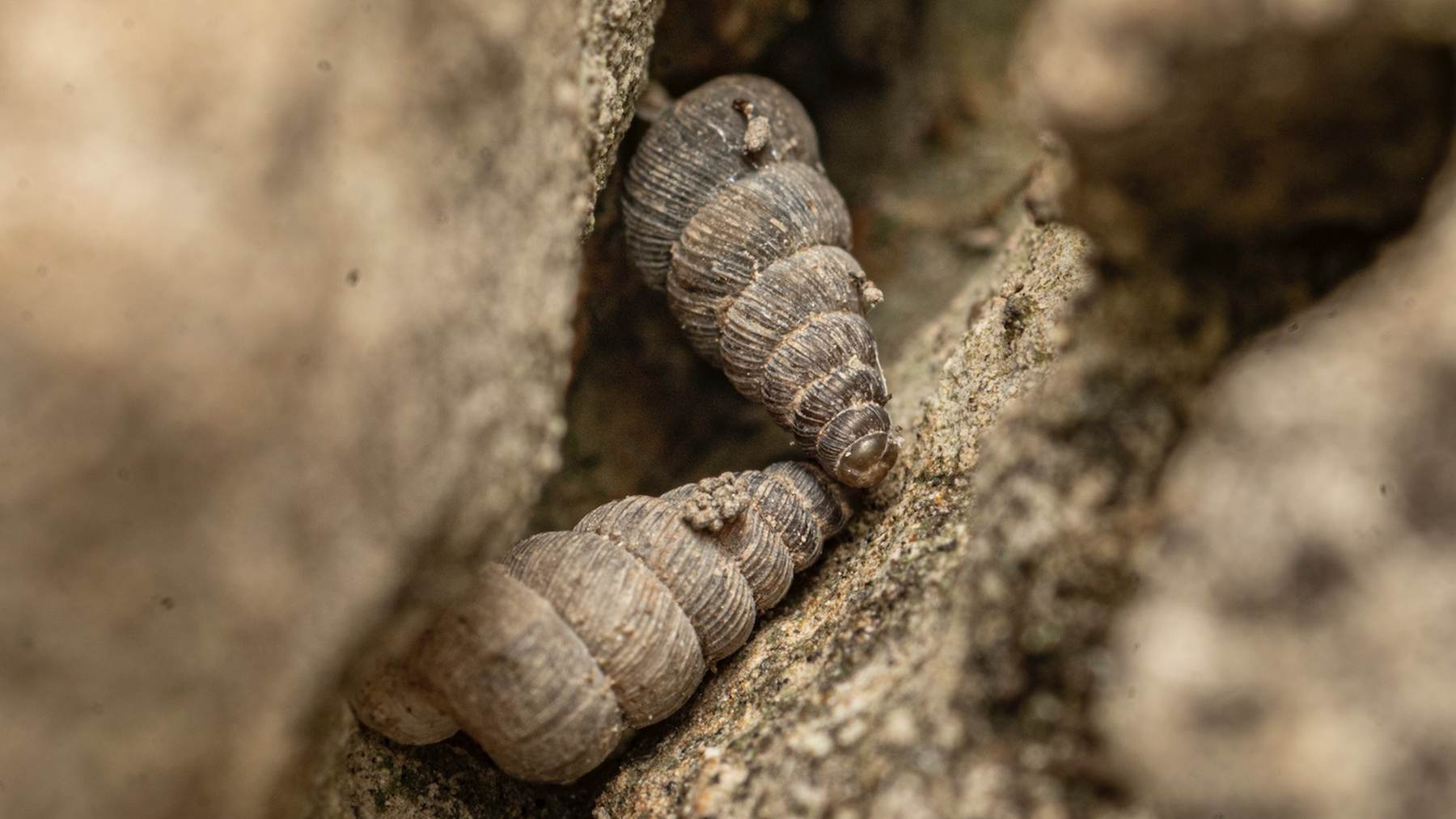
The events took place on July 25, 2024, when participants in an open-to-all scientific expedition collected a tiny snail from the left bank of the Komarnica River, at an elevation of 730 meters. That specimen now serves as the reference point for one of the two newly described snail species identified by a team of scientists and volunteers in northern Montenegro.
The species are named Cochlostoma komarnica and Cochlostoma dobrido, and their description was published on July 27, 2026 in the open-access Biodiversity Data Journal. The shells of C. komarnica average 5.46 millimeters, while those of C. dobrido average 6.78 millimeters, meaning both are around 6 millimeters—the size cited by Leiden University.
Two snails that close themselves in their shell
Both species dwell on limestone rocks, feeding on algae and lichens. They have eyes positioned at the sides of their heads, whereas most terrestrial snails carry theirs at the tips of their tentacles.
They also bear a circular disc attached to the tail which, according to Pensoft’s editorial note, “can close the shell like a door” when the animal withdraws inside. Biologists call that lid an operculum.
The shells are conical, pale yellow-gray, and free of any orange markings. C. dobrido appeared in high-density clusters on limestone cliffs at elevations between 1,680 and 2,080 meters, while C. komarnica was found from 730 to 1,735 meters.
A mixed team of researchers and enthusiasts
The snails emerged from Taxon Expeditions, an initiative co-founded by Menno Schilthuizen that organizes real scientific field trips open to anyone. Between June 2018 and July 2025, its teams surveyed Durmitor National Park and the Komarnica Canyon in collaboration with the Taxon Foundation and Montenegro’s Ecologists Society.
The article is led by Schilthuizen, Professor of Evolution of Characters and Biodiversity at Leiden University and a researcher at Naturalis Biodiversity Center, alongside 22 other coauthors.
The authors explain that in these kinds of expeditions “taxonomy tourists” are guided by biodiversity experts “throughout the entire process of discovering and describing species.” Taxonomy is the discipline that identifies, describes, and gives names to living beings.
One of these enthusiasts is Dutch musician Janine Buisman, who took part in one of the trips and ended up as a coauthor of the article. “I was surprised that it is still possible to discover new animal species in Europe,” she said in Leiden University’s note.
This is not an isolated case, because a few days ago a 17-year-old Chinese student helped identify a new snake species in the Kuocang Mountains after more than 40 nights of searching.
DNA confirmed they were new species
The teams found the snails at several points across the mountainous terrain, but only realized they were new species after dissecting them and analyzing their DNA in the field laboratory. That portable lab used a MinION sequencer, a device that reads DNA on site.
In Leiden University’s note, Schilthuizen sums it up: “It is actually quite remarkable that so many distinct species exist in this small region without obvious external differences translating that into visible distinctions.”
“The species differ mainly in their internal reproductive organs and in their DNA, and much less in their appearance than one would expect,” adds the researcher.
According to the study, the two new species are genetically separated by about 8% in the two mitochondrial DNA fragments analyzed.
Both belong to the subgenus Turritus, which contains at least 37 species spread across the Italic and Balkan peninsulas, the Alps, Sardinia, Sicily, and the coastal mountains of southern France and Spain. The closest relative of C. komarnica, Cochlostoma hallgassi, lives north of Naples, across the Adriatic Sea.
According to the authors, these snails move so slowly that they serve as indicators of long-standing stable habitats, in contrast to Antarctic snails that moved into new territories by riding on algae.
Names chosen at the camp
The team picked the names in a camp vote. The name for C. dobrido comes from the Dobri Do plateau between the peaks of Durmitor National Park, and it was chosen on the final night of the 2023 expedition, according to the article.
C. komarnica is named after the Komarnica Canyon, south of Durmitor. According to Taxon Expeditions, it is a gorge 600 meters deep and 25 kilometers long.
An electric dam threatens the Komarnica Canyon
The canyon lies outside Durmitor’s UNESCO World Heritage site limits, and a hydroelectric dam with its reservoir looms over it. The authors write that if the project goes ahead, “the type locality will be flooded and this population will disappear.”
The type locality is the place where the specimen used to officially define the species was collected.
Biologist Jovana Đokić, from Montenegro’s Ecologists Society and a coauthor of the study, views it with concern. “It is even more worrying that the Komarnica Canyon is earmarked to be flooded by a hydroelectric dam and its reservoir. This will destroy this wild river canyon and all the biodiversity it contains, including many species still unknown to science,” she stated.
Her organization is calling for the canyon to be included in Montenegro’s UNESCO Durmitor site and for the project to be abandoned. “Hydroelectric energy is neither green nor sustainable when it destroys a unique ecosystem like this,” Đokić says.
Amelie Huber, head of freshwater projects at the EuroNatur foundation, spoke on the Save the Blue Heart of Europe campaign website. “Once a unique ecosystem is lost, we risk losing species before science has even had the chance to document them,” she said.
Protection of the canyon yields mixed messages. Pensoft’s and Leiden’s notes call it “unprotected,” but a 2024 Montenegro Ecologists Society report, cited by the study, notes that the country lists it as a natural park (Dragišnica and Komarnica) and as a natural monument since 1969. What it does not have is World Heritage backing. The same report mentions a 171-meter-high dam, a 17.6-kilometer reservoir, and a 172-megawatt plant.
According to Discover Wildlife, a ministry report from Montenegro’s Ministry of Ecology, Sustainable Development and Northern Development includes the plant among recommendations to meet the nation’s renewable energy goals, and the project is postponed.
Each described species arrives at a moment when the IUCN Red List warns of another rise in threatened species across the planet.
What the study still does not know
The authors themselves acknowledge that reliable distribution maps for each species will require more fieldwork. For C. dobrido there are only three confirmed localities with morphology and DNA, all on the Dobri Do plateau, though it could be more widespread.
The shells are so similar to those of another local species, Cochlostoma scalariniforme, that the team had to rely on DNA to confirm each specimen. Moreover, the genetic analysis is based on two partial fragments of mitochondrial DNA, and some of the anatomical differences could be individual variation, according to the article.
The idea that C. dobrido might suffer if climate change pushes the mountain’s ecological bands upslope is, for now, the authors’ hypothesis. Additionally, all the voices on the dam gathered here come from scientists and ecologists, with no statements from the promoter or the government.
The area features many canyons, plateaus, and gorges at different elevations, so more snail species exclusive to a single valley or plateau could exist. “Therefore, it is also possible that more new species will appear,” the authors write.
The full study has been published in Biodiversity Data Journal.
The holotypes—the reference specimens for each species—are stored at Montenegro’s National Museum of History in Podgorica. The project was funded by the National Geographic Society, BIOPAT, and the Mohamed bin Zayed Species Conservation Fund.
Photo: S. Kountouras / Schilthuizen et al., Biodiversity Data Journal (CC BY 4.0)
