
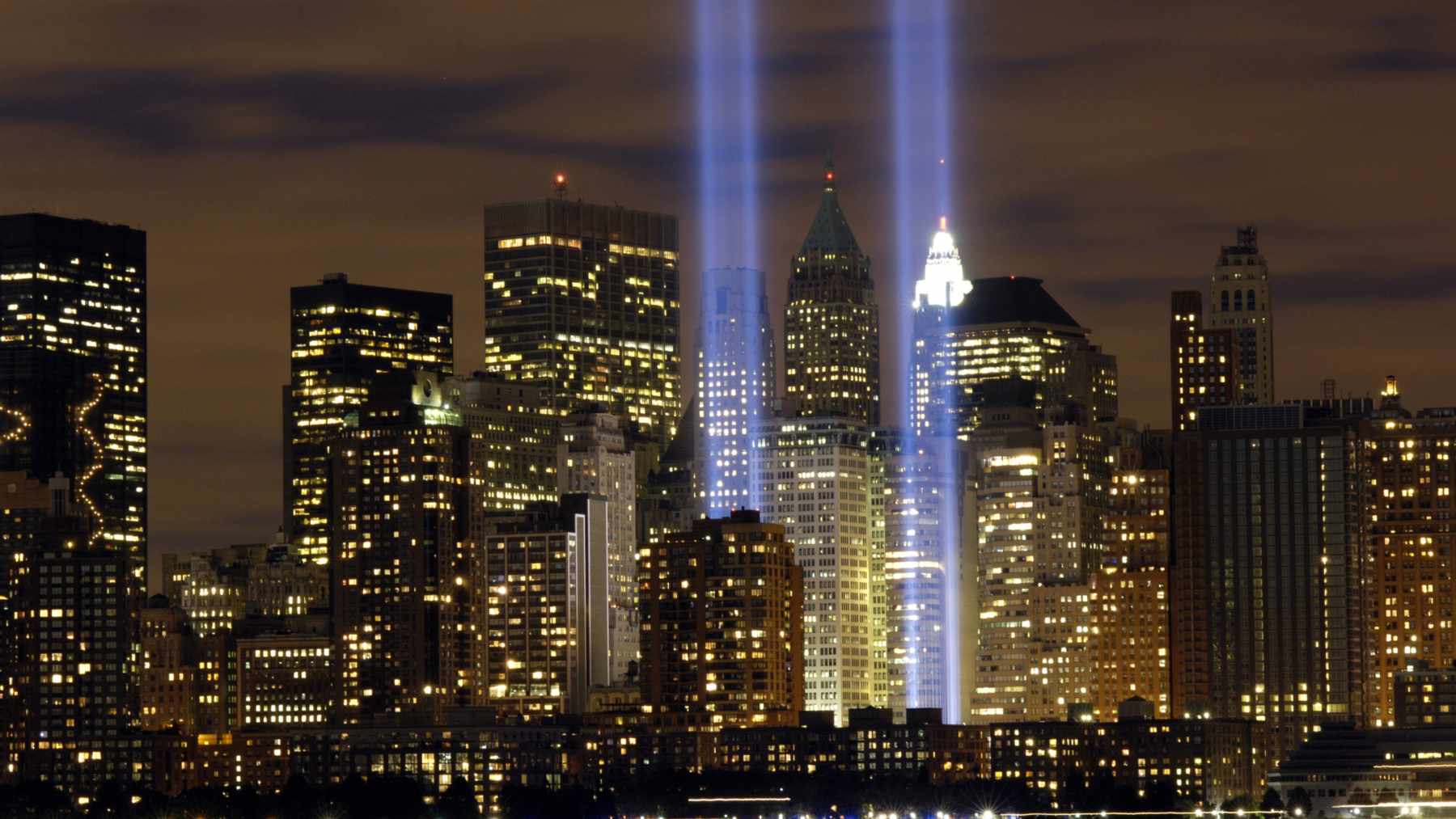
At 10:45 p.m. on September 11, 2017, volunteers counting birds from the rooftop of a parking lot near Wall Street were already watching more than a thousand birds circling within the beams of the 9/11 tribute in New York. “They are not angels or confetti. They are birds in distress,” said Susan Elbin, then the director of conservation and science for New York Audubon.
Shortly afterward, Elbin went to fetch the production team to ask them to switch off the lights, according to journalist Annie Novak, who recounted the incident in 2018 in Living Bird, the magazine of the Cornell Lab of Ornithology.
That scene has repeated every September for years, and a study published in 2017 put a figure to it. According to their calculations, Tribute in Light influenced the behavior of about 1.1 million migratory birds over seven nights of September across 2008 to 2016.
The figure refers to birds drawn toward or diverted by the light, and the authors do not present it as an accounting of birds killed.
Two Columns of Light in the Thick of Migration
Tribute in Light has recalled the victims of the 2001 attacks since 2002 with two vertical beams that evoke the Twin Towers. According to the 9/11 Museum and Memorial, the installation uses 88 xenon bulbs of 7,000 watts each, placed in two squares of about 14.6 meters on a side atop a parking lot in southern Manhattan.
The date coincides with the autumn migration peak in the northeastern United States.
“Most of the movement is invisible to us because it happens at night, and sometimes thousands of feet above the ground,” explained Andrew Farnsworth, an ecologist specializing in migration and a visiting scientist at the Cornell Lab of Ornithology, in a university note published on September 10, 2026.
“But when migratory birds encounter an extraordinarily bright artificial light, we can see that concealed migration,” added Farnsworth, who has been tracking the tribute’s birds since 2002.
How the 1.1 Million Figure Was Calculated
The work was led by Benjamin Van Doren, of the Cornell Lab of Ornithology and Oxford University, and Kyle Horton, of the same laboratory and the University of Oklahoma. Farnsworth and Elbin are among the coauthors.
The team reviewed the nights of September 11, 2008 to 2016 and excluded 2009 and 2011 because rain hindered radar data readings, leaving seven nights across seven different years.
To estimate the effect, the researchers compared the birds detected within a five-kilometer radius around the lights with what would be expected based on the surrounding density. Adding up those differences yielded about 1.1 million birds, with a 95% confidence interval of 600,000 to 1.6 million.
With the lights on, the maximum bird density near the memorial exceeded that of the surrounding area by more than 20 times in every year, rising to 60 times in five of them and to 150 times in 2008, 2012, and 2013. Without light, it never reached 13 times that reference level.
Birds That Slow Down, Turn, and Call Nonstop
“We had more than 20 excellent volunteers on the ground counting birds to confirm what was happening in the beams,” Farnsworth told All About Birds, the lab’s website, in October 2017. “We also used remote-sensing tools, including data from local National Weather Service radars, to understand the density and movements of the birds. Acoustic monitors recorded the birds’ calls and captured their vocal behavior in the beams.”
With the lights illuminated, the effect was noticeable even on clear nights and up to about 4 kilometers high. “They slow down, begin to circle, and call more often. They end up expending energy without making progress and they risk colliding with nearby buildings or being taken by predators,” Van Doren explained in the same publication.
In 2015 and 2016, observers noted that many birds struck the windows of a building under construction just north of the lights, at 50 West Street, a problem that in Spain also concerns the collisions of birds with glass.
Twenty Minutes in the Dark to Let Them Go
According to the study, when observers see more than 1,000 birds circling in the beams, New York Audubon asks organizers to switch off the installation for about 20 minutes. “It had to be a high figure because we are asking for a lot,” Elbin told Living Bird, which notes two other reasons for the blackout: a bird dying or birds appearing trapped, flying low and calling.
During the seven study nights, the lights were turned off 22 times, about 20 minutes each. When switched off, the birds dispersed, accelerated, called less, and moved away from the site “in a matter of minutes,” the authors write.
In 2024, the volunteers of the former Audubon, now NYC Bird Alliance, counted birds every 20 minutes and requested the blackout with 500 per beam or 1,000 across both, said Katherine Chen, who oversees citizen science and reducing bird strikes there.
That September 11, the first blackout arrived at 10:28 p.m. and lasted 15 minutes. “In less than two minutes after the lights were turned off, the birds had completely cleared the sky above us,” Chen wrote in NYC Bird Alliance’s summary.
The next morning, the organization adds, volunteers did not find more dead birds on nearby buildings than would be expected with the lights off.
What the Study Cannot Prove
The authors caution that their work was “opportunistic and not a controlled experiment.” Wind, temperature, clouds, and other city lights could influence how many birds concentrated, and in 2014 there were hardly any birds in the beams and the lights did not go off.
They also could not measure mortality. “We do not have enough data to analyze mortality in relation to lighting and the intensity of migration,” they write. Among other things, scaffolding prevented birds from falling to the ground, and scavengers and building staff removed the bodies.
A Useful Lesson for Homes and Offices
The U.S. Fish and Wildlife Service explains that nocturnal lighting can attract migratory birds from up to 5 kilometers away and that when birds become trapped in a light that cannot be escaped, turning it off for 15 to 20 minutes allows them to escape.
The agency recommends turning off unnecessary lights, especially from April to May and from August to October, directing lamps downward and using warm lights under 2700 kelvin. These are guidelines that fit with what is already known about light pollution in ecosystems as remote as Antarctica or about lights that divert the first flights of puffins in Iceland.
From Lower Manhattan to Mount Washington
This year, according to the Cornell note, a new light installation on Mount Washington in New Hampshire was to join the Tribute in Light to remember 9/11. “New Hampshire teams are following the lessons learned in New York,” Farnsworth explained, noting that there would be observers on the summit and others watching remotely.
“The Tribute in Light is, above all, a deeply meaningful memorial, and it is possible to honor that meaning while protecting the birds that cross New York’s night sky,” he added.
The full study was published in 2017 in the Proceedings of the National Academy of Sciences.
Kyle Horton, who spent the night of 2017 on that rooftop, summed it up in the Living Bird report: “That organizers are willing to switch off the lights for migratory birds is encouraging for conservation.”
Image: Denise Gould / U.S. Air Force (Public Domain)
