
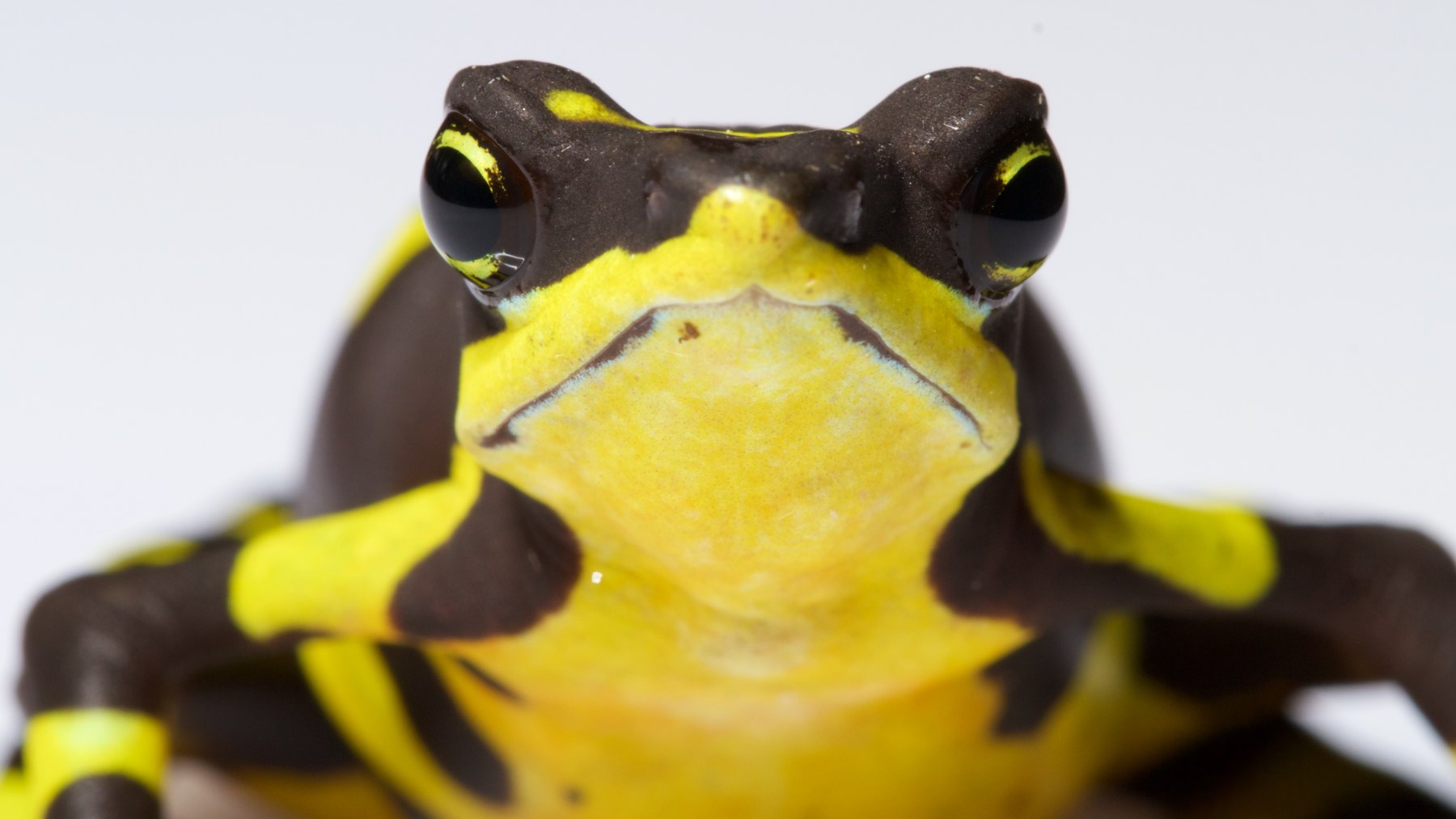
Nearly all harlequin frogs that remain alive in the wild in Panama persist in climate refuges, places where the climate slows the chytrid fungus in more than 80% of seasons. This is the conclusion of a study by the National Zoo and Smithsonian Conservation Biology Institute (NZCBI) and the Smithsonian Tropical Research Institute (STRI), published in the Journal for Nature Conservation.
The only exception is the variable harlequin frog (Atelopus varius), which also appears in sites favorable to the fungus. The others live in places where climate makes things difficult, often lower than the mountains where the fungus thrives.
The work was led by Carrie Lewis, a PhD student at George Mason University. The senior author is Brian Gratwicke, conservation biologist at the National Zoo and Smithsonian Conservation Biology Institute (NZCBI), and the study is also co-authored by researchers from the Smithsonian Tropical Research Institute (STRI), in Panama.
“We have attempted to reintroduce captive-bred harlequin frogs to the wild and have suffered many losses to the amphibian chytrid fungus, which persists in the environment,” Gratwicke explained in the Smithsonian press release dated October 1.
A fungus that preys on harlequin frogs
The disease is called chytridiomycosis, and its culprit is the fungus Batrachochytrium dendrobatidis, or Bd, which infects the frogs’ skin, disrupts the balance of salts and water, and ends up killing them. According to the Smithsonian, it has spread across Central and South America since the 1970s and is now widespread.
In Panama there are seven native harlequin frog species, in the genus Atelopus, and all are critically endangered or extinct, though five remain in breeding colonies. We have already explained why harlequin frogs are among the amphibians with the bleakest outlook, in a country where 43% of amphibians are in some risk category.
But the fungus needs a cool, damp environment and does not thrive when it is too hot or the air is too dry, so the same forest can be dangerous in one season and considerably safer in the next.
A season-by-season map of the fungus
The new map builds on two previous works. One, from 2019, estimated where harlequin frogs could live, and the other, from 2025, cross-referenced daily temperature and humidity data with more than 4,900 samples collected from amphibians at 314 sites across the country.
Both are species distribution models—programs that cross where a living being has been found with its climate to calculate where else it might be found.
Each year was divided into one dry season and two rainy seasons, yielding 42 seasons between 2005 and 2018.
The survivors live where the fungus struggles
To determine where harlequin frogs remain, the team gathered sightings uploaded between 2018 and 2024 to iNaturalist, a website where people share photos of wildlife. After reviewing them and requesting coordinates from Panama’s Ministry of Environment, they settled on 21 sites and five species.
In four of them, Atelopus limosus, A. certus, A. glyphus, and A. fronterizo, the sites occupied were unfavorable for average and strong infections in more than 80% of the seasons.
“It is possible, therefore, that most Atelopus species surviving in Panama (…) are persisting in climate refuges,” the authors write.
The opposite case is Atelopus chiriquiensis. All of its known sites and seasons were 100% favorable to the fungus, and today it is considered extinct.
The variable harlequin frog is the exception
Only the variable harlequin frog (Atelopus varius) appeared in sites where the fungus has it easy for much of the year. The authors believe it may have developed skin secretions that hinder Bd.
In 2018, a team led by Voyles, from the University of Nevada, Reno and co-author of the new study, already showed in the journal Science that the fungus remained equally lethal and that the frogs were the ones who survived more.
“The evidence indicates that the pathogen has not changed. It is possible that the hosts have developed better defenses in a relatively short period,” Voyles said at the time in the university’s press release.
Refuges are mostly in lower areas
Across the country, the highest mountains were largely favorable terrain for the fungus, while the lower zones generally were not. Large parts of the San Blas mountain range and the western Azuero Peninsula proved unfavorable to Bd in all versions of the model.
The team also marked areas that are becoming worse for the fungus in the Tabasará and Veraguas mountains, in Azuero and Darién. In harlequin frog sites, the average temperature rose by about 0.41°C between the first five years of the period and the last five years.
The golden frog opened the path for releases
In a trial announced in February 2026, the rescue project released 100 golden frogs into enclosed enclosures at Altos de Campana National Park, and over the 12 weeks there, almost 70% died from chytridiomycosis. It was a species not seen in the wild since 2009, as we reported then.
“Guided by these climate refugia maps and habitat suitability for Atelopus, we have already begun inspecting possible sites to verify whether the habitat is suitable and for potential release trials,” explained in the Smithsonian press release Roberto Ibáñez, STRI scientist, director of the Panama Amphibian Rescue and Conservation Project and co-author of the study.
“By mapping climate refugia we now have a tool to classify potential release sites, enabling us to choose locations where the released animals have the best chances of surviving,” Gratwicke now says.
“These tools will allow us to experimentally test the climate refugia hypothesis with future release trials,” Ibáñez said in the Smithsonian note.
What the map still does not prove
The study has limits. The fungus models use samples from many frog species, and a photo on iNaturalist proves that a frog was at a site on a given day, but not that a reproducing population lives there.
The map also assumes that the climate from 2005 to 2018 continues to describe these forests, even as temperatures rise. The Smithsonian note warns that this change could also harm frogs adapted to cool montane environments.
Nobody has yet demonstrated that frogs released into a refuge live longer than those released where the fungus thrives.
The full study has been published in Journal for Nature Conservation.
“These persisting populations could contribute genes to bolster populations that are under human care and offer opportunities to increase wild populations,” adds Lewis in the Smithsonian note.
Image: Brian Gratwicke / Wikimedia Commons (CC BY 2.0)
