
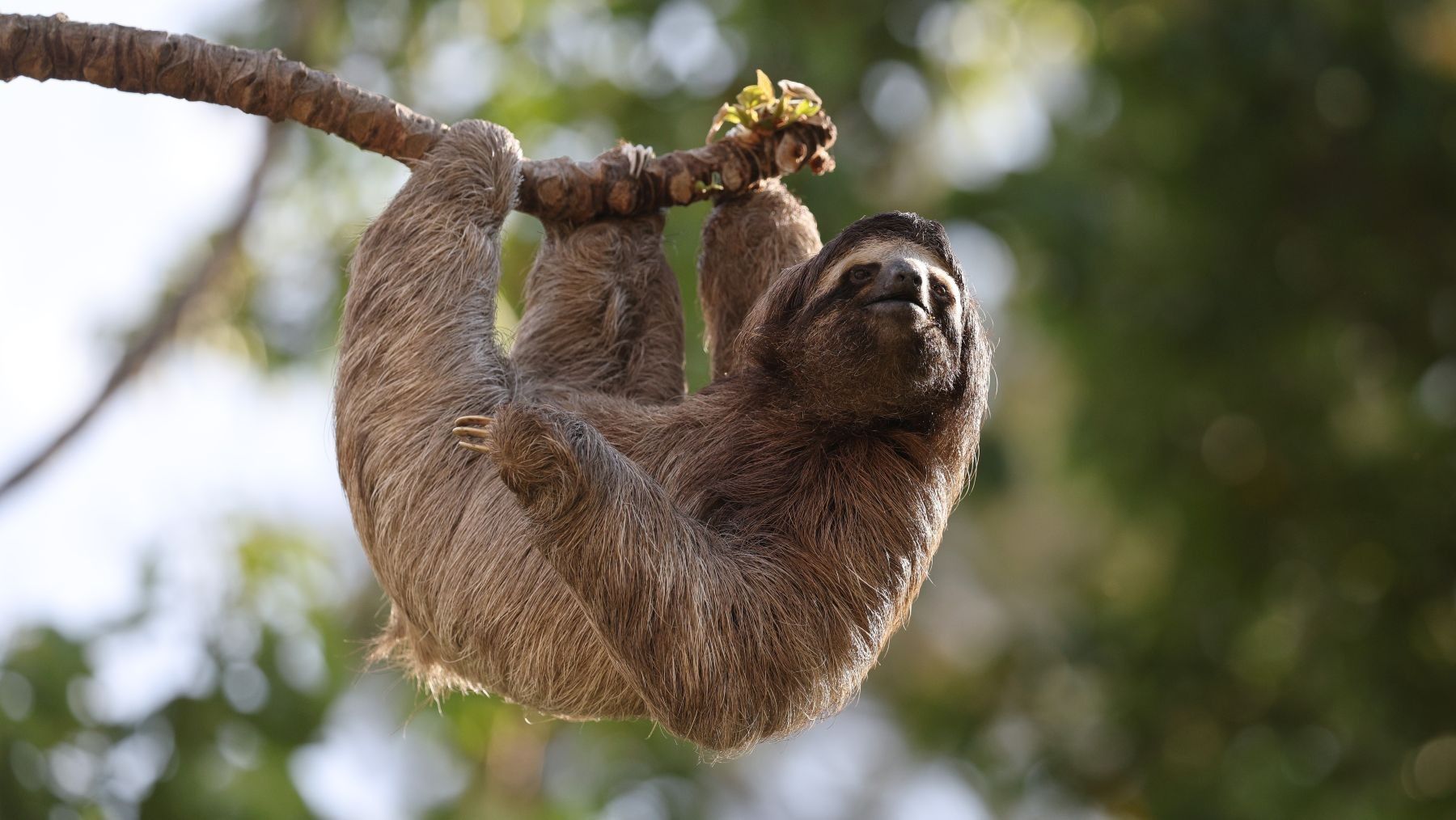
Deforestation and fragmentation of the three-toed sloth’s habitat forces it to descend from the trees, exposing it to countless dangers. International Sloth Day, celebrated today, October 17, focuses attention on protecting the tropical forests of Central and South America, which are its natural habitat.
This year’s International Sloth Day carries a prominent theme: the slowest mammal on Earth is losing its forest. This is crucial because the species relies on trees to survive, and deforestation leaves it even more exposed to the constant threats that loom over it.
One of the foundations for the establishment of International Sloth Day is the need to defend the ecosystems in which it lives, since it is essential to maintain connectivity between protected areas to preserve the genetic wealth of the various species that dwell in the rainforests of the Americas.
This is a solitary animal with unique characteristics, such as the ability to hang for most of its life thanks to an anatomy and physiology that are highly adapted, being the slowest in the world due to its diet and metabolism, and possessing distinctive long and sharp claws that differentiate the two species, since one has two toes and the other three.
In this article we will discuss the main objective of International Sloth Day, which is celebrated annually on the third Saturday of October, the features of this animal, what it eats, where and how it lives and why the IUCN concerns itself with certain species.
Día Internacional del Perezoso: un animal que debe ser protegido
The International Sloth Day is observed on the third Saturday of October each year; in this case, today the 17th, to raise awareness about the problems affecting its natural habitat, about its peculiar lifestyle, and to understand the dangers that threaten it.
They owe their name to moving with great slowness, since their energy intake is low and their slow metabolism provides little energy, but they do not sleep more than humans, and that is a myth it is good to dispel on International Sloth Day.
From the three-toed sloth, whose genus is Bradypus, there are 5 species and 3 of them are threatened according to the IUCN classification, and of the two-toed sloth there are two species; while these are not currently endangered, they need their habitat to survive and they are losing it due to human activity. This is one of the reasons International Sloth Day exists.
Raro, pero esencial para mantener el equilibrio de los ecosistemas
Sloths are vital to the ecosystems that constitute their habitat, as their fur hosts several insects that are extremely useful, many of which are endemic to the region and with some of them they share a cooperative relationship. Sloths are highly adept at camouflage; in fact, they even host a green algae as a kind of disguise.
The sloth’s digestive system comprises four stomachs like ruminants, but digestion is extraordinarily slow, to the point that, depending on what they have eaten, it can take up to a month to complete it, and for that reason these animals only need to defecate and urinate once a week.
It has a very long tongue (up to 25 cm) that allows it to feed on fresh leaves and the shoots of certain trees (hence they are called folivores) and extensive, sharp claws that it uses to eat and defend itself. They also serve during the reproductive period, for fights between males over the favor of the females.
Sloths have additional vertebrae at the base of the neck, enabling them to rotate their head on a 270° axis. They can achieve a view of almost 360° of their surroundings, which proves to be a very advantageous defense mechanism. This unique feature makes sloths stand out from other mammals whose skeletal structures do not allow this flexibility.
Colgados, pero no tan dormilones como se cree
It is important to clarify on International Sloth Day that the notion of them sleeping for many hours is a myth, as they only sleep about 10 hours a day. And while they are slow on the ground, they are very agile when moving between trees and are excellent swimmers.
Sloths can spend up to 90% of their lives hanging upside down thanks to their remarkable biology. Studies show this is possible because their organs are attached to their rib cage, so they do not press on their lungs. Unlike us, a sloth can hang upside down without hindering its breathing.
They are solitary animals, closely related to anteaters and armadillos, although they differ clearly from the former because sloths have a round head. They are native to the humid forests of South and Central America, and their natural predators are eagles, jaguars, and constrictor snakes.
¿Por qué están en grave peligro?
Their worst enemies are undoubtedly humans, since through deforestation of the rainforests and the degradation of wetlands they shrink their habitats and force them to move or die of starvation. They also fall victim to poaching and illegal wildlife trafficking.
On International Sloth Day we should remember that of every 10 sloths captured, 8 or 9 die before reaching their destination, and those that do survive are often victims of mistreatment, such as claw or fur cutting and inadequate feeding. Therefore, species that have not yet become extinct are at serious risk of doing so in the coming decades.
