
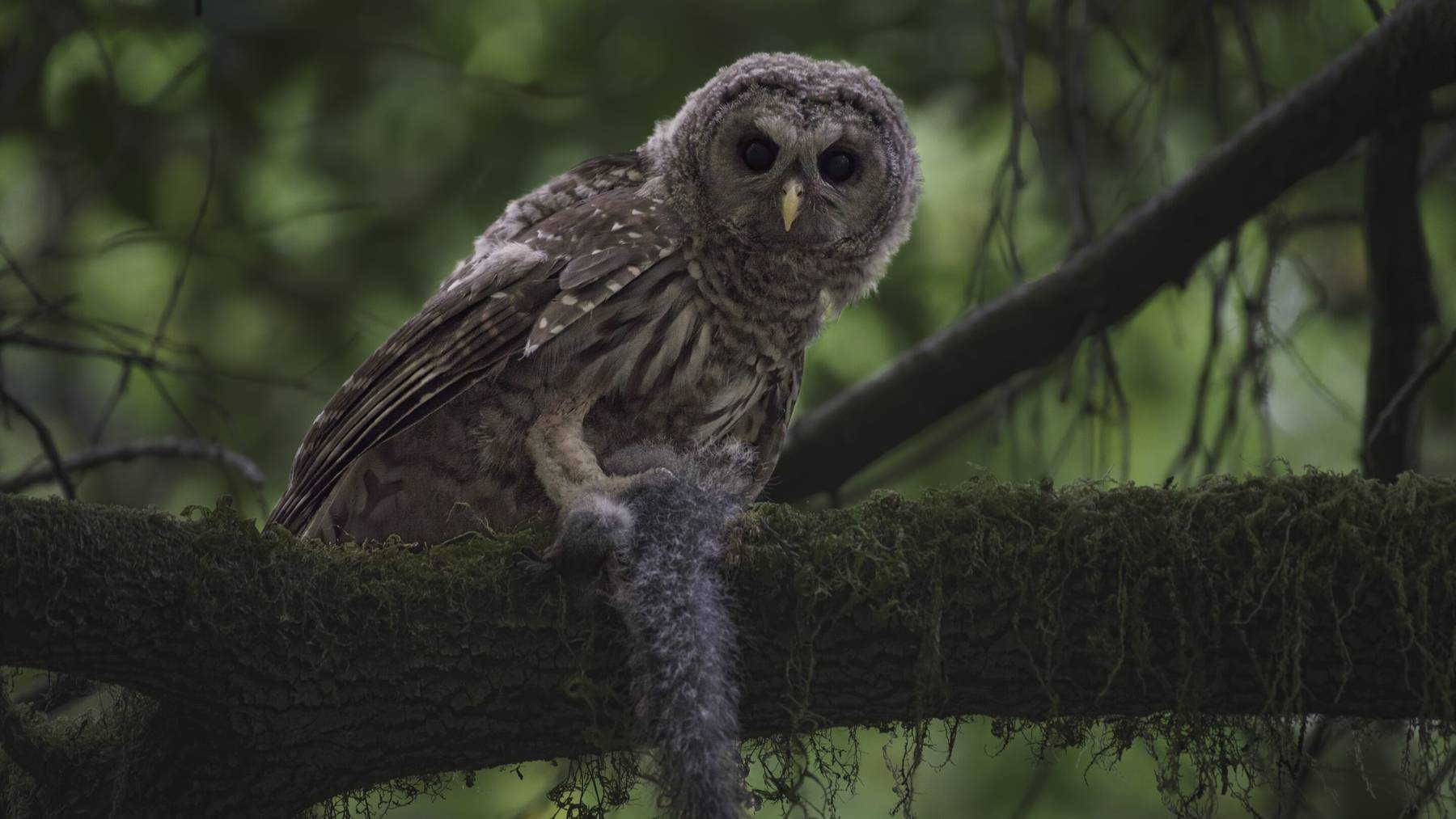
Between 2019 and 2025, teams removing barred owls from the forests of northwest California kept liver samples from 1,003 birds. In the regional cohort, formed by 837 barred owls collected between 2022 and 2025, 35.7% carried at least one anticoagulant rodenticide, the rat poison that kills by internal bleeding, even though the birds inhabited forests largely distant from urban centers and agricultural operations.
To reach that point, the poison has to move from one animal to another. Rodents eat the bait, and predators that prey on them accumulate the compounds in their livers, a process scientists call secondary exposure.
The study was led by Vitek Jirinec, a researcher at the Integral Ecology Research Center (IERC), a nonprofit organization. According to the IERC press release, it represents the largest rodenticide biomonitoring dataset ever assembled for a single wildlife species in North America. Biomonitoring involves tracking a contaminant through the tissues of living or dead animals.
Healthy Owls Instead of Corpses
The barred owl (Strix varia) is native to the eastern United States and has invaded the West, where it competes with the northern spotted owl (Strix occidentalis caurina), an endangered subspecies. To assess whether removing barred owls helps stabilize the northern spotted owl, experimental removals of barred owls are conducted in the region, and the birds used in the study come from those removals.
That changes the type of sample. “Most studies on rodenticides are based on animals that appeared sick or dead, so they tend to collect the worst cases,” Jirinec explained in the IERC press release. “Our owls looked like healthy birds going about their lives. That gives us a much truer picture of what is circulating in the population and more confidence that the trends we see are real.”
The sampling area spans 3,990 square kilometers across Humboldt, Del Norte, Siskiyou, and Trinity counties, from the coast to about 100 kilometers inland and from the Oregon border to roughly 230 kilometers south. It includes federal, state, tribal, and private lands between the Klamath Mountains and the Coastal Range.
More Than a Third Carried Anticoagulants
The researchers screened each liver for 14 rodenticide compounds. Almost all anticoagulant exposure corresponded to second-generation products, present in 35.2% of the owls, while first-generation products appeared in only 1.2%.
Second-generation products are more potent and were developed because rats became resistant to the first-generation poisons, a problem that also concerns Europe, where Spanish rats have developed resistance to the more toxic poisons. The study notes that the half-life of brodifacoum in the liver of laboratory rats reaches 113 days.
That compound was the most frequent, found in 30.6% of the birds, followed by bromadiolone at 14.2%. Among owls with anticoagulants, the average concentration of these compounds was 14.7 parts per billion.
“Rodenticides are spread across forest food webs in the western United States, even in landscapes far from urban and agricultural centers,” the authors write. In Spain, a high prevalence of anticoagulant rodenticides had already been described in urban and peri-urban wild boars, though in that case near cities.
Females and Adults Accumulate More Poison
The exposure rate, concentration, and the number of distinct compounds were higher in females than in males and increased with age. The authors view this as consistent with bioaccumulation, that is, the animal accumulates the toxin faster than it eliminates it.
Barred owls live 15 years or more, so adults keep accumulating what they eat in their territory. According to the IERC, breeding-age females and adults with their own territory are precisely the individuals whose persistence is most crucial for a population’s survival.
The Decline Coincides with California Laws
California has been tightening access to these products for more than a decade. In 2014, its Department of Pesticide Regulation removed brodifacoum, bromadiolone, difenacum, and difethialone from consumer sales, and in 2020 AB 1788 prohibited their use statewide, with exceptions such as agriculture or public health emergencies. The 2024 AB 2552 bill extended the ban to chlorophacinone and warfarin starting in 2025.
Young owls may reflect more recent exposures, so the team used them to measure the trend: 292 subadult owls from Hoopa Valley collected between 2019 and 2024. In them, the model estimates anticoagulant exposure fell from about 50% in 2019 to about 20% in 2024.
For Greta M. Wengert, cofounder and co-director of the IERC and the lead researcher of the study, the result shows something unusual in conservation: a law translating into a measurable effect on wildlife. “We have been seeing for more than a decade how illegal use and unregulated products fuel exposure to rodenticides in these forests,” she said. “Seeing anticoagulant exposure truly decline within a few years of California’s rules coming into effect demonstrates that policies, when based on solid data from effective biomonitoring, can improve wildlife outcomes.”
The authors summarize it this way in the article: “That restrictions on the most persistent anticoagulants produced a detectable signal within a few years shows that policies can translate into a measurable benefit for wildlife.”
A Substitute Poison Emerges in the Analyses
The study also looked for colecalciferol, vitamin D3, sold as a rodenticide and that kills by altering calcium in the body to mineralize soft tissues. No previous study involving Strix owls had analyzed it.
It appeared in 18.5% of the owls, and 9.9% carried it without any anticoagulant. Its detections rose as anticoagulant detections fell, which, the authors note, points to a possible substitution of products that warrants monitoring. Counting all rodenticides, up to 46% of the birds carried at least one, according to the IERC.
The other common substitute, bromethalin, was not detected, though the authors caution that the liver may not be the best tissue to detect this neurotoxin.
The Northern Spotted Owl Feeds from the Same Chain
In 2012, the IERC had already linked anticoagulants found in fishers to illegal cannabis cultivation on public lands, in line with how narco marijuana threatens California’s forests. In 2018, another study in Humboldt, Mendocino, and Del Norte found poison in seven of ten northern spotted owls and in 40% of 84 barred owls.
“Northern spotted owls tend to feed along forest edges. As crops fragment these forested landscapes, they are probably sources of exposure,” said Mourad Gabriel, who led that earlier work and also signs the new one, in a note from the California Academy of Sciences.
The northern spotted owl includes more rodents in its diet than the barred owl, so the pattern observed could pose an added risk to its recovery, according to the IERC.
What the Study Cannot Prove
The authors acknowledge that the origin of the current exposure is not resolved. State pesticide records only track licensed commercial applicators, so household purchases and illegal use are not captured, and former illicit crops may continue releasing contamination years after being abandoned.
The drop from 50% to 20% comes from a sub-sample of subadults from a single site, Hoopa Valley, and aligns in time with the laws, which is what the study can demonstrate. Additionally, detecting a compound in the liver does not equal poisoning, and for colecalciferol, diagnosis requires compatible lesions because vitamin D3 is also naturally present in the body.
The full study has been published in Environmental Pollution.
The work was funded by the California Department of Fish and Wildlife’s Cannabis-affected Areas Restoration Grant Program.
Photo: Daniel Hofstadter / IERC
