
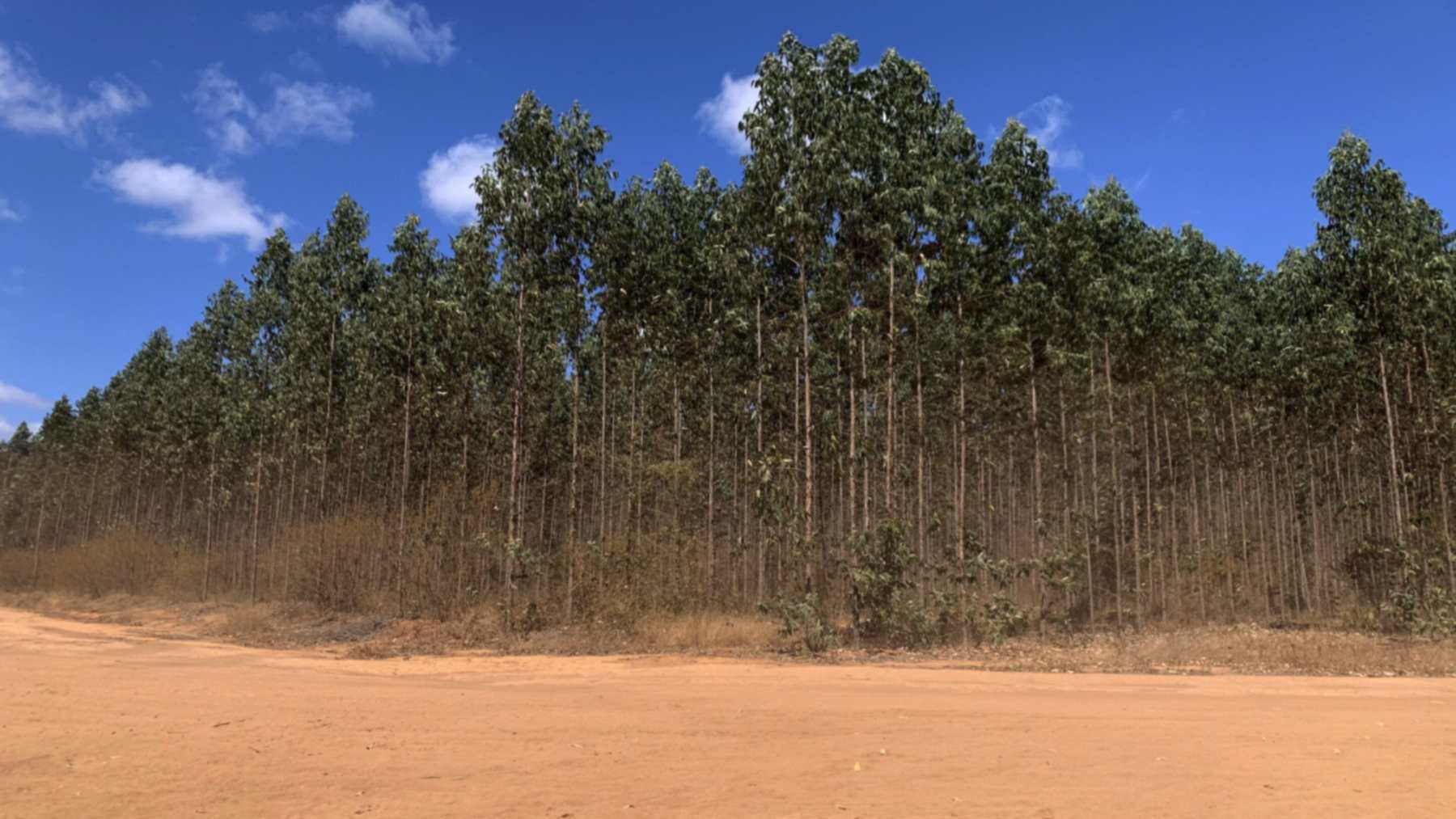
A regional report estimated that in the eucalyptus monoculture zones of Alto Jequitinhonha, in the Brazilian state of Minas Gerais, groundwater declined by about 4.5 meters between 1974 and 2019, at a rate of around 10 centimeters per year. The eucalyptus in that region is mainly grown to produce charcoal for the steel industry.
The figure has circulated in recent weeks as though it were the measurement of a scientific team working in Brazil’s paper plantations, but the original sources tell a different, more concrete story: it is an estimate for Alto Jequitinhonha, a northeastern region of Minas Gerais, and not a direct measurement.
Eucalyptus for Steel Production
In the mid-1970s, during Brazil’s military dictatorship, authorities offered incentives to companies to plant eucalyptus on lands that traditional communities had long used communally. This is the account given by the Global Forest Coalition. Most of the current plantations were established by the steelmaker Acesita, and over the years about 60% of the native vegetation in that stretch of the Cerrado, the vast savanna at the heart of Brazil, was replaced by eucalyptus that were later felled to produce charcoal.
Acesita was privatized in 1992, and since 2011 its lands have been owned by the European group Aperam. Its subsidiary Aperam BioEnergia now manages around 150,000 hectares, two-thirds of which are planted with eucalyptus, and it yields more than 420,000 tonnes of charcoal per year. That charcoal is shipped to the Timóteo steelworks, more than 300 kilometers away, according to the Global Forest Coalition report published in September 2026.
How the 4.5 meters were calculated
The figure appears in the final February 2022 report of the Socio-environmental Safeguards project, led by the Vicente Nica Center for Alternative Agriculture (CAV) and the Brazilian Institute for Consumer Defense (IDEC). The water table is the depth at which the soil becomes saturated with water, i.e., the upper boundary of groundwater.
The authors based their estimate on a 2013 study by Vico Mendes Pereira Lima, which estimated an average drop in the groundwater level of 10 centimeters per year in the eucalyptus monoculture zones of Alto Jequitinhonha. Multiplied by the 45 years from 1974 to 2019, the result is a decline of 4.5 meters.
The same report translates the calculation into volume. Each year would stop infiltrating at 218 liters per square meter, and the report estimates about 245 million cubic meters per year as the lost recharge in the Capelinha microregion.
The rain that no longer reaches the aquifer
When it rains, part of the water evaporates or is released back into the air through plant transpiration, another portion runs off on the surface, and another portion seeps down to groundwater reserves. Eucalyptus transpires heavily year-round, while the Cerrado is adapted to a dry season of about eight months, during which it uses less water.
An article published on April 20, 2022 in the journal Campo-Território assessed this balance for Chapada das Veredas, a plateau in the region. With native Cerrado, annual rainfall recharge was 525.8 millimeters, while with eucalyptus it dropped to 308.5 millimeters, about 217 liters less per square meter. One millimeter of rainfall equals one liter per square meter.
Pereira Lima, a researcher at the Federal Institute of North of Minas Gerais (IFNMG) and co-author of that article, explains in the Global Forest Coalition report that native Cerrado infiltrates roughly 50% of the annual rainfall and recharges the aquifer, whereas with eucalyptus the share falls to 29%, resulting in an accumulating water deficit.
Dry springs and tanker trucks
The article is authored by Emília Pereira Fernandes da Silva of the Federal University of Minas Gerais (UFMG) and six other authors from UFMG, IFNMG, and CAV. They write that eucalyptus masses “influenced water dynamics, drying up springs and causing water insecurity in communities.”
In the studied rural communities, a quarter of families needed water delivered by tanker trucks during the dry season. Fifty-two percent lived with about 43 liters per person per day, compared with the Minas Gerais average of 159, and in Cabeceira do Tanque all neighbors depended on the truck for about nine months a year.
The Global Forest Coalition report also cites a 2019 Turmalina City Council survey, which found that 89% of the springs had already dried up.
The CAV helps families build small dams and rainwater storage deposits. “Here at CAV we know these things help, but they don’t solve the whole problem,” Renato Alves de Souza, an agricultural engineer with the organization, told the Global Forest Coalition. While the true water reservoir—the plateau—remains unaddressed, he added, “the water problem will never be fully solved.”
Aperam’s response
The company denies that its plantations are responsible for the scarcity. According to the Global Forest Coalition report, Aperam cites publications claiming that eucalyptus consumes the same amount of water as native species, argues that its planting is concentrated in the rainy season, and maintains that its clones do not have pivoting roots capable of reaching groundwater.
Aperam also asserts in its 2025 annual report that it preserves more than 33% of the land area under its control. The Global Forest Coalition responds that this figure gives an idea of the scale of the ecological damage caused to establish the plantations.
What the figure does not prove
The 4.5 meters result from multiplying an average rate by the years of cultivation, not from continuous borehole measurements across nearly half a century. It is an estimate for specific areas of Alto Jequitinhonha and cannot be extended to all of Brazil or to all eucalyptus plantations.
The case did not originate in the paper industry, as has been claimed in recent days. Direct measurements exist in other places. A study by researchers from the University of São Paulo, published in 2019 in the journal Water, followed four wells every 15 days between 2004 and 2016 in a sector of the Guaraní aquifer where pastures were replaced by eucalyptus. The recharge average dropped from 407 to 194 millimeters per year.
That work supports the same mechanism, albeit in another region, with different soil and previous vegetation. Eucalyptus water use depends on climate, soil, and plantation density, and a 15-year trial in Australia already confirmed its high water consumption relative to crops. Spain is familiar with the debate as well, because millions of eucalyptus were planted there starting in 1940.
Neighbors call to restore the Cerrado to the veredas
The veredas are Cerrado wetlands that recharge groundwater and maintain river flow during the dry season. Residents are asking for the eucalyptus along their slopes, where springs originated, to be removed and the area restored with native forest.
The article on Chapada das Veredas has been published in the Campo-Território journal.
The 4.5-meter estimate comes from the February 2022 CAV and IDEC report, and the Global Forest Coalition has referenced it again in its September 2026 Aperam report.
Photo: Global Forest Coalition
