
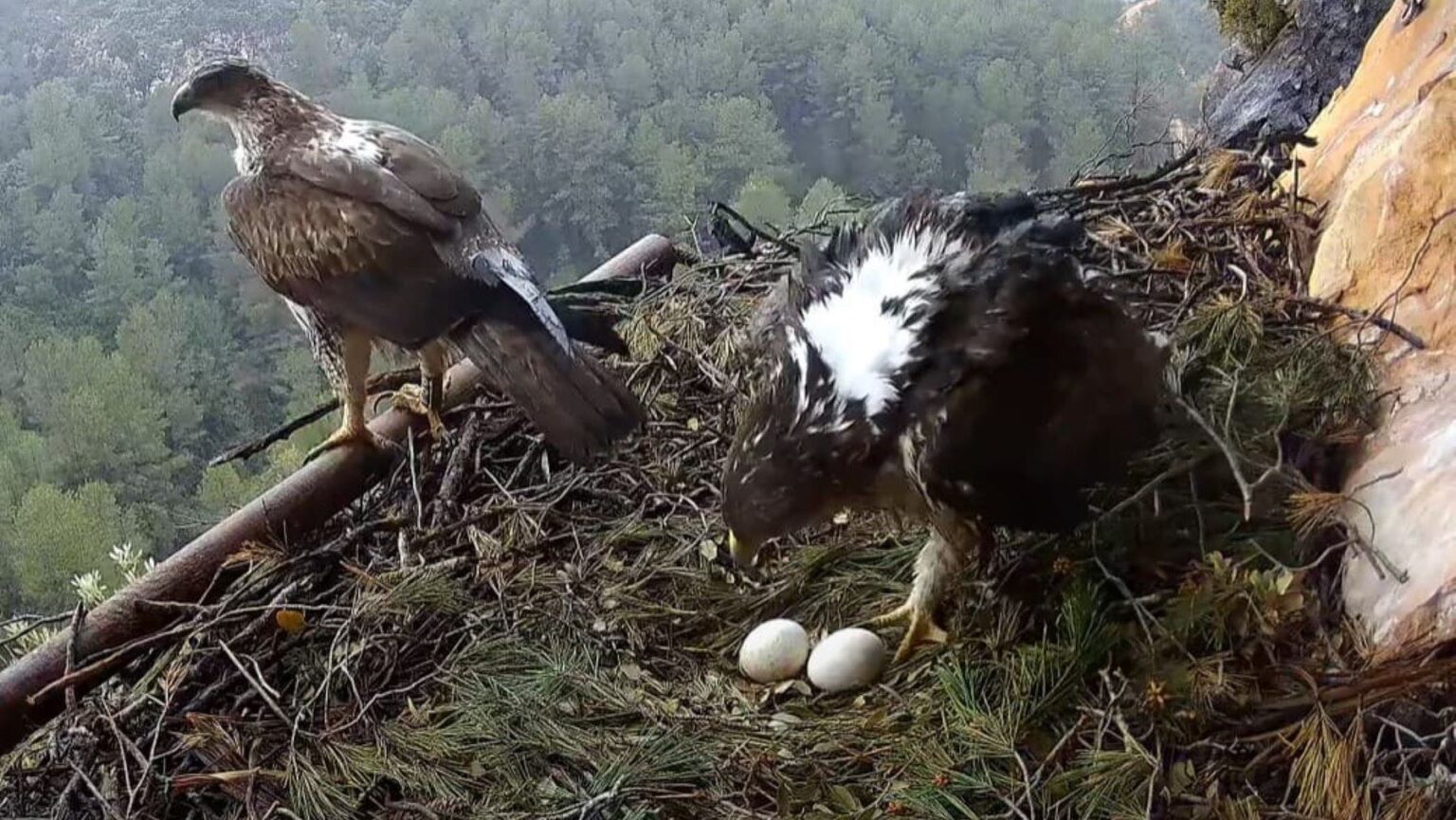
Environmental agents reconstruct nesting platforms on steep, hard-to-reach rock faces to foster the reproduction of the endangered Bonelli’s eagle in the Valencian Community.
Bonelli’s Eagle
The fire also destroyed sites where the next generation of Bonelli’s eagles could begin. In the Sierra de Espadán, the Generalitat has rebuilt two nests for these birds to support their breeding after the July fire.
The intervention restores two nests for this raptor, listed as endangered in the Valencian Community, according to information released by the regional administration.
The High-Altitude Intervention Group has worked at remote mountain locations, coordinated with the Wildlife Service and Natura 2000 Network.
Restoring these nests is a first step to maintain the breeding territories affected. The action helps to understand why restoring a burned space also requires addressing the specific needs of its fauna, in this case the Bonelli’s eagle.
Natural Park of the Sierra de Espadán hosts several Bonelli’s eagles
The High-Altitude Intervention Group of the Generalitat’s environmental agents, in coordination with the Wildlife Service and Natura 2000 Network, has rebuilt two nests of Bonelli’s eagle (Aquila fasciata) that were destroyed by the forest fire that last July burned part of the Sierra de Espadán Natural Park.
The aim of the intervention is to recover nesting platforms and promote the reproduction of this species, listed as endangered in the Valencian Community.
The restoration of these structures constitutes a first step to facilitate the continuity of reproduction in the territories affected by the fire and contribute to the conservation of their populations, the Generalitat stated in a press release.
The works began shortly after the fire on steep, inaccessible rocky faces, therefore requiring specialized vertical-work techniques in the natural environment.
The High-Altitude Intervention Group’s work allows direct action on these walls, where the terrain’s complexity makes it necessary to have specialized human and technical resources.
These interventions are part of conservation actions promoted by the Third Vice Presidency and the Department of Environment, Infrastructure, Territory and Recovery to support the recovery of the areas affected by the Vall d’Uixó wildfire, registered last July.
The reconstruction of the nests adds to the measures developed by the Generalitat to recover the areas affected by the Vall d’Uixó wildfire, which burned nearly 9,600 hectares in the Sierra de Espadán Natural Park.
The package of emergency works has a total investment of 4.2 million euros, allocated to forest recovery and pathways, the repair of roads CV-219 and CV-223, and measures to improve safety in spaces affected by the fire in the Espadán area.
Notes
Two rebuilt nests do not equal two pairs of Bonelli’s eagles. The intervention replaces nests destroyed by the fire, but the published information does not confirm occupancy or chick birth. The distinction is important: a reproductive resource has been recovered; verifying the outcome will require observing whether the birds return to use it and manage to rear offspring.
It is also advisable to interpret correctly the announced investment: the 4.2 million euros correspond to the total of the emergency works, which include forest recovery, pathways, the repair of roads CV-219 and CV-223 and safety improvements. The article does not detail how much it cost to rebuild the two nests. Distinguishing the two figures allows evaluating this intervention without attributing the entire recovery budget to it.
