
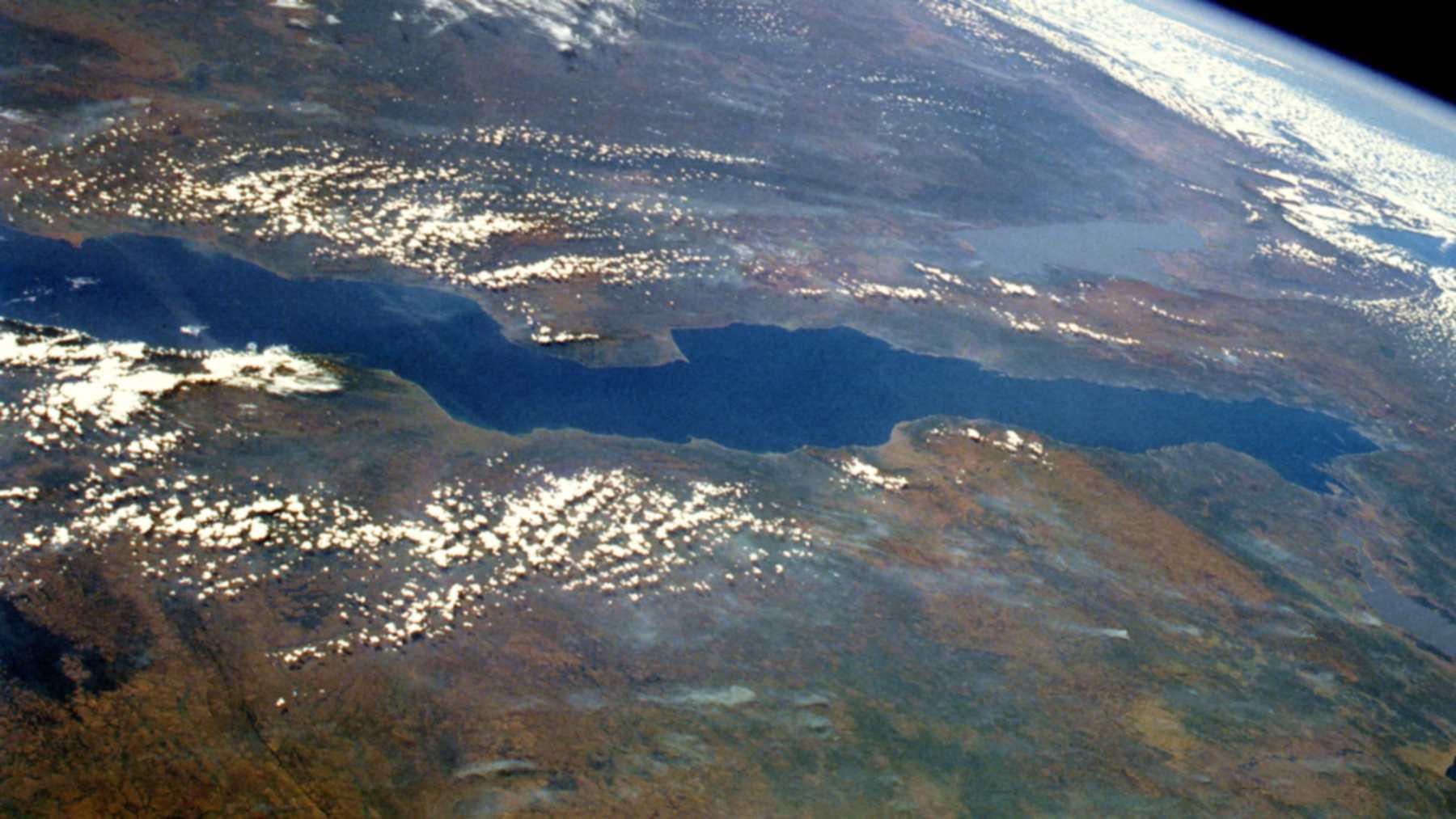
From the space shuttle, in June 1985, Lake Tanganyika appeared as a dark blue stripe hundreds of kilometers long, squeezed between the red soils of eastern Africa. That narrow band holds about 18,900 cubic kilometers of fresh water, around 83% of the combined total of North America’s five Great Lakes.
The Great Lakes figure comes from the United States Environmental Protection Agency (EPA), which estimates 22,684 cubic kilometers for Superior, Michigan–Huron, Erie, and Ontario together, measured with the water level at a lower baseline. The Tanganyika figure comes from a 2023 study, and the African Center for Aquatic Research and Education (ACARE) provides a very similar estimate, 18,980 cubic kilometers.
Between these two totals there remains a gap of about 3,800 cubic kilometers. Even so, a single African lake comes very close to the largest surface freshwater body in North America, and it does so at a moment when the planet is running down its freshwater reserves.
A Lot of Water in a Small Footprint
The five Great Lakes cover 244,160 square kilometers, according to the EPA. Tanganyika occupies about 32,900 square kilometers, i.e., roughly 13% of that surface area.
Lakes Superior, the largest of the five, spans 82,100 square kilometers and holds 12,100 cubic kilometers of water. Tanganyika contains about 56% more water than Superior yet uses only 40% of its surface area, and the smallest by volume of the five is Lake Erie, which contains barely 484 cubic kilometers.
Depth Explains the Volume
The difference lies in the bottom. Tanganyika reaches a maximum depth of 1,470 meters and an average depth of about 570 meters, according to a 2023 study by Kevin Sterckx, from the Department of Hydrology and Hydraulic Engineering at Vrije Universiteit Brussel, and five other researchers from Belgium, the Netherlands, New Zealand, and Switzerland.
Superior, the deepest of the Great Lakes, reaches 406 meters at its maximum depth and has an average depth of 147 meters, according to the EPA. The average depth of the African lake is therefore nearly four times greater.
ACARE describes it as the deepest lake in Africa, the second deepest in the world in terms of depth and in freshwater volume, behind Baikal in Siberia, and the longest freshwater lake on the planet. According to the 2023 study, it measures 673 kilometers in length (ACARE gives 676) and has an average width of 50 kilometers, spanning Burundi, the Democratic Republic of the Congo, Tanzania, and Zambia.
A Trench Opened Over Millions of Years
That bottle-like, narrow, and deep shape has tectonic origins. The lake sits in a trough of the western arm of the East African Rift, the region where the Earth’s crust stretches and fractures gradually.
Its three basins formed at different times. The central basin began to open between 9 and 12 million years ago, the northern between 7 and 8 million, and the southern between 2 and 4 million, according to Sterckx’s study.
A Lake That Never Fully Mixes
A large portion of that volume lies beyond the reach of fish. Tanganyika is meromictic, a term describing lakes whose layers never fully mix, and between 60% and 70% of its water is oxygen-poor, according to the 2023 study.
Most animal species live in the upper 100 meters, Brown University explained in 2010.
“Lake Tanganyika is a truly large lake, so large that the riverine input of nutrients is small relative to the demand from the algae that form the base of its food chain,” Jim Russell, then an associate professor of Earth, Environmental and Planetary Sciences at Brown University, explained in a 2016 interview published by his university.
“Instead, most of the nutrient supply comes from recycling the nutrients stored in the lake’s enormous mass of cold water at the bottom,” he added. In the dry and cool season, that bottom water rises and mixes with the surface, but that upwelling requires the surface water to be cold.
Warming Has Already Left a Mark
The sediments at the bottom record the history of that balance. In 2010, a Brown-led team reconstructed 1,500 years of lake temperature from sediment cores—clay cylinders extracted from the bed—and concluded that the 26°C measured on the surface in 2003 was the highest value of that entire period.
“Our data show a consistent relationship between the surface temperature of the lake and productivity (such as fish populations),” said Jessica Tierney, a Brown PhD and lead author of the Nature Geoscience study at the time. “As the lake warms, we expect productivity to decline, and we expect that to affect the fishery,” she added.
In 2016, Andrew Cohen, Distinguished Professor of Geosciences at the University of Arizona, published with his team in the Proceedings of the National Academy of Sciences that the oxygenated bottom of the lake—the habitat of snails and other organisms living on the bed—had shrunk by 38% since 1946.
“Warmer surface waters cause large portions of the lake floor to lose oxygen, which kills bottom-dwelling animals, such as freshwater snails,” Cohen explained in the University of Arizona’s press release.
Cohen also discussed a common explanation for the fisheries decline. “There are those who say that the Tanganyika fishing problem is ‘too many fishing boats,’ but our work shows that the decline in fish has been occurring since the 19th century,” he noted.
More Than 10 Million People Live in Its Basin
In the lake’s basin live more than 10 million people, according to the United Nations Environment Programme (UNEP). ACARE estimates that its fishing yields between 165,000 and 200,000 tons per year, provides work for about 100,000 people and covers between 25% and 40% of the protein needs of around one million inhabitants.
The lake also hosts around 2,000 species of fish, plants, crustaceans, and birds, and about 500 of them are not found anywhere else on Earth. Half of those exclusive species are cichlids, a family of fish highly diverse in these waters.
In June 2026, the Lake Tanganyika Authority (LTA) validated in Kigoma (Tanzania) an assessment of the lake’s three main open-water commercial species, conducted by the Tanzania Fisheries Research Institute (TAFIRI) at the 2025 dry-season station and the 2026 rainy-season one. The estimated mean biomass, i.e., the total weight of those fish in the lake, was 116,000 tons, 62% less than the 1998 assessment.
The four riparian countries launched in February 2025 a five-year, $14.5 million project funded by the Global Environment Facility to protect biodiversity and restore degraded lands. “With this transformative project we are taking concrete steps to reverse biodiversity loss, promote sustainable fishing and restore the lake’s health for current and future generations,” Sylvain Tusanga Mukanga, executive director of the LTA, said in the UNEP statement.
What the Figures Leave Open
Volumes are estimates and vary by source. The 2023 study gives 18,900 cubic kilometers and ACARE 18,980, and the portion of the world’s surface freshwater attributed to the lake ranges from 15% cited by Brown University to 16% in Sterckx’s study. The EPA figures for the Great Lakes are measured with the water level at low.
The 2026 fishery assessment also does not apportion the decline to specific causes, and the LTA’s press release does not detail how much weight to fishing versus climate. Cohen’s team acknowledged in 2016 that overfishing is one of the causes of the drop in catches.
What comes next will depend on emissions. In the most pessimistic scenario, known as RCP8.5, the lake’s surface would warm by an average of 3 ± 0.5 °C by the end of the century, and the mixing that ventilates the deep water of the southern basin would eventually stop, according to Sterckx and colleagues’ simulation. “Our results highlight the extreme changes that Lake Tanganyika is likely to face if global greenhouse gas emissions are not curbed,” the authors write.
The full study has been published in Environmental Fluid Mechanics.
“We know this warming is happening in other lakes,” Cohen said in 2016. “We believe Lake Tanganyika is an early indicator of this process.”
Photo: NASA
