
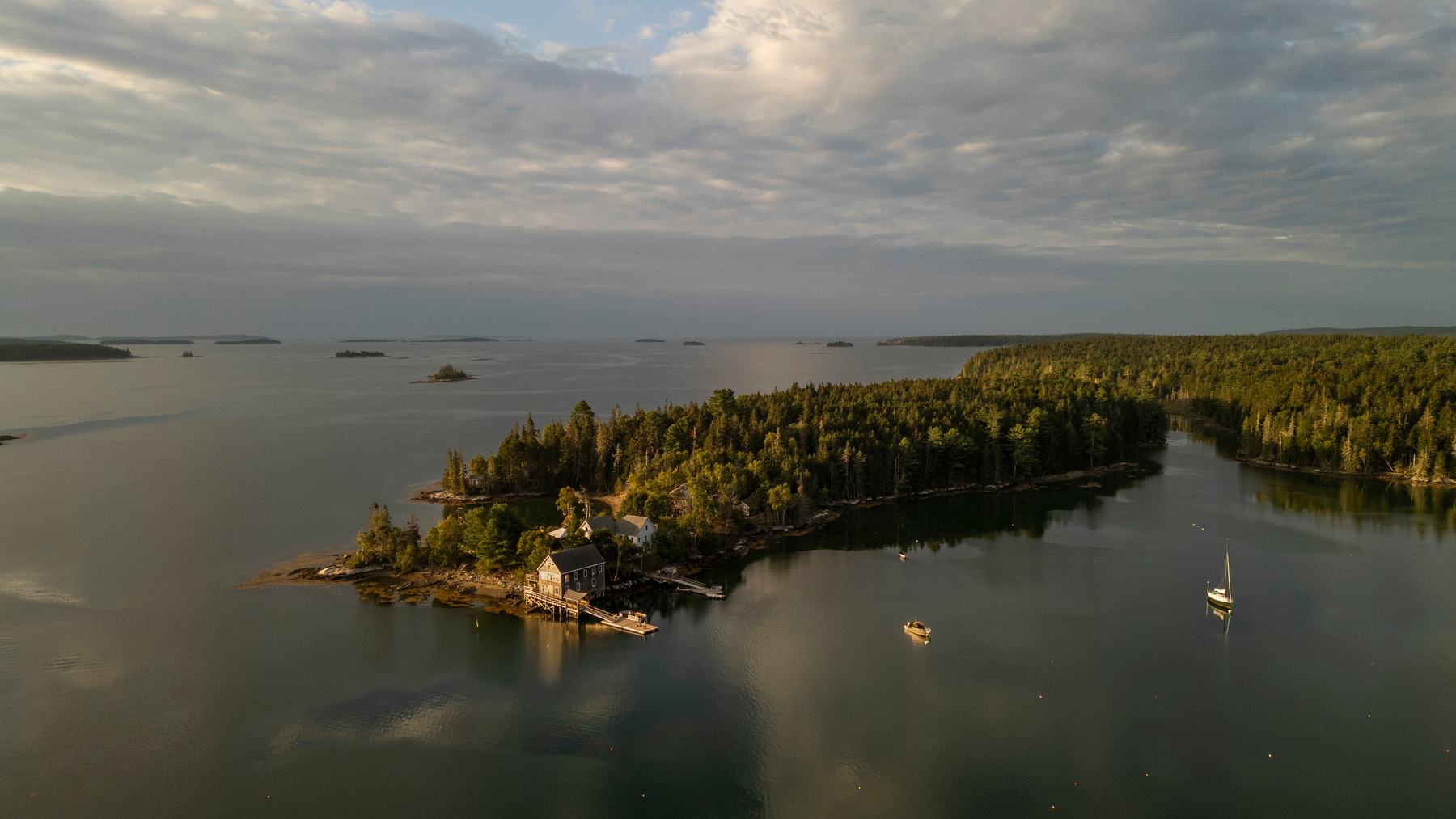
Anyone walking today through the spruce forest of Hog Island, facing the coast of Maine, occasionally encounters an old tree with unusually open branches that stands out among the others. Forest ecologists call it the “wolf tree,” and on this island it marks the footprint of pastures that farmers cleared for cattle, leaving a single tree to shade the flock.
Hog Island spans about 133 hectares (330 acres, according to the National Audubon Society) and sits in Muscongus Bay. Between August 20 and 23, 2026, more than 200 people—including workers, former participants, and volunteers—gathered there to celebrate the 90th anniversary of Hog Island Audubon Camp, the first environmental education camp run by Audubon.
A Purchase to Stop the Logging
The story begins in the summer of 1908, when David Todd, a professor of Astronomy at Amherst College, and his wife, Mabel Loomis Todd, visited the island during a trip along the Maine coast. According to Friends of Hog Island, Mabel was “horrified by the haphazard logging” she saw and resolved to save the island by taking the first steps toward buying it.
Mabel Loomis Todd was a writer and the first editor of Emily Dickinson’s poetry. The Todds bought a portion of the island and built there a small cluster of houses for summer stays, according to the story published by Audubon on its artist-in-residence program page.
When Mabel died in 1932, her daughter, the geographer Millicent Todd Bingham, took ownership of the remainder of the island. Friends of Hog Island preserves some of her words about the place: “When I walked through the forest and listened to the thrushes, the cry of the osprey circling overhead or the hoot of the great horned owl at night, I could never feel that I owned a place like this. It seemed, rather, to belong to all who appreciated it and wished to preserve it for others who would appreciate it in the years to come.”
The Deal with Audubon in 1935
Millicent spent the years of the Great Depression looking for someone to help her safeguard the island. She found him in 1935 in John H. Baker, who had just been placed at the head of the National Association of Audubon Societies, the precursor to the National Audubon Society.
According to the origin story published by Friends of Hog Island, Bingham offered to purchase 33 acres (about 13 hectares) at the island’s northern end, and Baker replied, “Exactly what I wanted.” He was seeking a site to train teachers and youth leaders in field ecology so that they could bring that approach back to their communities.
The camp opened in June 1936 with Carl Buchheister, a young Latin teacher, as its first director. Roger Tory Peterson was its first bird instructor.
Teachers Who Return to Their Classrooms
The aim was to train those who teach, so that what was learned on Hog Island would reach many more students in turn. “By focusing Hog Island’s programming on educators, who are often our most passionate ambassadors of conservation, we have been able to multiply our impact exponentially,” explained Judy Braus in 2011, then vice president of Education at Audubon.
Friends of Hog Island estimated in 2006 that more than 20,000 teachers had passed through the camp, and its origin chronicle puts the number of adults and young people who visited in its first 60 years at more than 50,000. According to Audubon, Rachel Carson described her visit to the island in Silent Spring.
It is the same conviction that leads UNESCO to defend that environmental education is the best defense of the planet.
Eastern Egg Rock Puffins
The link between the camp and research has a name. Stephen Kress was working as a summer educator on Hog Island while pursuing a graduate degree in Ornithology at Cornell University, and in the camp’s library he read that Atlantic puffins had bred on Eastern and Western Egg Rock, two islets within 16 kilometers of the coast.
Decades of hunting had decimated all Maine colonies except Matinicus Rock. In 1973 Kress obtained permission from David Nettleship, a biologist with the Canadian Wildlife Service responsible for permits, to move chicks from Newfoundland. “To my surprise, David said, ‘Okay, we’ll accept this risky idea. You may move six puffins, no more than six, from Newfoundland,’” Kress recalled in the oral history published by Audubon in 2023.
“We began rearing puffins along Hog Island’s shore, in small cement caves,” Kress said. By the summer of 1981 the team had raised about 630 chicks, but the only one to return to breed did so on Matinicus Rock. On July 4 of that year came the signal they had been waiting for: “Looking through a telescope from the cabin, I saw a puffin arrive flying with fish, dive under the rocks, and come out without them. That was the proof we were waiting for.”
The method is known as social attraction, and it consists of convincing the birds that an island is already occupied by their species. “Social attraction is the greatest contribution we have made to the conservation of seabirds. It is essentially the same recipe each time: decoys, sound recordings, and habitat management,” summarized Kress.
According to Audubon, in 2023 there were about 1,300 breeding puffin pairs across five Maine islands, and the Puffin Project techniques have been used in seabird colonies around the world, in the same vein as other efforts to restore seabirds to islands from which they had disappeared.
A Closure and a Second Chance
In 2000, the National Audubon Society handed the camp’s management to Maine Audubon, which even closed it for the summer of 2009. “Suddenly we had to figure out how to run a summer camp. It was hard to keep the doors open. We had to close a year to stop losing money,” Alexander “Sandy” Buck, a member of the Maine Audubon board and of the youth camp Kieve-Wavus, told the Portland Press Herald in 2012.
Kress, who had been working on the island since 1969, returned to offer ornithology programs in 2010 under the Puffin Project. “The summer it closed was a very, very sad summer. But we started with four programs in 2010 and this year we are up to nine. It’s working,” Pete Salmansohn, a camp instructor since 1980, told the same newspaper.
In 2010 the Friends of Hog Island association was re-founded. According to its own accounts, since 2011 it contributes at least $50,000 per year and an average of 7,000 volunteer hours each summer, mainly helping to prepare, serve, and clear away camp meals, and it has funded improvements to its buildings. The COVID-19 pandemic forced a new temporary closure in 2020.
Ninety Years Looking Toward the Next Decade
During the anniversary, on August 21, in the building known as Fish House, Audubon’s Director of Conservation Marshall Johnson and instructors Maggie Dewane and Anthony Hill discussed what the camp may accomplish in the next ten years.
The island also hosts an artist residency program, which began informally in 2014. Artists stay in the Bingham cabins, the former Todd family summer home, which Friends of Hog Island began restoring in 2012, and Audubon prefers participants who help appreciate the nature, culture, or history of Maine’s coast.
What the Anniversary Does Not Resolve
The Gulf of Maine is warming faster than 99% of the world’s oceans, according to Audubon, and that trend pushes away the small fish on which puffins feed their chicks. In 2021, the number of puffin chicks that fledged dropped by half, partly because parents delivered too-wide herring for their youngsters to swallow.
In 2022 the colonies recovered, but Dallas Jordan, supervisor of the Pond Island colony, warned that “we have entered a cycle in which the birds can no longer count on anything.” Atlantic storms also take a toll on these birds, as evidenced by mass puffin deaths after several nor’easters.
Even the sources of the history do not always agree. Audubon speaks of 330 acres on some pages and 300 or 335 on others, and the chronicles differ on whether Bingham sold Audubon 33 acres on the island’s north or gifted the entire island. It is not virgin forest either, since European settlers cleared land for farms starting in the late 17th century.
The official anniversary chronicle appeared on the Audubon Seabird Institute website on August 28, 2026.
The island is part of the Todd Wildlife Sanctuary, and the public may walk its nearly 9.7 kilometers of trails, though there is no public ramp to launch boats in the mainland portion of the sanctuary.
Photo: Sydney Walsh / Audubon
