
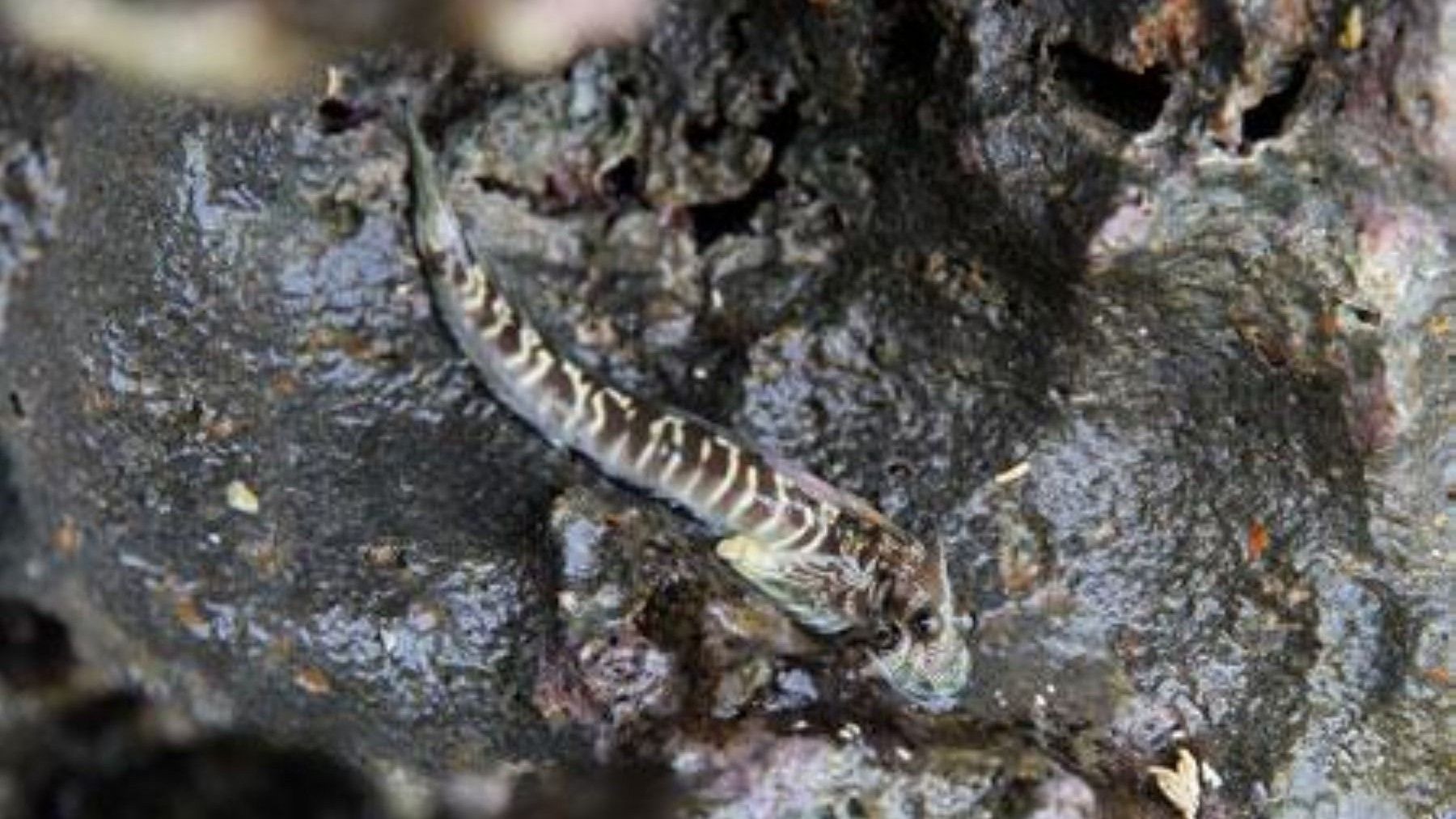
A study involving the participation of the MNCN-CSIC compared three species of fish that inhabit Guam and found a microbiome significantly more differentiated in the terrestrial fish. The presence of cyanobacteria raises new questions regarding their sun protection and respiration.
Not all the fish live in water; some roam freely among the rocks and, being so peculiar, they are still being studied. A new theory points to the possibility that the key to their adaptation and survival could lie in their skin and the microorganisms that cover it.
Three evolutionarily related fish species were studied, and among the terrestrial ones distinctive microbiomes were found on the skin surface, which could explain why they are able to live outside of water. The research included collaboration with the Museo Nacional de Ciencias Naturales and was published in FEMS Microbiology Letters.
It was found that the microbiome of terrestrial fish contains cyanobacteria, prompting experts to consider whether these could be responsible for supplying the oxygen needed for respiration or if they protect them from solar radiation.
The research is still in development and has opened several fronts. It is not yet known if cyanobacteria are truly responsible for the actions scientists suspect and, furthermore, these bacteria must be identified (there are more than 27) to determine what functions they promote and what role they play in the adaptation of terrestrial fish.
The Mysteries of Terrestrial Fish
“How did life transition from the oceans to terrestrial colonization? Did microorganisms play a role in that terrestrialization process? These are some of the questions the research team from the National Museum of Natural Sciences (MNCN-CSIC) is trying to answer in their latest work recently published in FEMS Microbiology Letters.”
In it, they suggest that the microbial communities living on the animals (the microbiome) could have been relevant in the process of colonizing the terrestrial environment.
Specifically, they analyzed the skin microbiomes of some very special fish that lead amphibious lives, revealing an unexpected pattern: the skin bacterial communities of the fish differ from the rock communities where they dwell, and this divergence neatly mirrors the preferences of the various fish species for increasingly terrestrial habitats.
To reach this hypothesis, the team used genetic methods of high-throughput sequencing of bacterial barcodes, which, when compared with a reference database, allow estimating the composition of bacterial species on the skin of each fish species, as well as on the rocks they inhabit or the surrounding seawater.
Three closely related species from the blenny family that share a Guam beach, in the Mariana Islands archipelago in the Pacific, were compared.
The blue-spotted blenny, Blenniella caudolineta, is entirely aquatic and lives completely underwater, the crenulated-lip rock jumper, Praealticus labrovitattus, is an amphibious species with a preference for intertidal pools (the band between low and high tide) and sometimes is found outside water.
Finally, the Pacific jumping blenny, Alticus arnoldorum, is considered a terrestrial fish species, since it lives on coastal rocks above the waterline for most of its adult life.
Microbes that allow them to live on land?
“Our results indicate that, while the microbial communities found on the rocks where the three species live are quite similar to each other, the microbiome differs among the fish species. To be precise, the skin microbiome of the aquatic fish is very similar to that of the rocks on which it lives; the amphibious fish microbiome diverges notably from that of the rocks; and the most pronounced divergence occurs in the Pacific rock jumper, the terrestrial blenny species,” explains MNCN researcher Iker Irisarri.
“One of the surprising results was finding a greater prevalence of photosynthetic bacteria (cyanobacteria) on the skin of the terrestrial rock jumper. We believe that cyanobacteria, which like plants use sunlight to generate their own food and, in the process, release oxygen into the atmosphere, could be benefiting the jumper. It is possible that the oxygen released by cyanobacteria helps with cutaneous respiration or that these bacteria produce certain compounds that protect terrestrial fish from the sun, although at the moment these are only speculations that need to be tested,” he continues.
This new study suggests that habitat-specific selective pressures along the intertidal gradient defined by the high and low tides may be shaping the skin microbiomes of the fish that inhabit it. These data hint that the microbiome could contribute to ecological and physiological adaptations that enable amphibious and terrestrial life in these very special fish.
“The hypothesis we are pursuing is that the microbial communities could have been very relevant in the evolutionary leap from aquatic to terrestrial life, but it is necessary to continue experimenting and gathering genomic data to determine whether there really exists a beneficial symbiotic relationship between bacteria and terrestrial fish that has allowed them to adapt better,” concludes Irisarri.
