
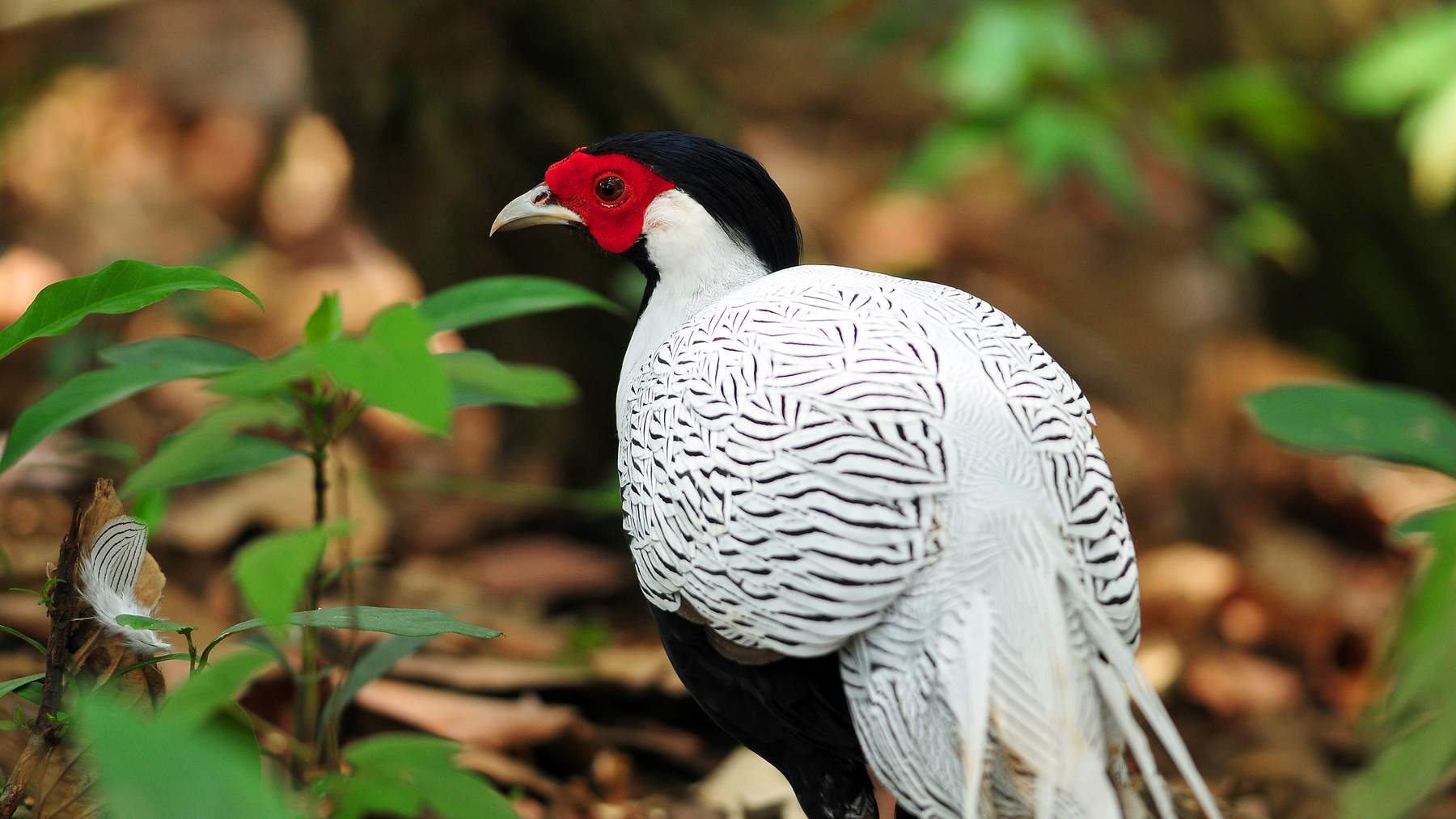
The silver pheasant, a bird native to Southeast Asia, now occupies the entire Victoria Island in Nahuel Huapi National Park (Patagonia, Argentina). According to the principal study, it arrived in the 1950s. A team from CONICET and the National University of Comahue measured it between 2011 and 2013. They calculated 5.69 pheasants per hectare near the port, in the most disturbed areas, and 1.77 in the better-preserved ones.
A second study by the same team analyzed its droppings. The pheasant disperses more exotic seeds than native birds in proportional terms. Additionally, it promotes the germination of an invasive plant.
An island full of species introduced from outside
Victoria Island covers 31 square kilometers and sits in the middle of Lake Nahuel Huapi, at an altitude of 770 meters. Its native forests are made up of coihue and cordilleran cypress, with colihue reed, michay and maqui.
Between 1903 and 1911, Aarón Anchorena used the island as a residence and brought exotic plants and animals. This is described by Gabriela Klier, from the National University of Río Negro, and Maia Gattás Vargas in the journal Bosque (2022). According to them, the National Nursery of 1925 aimed to turn Patagonia into an «Argentine Switzerland.»
The pheasant study adds other data. On the island were planted at least 73 conifer species and 62 broadleaf tree species. Three deer species and at least six pheasant species were released.
Only the red deer, the fallow deer, and the silver pheasant thrived. The latter arrived after the Anchorena period. The 2017 study places its introduction in the 1950s, in several releases over a number of years.
Camera traps and on-foot surveys
The study was authored by Valeria L. Martin-Albarracín, Guillermo C. Amico and Martín A. Núñez, from INIBIOMA in Bariloche. They published it in December 2017 in El Hornero, the journal of Aves Argentinas.
They marked ten 500-meter transects. Four were in highly altered zones and six in less altered zones. Eight motion-activated cameras recorded from June 2011 to May 2012, totaling 1,253 camera-days.
Additionally, the researchers walked the transects on foot between January and March 2012 and 2013.
The altered zone surrounds Anchorena Port. It features conifer and eucalyptus plantations, invaded scrublands, and nine resident individuals. Each day, visitors arrive ranging from dozens to a thousand.
Three times as many pheasants near the port
The cameras registered 710 independent sightings of eight species. 99.7% of them were exotic. The silver pheasant accounted for 222, second only to the deer, and the chucao was the only native bird, with a single sighting.
On foot, the team detected 33 groups of pheasants. The density was three times higher in the altered zones. Even the lowest figure far exceeds the 0.15 birds per hectare recorded in its native range.
The authors attribute this to the lack of predators and of competing pheasants. The puma and the red fox live on the lake’s shore, but not on the island. In their conclusions they speak of «a great success on Victoria Island».
The groups ranged from one to six individuals, sometimes up to twelve. The usual pattern was a female with one to three males. In Asia the situation is the opposite. The cameras also recorded aggressive clashes with a chimango and with a bandurria.
Seeds traveling in the droppings
In 2018, the same team published another study in Biodiversity and Conservation. They collected fresh droppings from the pheasant and from the two native birds that disperse the most seeds in these forests.
They then germinated seeds from four plants. Two were native, maqui and Rhaphithamnus spinosus. The other two were invasive, blackberry and rosa mosqueta.
The native birds moved mainly native seeds and helped germinate the two native species. The pheasant moved many exotic seeds and improved the germination of one invasive species. According to the abstract, its role «may contribute to the expansion of some fleshy-fruited invasive plants.»
A 2025 study already showed that introducing species alters seed dispersal on islands more than extinctions. In Hawaii, another team is testing releasing insects with drones against the invasive strawberry guava.
An invasive species under controlled use
The Ministry of Environment and Sustainable Development signed Resolution 109/2021 on April 12, 2021. Its Annex I lists the country’s invasive exotic species. In the Phasianidae family appears Lophura nycthemera, with a 2 next to it.
That 2 marks the «controlled use» category. Article 2 reserves it for species with some productive use, which the authority maintains “despite the associated risk.” No article orders removing the pheasants from Victoria Island.
The island’s nursery is currently in a new phase. On October 18, 2024, Mayor Dámaso Larraburu attended the centennial celebration of the Victoria Island Forestry Nursery. Studies date the nursery to 1925. The park’s note does not specify which year marks the centenary.
There, Camilo Bagnato, a forestry engineer and head of the Forest Area, spoke. He outlined four work axes. Two are environmental education and native plants to restore degraded ecosystems. The others are seeds for a future germplasm bank and research with CONICET and universities.
FAO advocates the same approach for restoring degraded forests. The results take time: in England, a forest planted 25 years ago still does not have the soil of an ancient one.
What is still unknown
The figures of 5.69 and 1.77 pheasants per hectare come from ten transects walked between 2011 and 2013. No one has published since how many pheasants remain on the island.
The 2018 trial measured how many seeds from the droppings germinated. It did not follow the new plants in the forest. With the chucao, something similar happened: the cameras captured it only once. The 2017 study leaves as a hypothesis that the pheasant competes with it or transmits diseases.
Foto: Emaruchi / Wikimedia Commons (CC BY-SA 4.0)
