
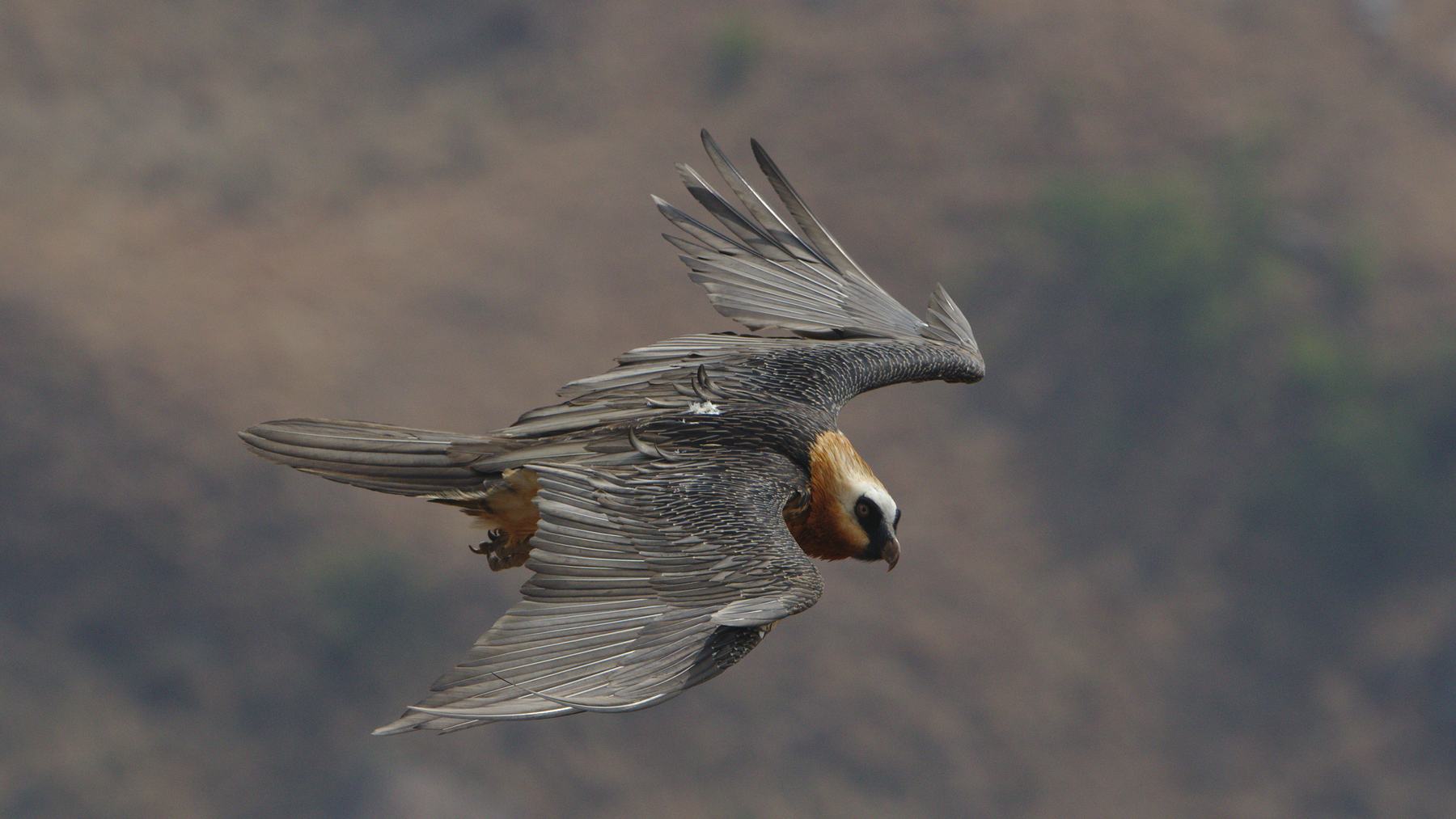
Approximately 334 bearded vultures survive in the mountains of South Africa and Lesotho, with only around 209 adults, according to a 2022 analysis that underpins BirdLife South Africa’s 2025 regional assessment. To stem the southern Africa bearded vulture’s decline, the Bred 4 the Wild program breeds birds in captivity with the aim of rearing at least 32.
That minimum comes from the same population viability analysis that the IUCN released in 2022. Its models estimate that, if no further actions are taken, about 62 birds would remain in the wild by 2072—fifty years from now.
An isolated population in the Drakensberg
The southern bearded vulture belongs to the subspecies Gypaetus barbatus meridionalis. It lives separated from its closest relatives, which are in Ethiopia.
BirdLife South Africa classifies it as “critically endangered” in the region. Globally, by contrast, it is listed as near threatened.
Today it breeds only in the highlands of Lesotho and along the Drakensberg escarpment. It forages on alpine meadows above 1,500 meters and has lost almost 40% of its historic range.
Counts show the collapse. In 1991 there were an estimated 204 breeding pairs, 122 in Lesotho and 82 in South Africa. BirdLife calculates a decline of 82.8% over three generations.
What the 2022 model says
The Bearded Vulture Breeding Programme and Ezemvelo KZN Wildlife commissioned the analysis. Among its authors are Ezemvelo ecologist Sonja Krüger and the breeding lead, Shannon Hoffman.
Its final statement sums it up this way: “It is a desperate situation.” Adults have an annual survival rate of 90% and reproductive productivity sits at 46%.
To turn this around, the model calls for preventing about six deaths per year. That implies reducing mortality by 15% across all ages. It also requires increasing productivity in the wild by 5% annually, with the goal of reaching 150 breeding pairs by 2070.
The second egg that never gets to fly
Bearded vultures breed in mid-winter, in shaggy-stick nests tucked inside cliff hollows. Pairs typically lay two eggs, but only one chick is raised.
According to the Swiss foundation Pro Bartgeier, the second chick rarely survives the early days. That spare egg is the one that captive rearing takes advantage of.
“We have successfully raised seven chicks from eggs removed from wild nests,” Krüger explained to the University of Cape Town in June 2020. According to the ecologist, such removals did not affect the wild population.
The 2022 analysis set the pace: six eggs per year for three years. After that, between two and four eggs every four years would suffice.
With 32 birds, the captive group would retain more than 90% of the wild genetic diversity. If wild productivity does not improve, the figure rises to 42.
Years of waiting before the first breeding
The report located the breeding center at the African Bird of Prey Sanctuary, in Lynfield Park (KwaZulu-Natal). By 2022, no chick had yet hatched in captivity in southern Africa.
The authors added that the site felt warm for the birds. Hence they sought a second, cooler center within the species’ range.
The delay has a biological explanation. Pro Bartgeier notes that the bearded vulture matures between ages 5 and 7, but on average does not breed successfully until 8 or 9 years old.
The plan anticipated starting releases around 2026. In Europe, reintroductions have already returned the bird to ranges where it had disappeared, as evidenced by Cardaor’s birth in Albacete.
Poison, lead and power lines
Adults continue to die outside the conservation center, and that is where a large share of the plan hinges. In the studies by Sonja Krüger and Arjun Amar, 42% of 21 bearded vultures with transmitters—about nine individuals—died from poison or lead exposure.
Often the bait targeted jackals, and the vulture fed later on the carcass. Deaths from encounters with power lines add to the toll, and BirdLife believes many more deaths go unrecorded because the terrain is so remote that finding carcasses is difficult.
In Lesotho, roads opened around the Katse and Mohale dams have brought people into previously empty areas. The report also notes birds captured in Lesotho, likely for the traditional-use trade.
The 2022 assessment sets 2027 as the deadline. If by then the issues of poison and power lines remain uncontrolled, the working group will have to study other release sites.
A 2020 UCT study already proposed five zones in the Eastern and Western Cape. Its supervisor, Associate Professor Arjun Amar, argued that a new population could act as a “policy insurance against extinction.”
Money from the mountain
Thirty runners set off in September 2026 toward the Drakensberg, braving cold, rain and wind, and a swollen river forced them to switch peaks. According to the Endangered Wildlife Trust, that Rhino Peak Challenge raised 1.2 million rand for the Bearded Vulture Recovery Programme, Wildlife ACT, and the EWT itself.
The same event funded the 2022 in-person viability workshop. And every first Saturday in September, a census of bearded vultures is held in conjunction with World Vulture Awareness Day.
What remains unknown
Population figures come from the 2022 analysis based on known nests. They are not a current census for this year.
The report itself warns that mortality rates come from a small number of birds tracked for a limited time. There is also no official, recent tally of how many birds the program currently retains or whether any pair has already bred.
The full viability analysis report has been published in the Conservation Planning Specialist Group of the IUCN.
BirdLife South Africa’s entry also includes the bilateral recovery strategy, with 10 objectives and 127 actions.
Photo: Derek Keats / Wikimedia Commons, CC BY 2.0
