
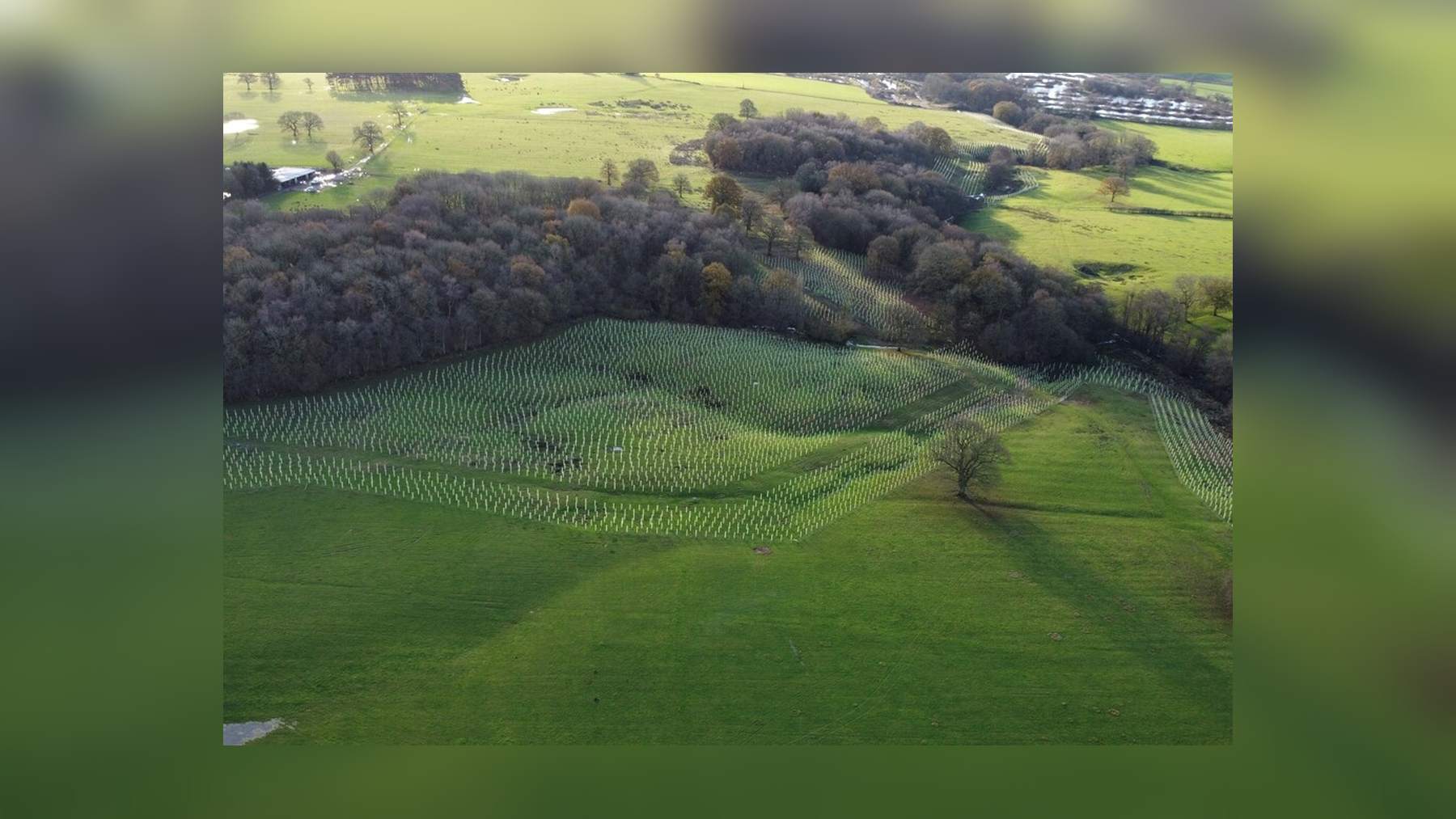
Jonathan Capener inherited Racecourse Farm from his father in 2023, a 196-hectare farm located in Newcastle-under-Lyme, Staffordshire, England. In 2024 he planted 23,015 native trees spread across 12.26 hectares. His objective is to reconnect the woods that the estate lost or fragmented during the past century. The Forestry Commission, the British government’s forestry authority, published the case on March 17, 2026.
The mixture includes oaks, field maples, hazel trees, and wild pines, and it was funded by the England Woodland Creation Offer (EWCO), the English public aid to create new forests. It forms part of a broader plan that adds restored ponds, small permeable dams, and 1,500 meters of new hedges.
A forest split by hunting
The farm derives its name from a racetrack that operated on these grounds in the early part of the 20th century, and in recent decades it has been mostly devoted to hunting. According to the case published by the Forestry Commission, the woods were cut apart to create clearer shooting lines.
Capener intends to turn those scattered patches into a continuous, well-managed forest. “This work is helping to restore the forest to what it could have looked like in my grandfather’s days,” he explained.
Oxhay Wood, felled in the forties
The project focuses on two woods on the estate: Bentilee Wood will reclaim its historical boundaries, and Oxhay Wood, a 6.7-hectare area felled in the 1940s, had never been replanted until now.
The new plots were planted adjacent to the existing woods to create wildlife corridors, and the Forestry Commission says that this will allow species to move freely across the landscape for the first time in generations. It is a small-scale step within the broader effort to restore degraded forests.
Forest Research, the UK forestry research institute, explains in a 2025 briefing that expanding an existing forest speeds the arrival of species from the mature forest. For many plants and fungi that disperse slowly, proximity greatly influences their ability to colonize the new area.
Soil, climate and badger havens
To choose the species, the team used Forest Research’s Ecological Site Classification tool, which cross-references soil, climate, and drainage of each plot with what each tree needs. In this case, climate-change projections through 2080 were also taken into account.
According to the Forestry Commission, the site presented its own challenges, including archaeological remains, active badger setts, buried gas pipelines, and a small herd of deer living on the estate. Where fences could not be erected, each young tree carries its own protector, and in fenced areas other smaller tubes deter rabbits, so wildlife continues to use the property.
Eleven weeks of processing
The aid arrived via the EWCO fast track, which, for low-sensitivity land, promises a response within 12 weeks, and at Racecourse Farm the entire process took 11, just in time to plant in the same year as the application. Simon Smith, a forester with Robinson Forestry Ltd, processed the application with Capener and notes that the swift response from the forestry officer allowed them to “plan and plant without losing a season.” The project also secured extra funds for its water benefits, flood risk reduction, nature, and neighbor access.
Kestrels over the tall grass
The Forestry Commission describes early promising signs: from the planting, kestrels and harriers can be seen hunting across the farm, and the taller grass has drawn in a population of voles. The planted alders are growing well and already host alder beetles, which in turn provide food for birds.
Capener has reserved the poorer-quality land for the forest. “It allows me to focus on improving the rest of the pastures,” he said. He also estimates that the woods will retain about 3,500 tonnes of carbon in the next century, which he intends to use to offset the carbon footprint of his other business.
Part of the trees were planted along the estate’s streams, and the Forestry Commission hopes they will curb erosion and reduce flooding.
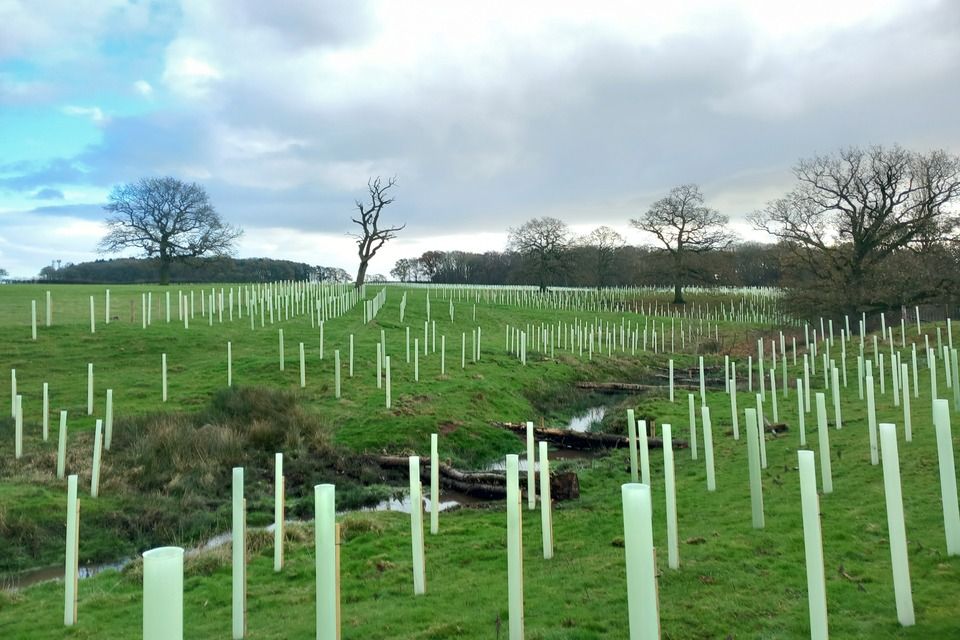
Woods and Water reminds that water infiltrates 60 times more slowly under grass than under a forest, and that roots help hold riverbanks in place. England applies the same logic in streets, parks, and fields, where as many as 500,000 trees will be planted to combat heat and floods.
Flooding and species, with no measurements
The Forestry Commission case does not indicate how much flood risk has decreased on the estate, nor how many new species have arrived, and birds and voles are early observations, not a scientific follow-up. Neither the total cost nor the amount of aid has been published.
Forest Research warns that the benefits of a new forest can take years to materialize. Elsewhere in England, a forest planted 25 years ago on farmland still showed soils, plants, and fungi distinct from those of the neighboring old forest.
The Forestry Commission advises other landowners to consider a 15-year plan, and the forester is already drafting a management plan for Racecourse Farm, where planting covers a little over 6% of its 196 hectares.
Photo: Robinson Forestry Ltd / Forestry Commission
