
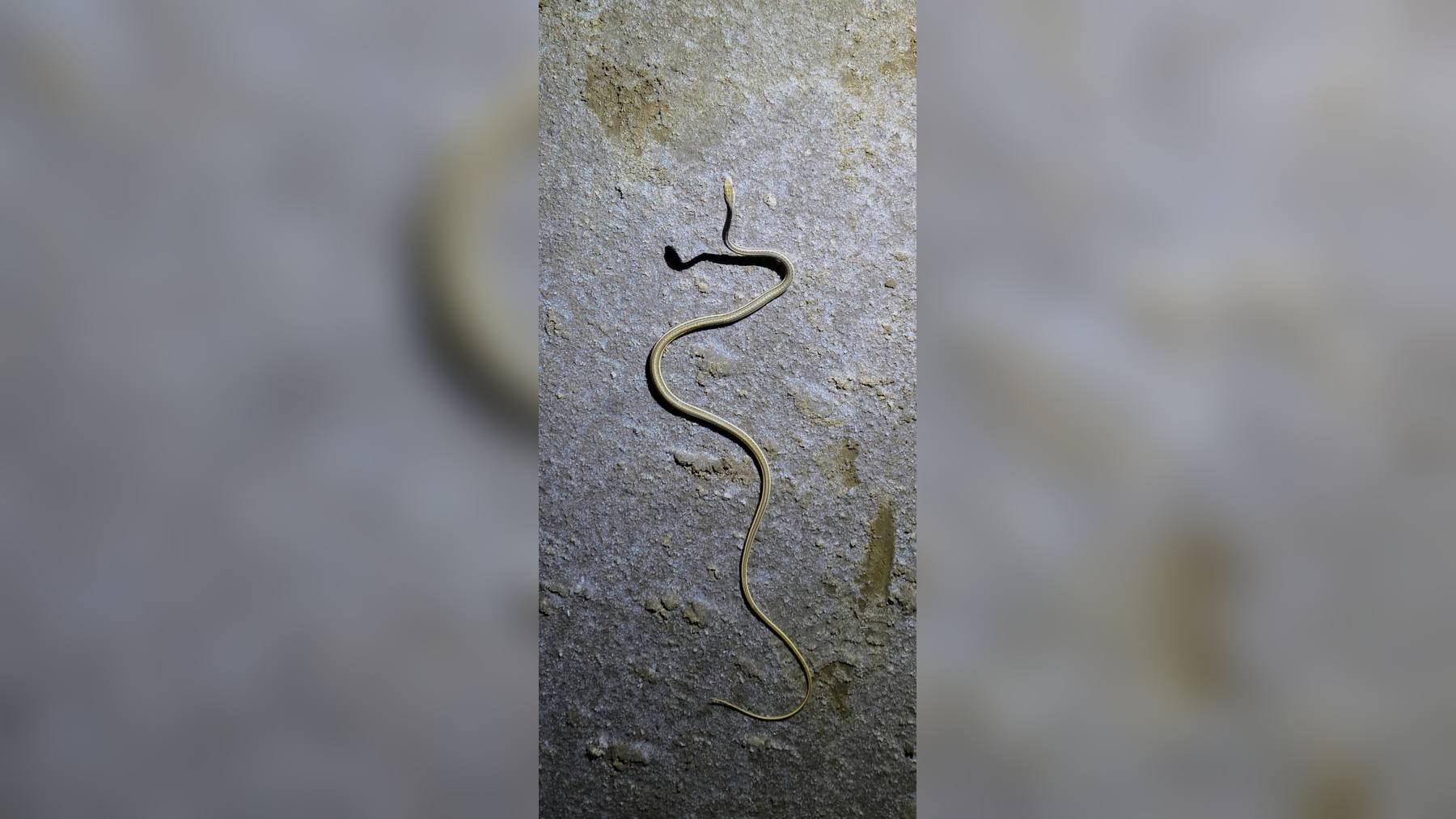
The Gujarat Forest Department, in western India, has documented an Afro-Asian sand snake (Psammophis schokari) in Kutch. It was photographed by forest officer Jayesh Dumania from the Bhuj North division. According to the latest scientific review, published in 2019, the state’s only record previously published was from 1872, 154 years ago.
The department announced it on September 21 on its official X account with the title “Rediscovery of the Schokari Sand Snake” and two nocturnal photographs taken on sandy and earthy ground.
Stoliczka y el Psammophis sindanus
That initial record was authored by naturalist Ferdinand Stoliczka (1838-1874), who traversed Kutch between 1871 and 1872 to study its fauna and collected several sand snakes. With them he described in 1872, in a publication of the Asiatic Society of Bengal, a new species, Psammophis sindanus.
Later, zoologists realized that it was the same species Forsskål had described in 1775 as Psammophis schokari. For the forest department, Dumania’s photograph is “a centennial record” and it brings Gujarat’s reptiles back into the conversation.
Patel, Vyas y 107 especies
When herpetologists Harshil Patel and Raju Vyas reviewed Gujarat’s reptiles in 2019, they settled on 107 species. Another 23 appeared in books and papers without reliable evidence, and they requested their removal from the list. The Afro-Asian sand snake was excluded because, according to the review published in Herpetology Notes, Stoliczka’s record remained “the only” record for the state.
The authors considered the habitat of Kutch and northern Gujarat suitable, but called for a fresh specimen to confirm that the species still occurred there, and the Bhuj North photos now provide official proof of its presence.
In India’s official list of reptiles, published by the Zoological Survey of India (ZSI) in July 2024, it is listed as one of four Psammophis species in the country. The list totals 778 species and subspecies, 6.33% of the roughly 12,134 known worldwide as of the end of 2023.
Kutch had already delivered other surprises with reptiles, because in a mine in the region the remains of Vasuki indicus, a fossil snake, were found—measuring up to 15 meters in length.
Serpiente látigo de cuerpo fino
Outside India, this snake inhabits North Africa and the southwestern part of Asia, and within the country inventories place it in the northwest, for instance in the Thar Desert in Rajasthan. In English it is called the whip snake, and the department’s photograph shows a very slender body with light bands running along its back.
Amanda Cottone and Aaron Bauer studied 226 museum specimens for a paper published in Amphibia-Reptilia in 2009. According to their data, it has a varied diet, but “feeds mainly on lizards,” mates toward the end of the monsoon season, and lays few eggs.
Mordisco con tres meses de secuelas
This snake does not have fangs at the front of its mouth, and its bites are rare and less well documented than those of vipers such as the green viper that bit a researcher in Chengdu.
In 2020, herpetologist Ivan Ineich, from the National Museum of Natural History in Paris, described in the journal Toxicon how a one-meter specimen bit a 59-year-old man on a finger and took a long time to release it. The area swelled gradually, the pain persisted, and it took nearly three months to recover, which the authors presented as the first described case of local envenomation by this species.
Censo y artículo científico, pendientes
With a single photo, it is not possible to know how many snakes inhabit Kutch, nor whether they are more or less numerous than before. It also does not prove that the species left the area, as perhaps no one was looking for it. The 154 years separate Stoliczka’s record from the 2026 photo, not a proven interval without sightings.
Patel and Vyas only took published material into account, and the department itself speaks of a rediscovery but does not state that it is the first since 1872. There is even news of an earlier photo in Lodai, also in Kutch, which expert Ajay Desai included in a book with no published date.
No one has yet authored a scientific article on Bhuj North’s snake. Much reptile data arise from casual encounters, such as the king cobra nest discovered by mushroom foragers in Nepal, but they count when other experts review them, as happened with the snake that a 17-year-old student helped describe in the Kuocang mountains.
Photo: Jayesh Dumania / Gujarat Forest Department
