
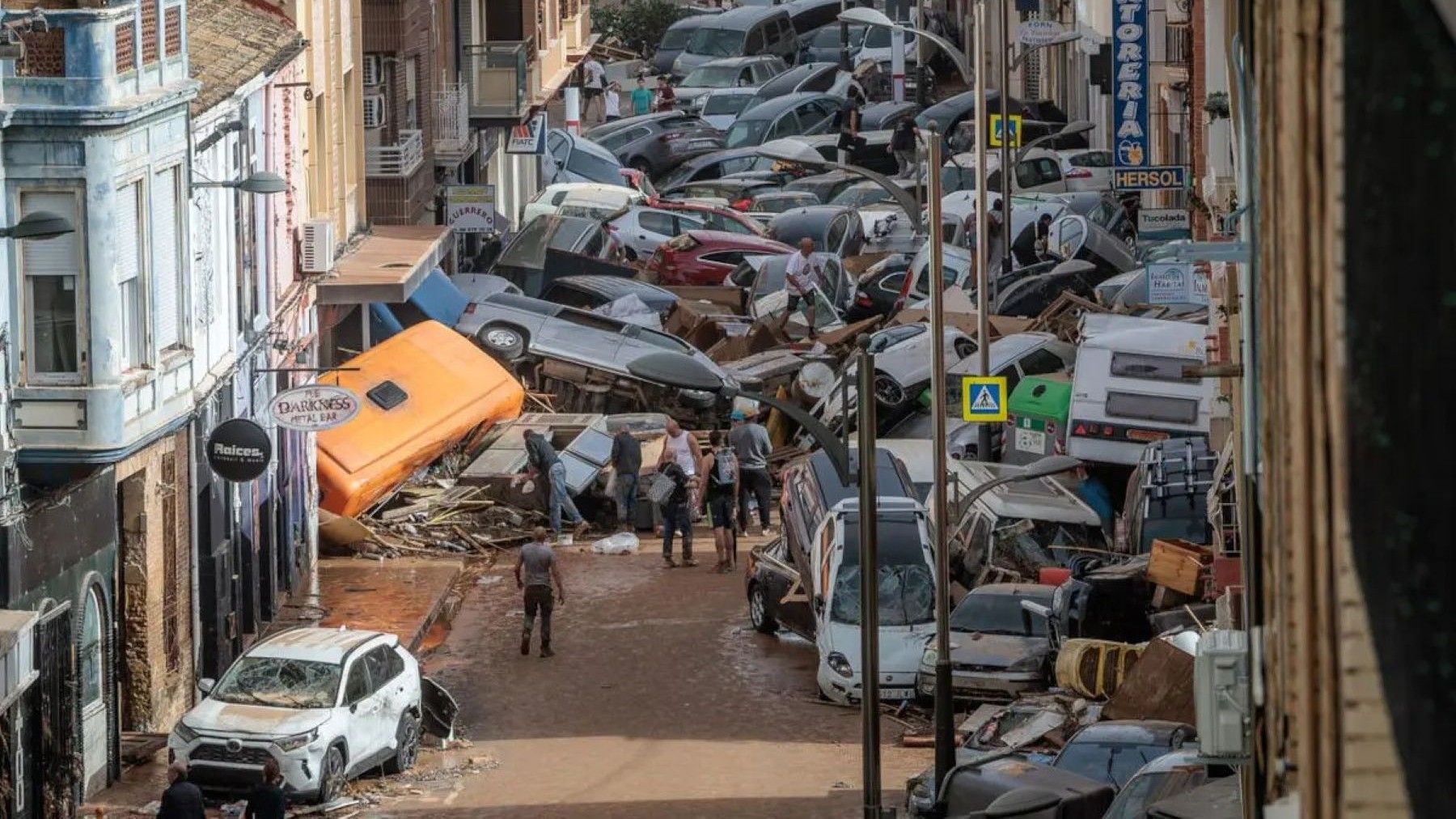
Family members and social, agrarian, and ecological groups demand that reconstruction after the DANA be carried out in a way that protects homes, restores river courses, and prevents reproducing the territory’s vulnerability.
Two years after the catastrophe, rebuilding also requires deciding where not to rebuild. This is one of the main demands of the manifesto on reconstruction after the DANA that more than a dozen organizations of victims’ relatives, neighborhood collectives, and social, agricultural, and ecological entities have presented. Their claim is that the works should reduce danger and protect those who remain exposed.
The alliance denounces that administrations maintain a response that is too focused on asphalt, on rigid concrete seawalls and on aid-based measures. In contrast to that model, what they propose is to halt new developments in risk zones, reclaim space for rivers, and protect agricultural soils, with adequate funding, transparency, and binding community participation.
The reconstruction after the DANA ten-point plan links flood prevention with housing, public services, and agriculture. It calls for adapting or relocating exposed schools, nursing homes, and health centers, for promoting agroecological practices, and for strengthening civic preparedness. For the signatories, rebuilding better means preventing recovery from placing the population in danger again.
Reconstruction after the DANA that does not repeat the same mistakes
Two years after the DANA, the most devastating event in Spain’s history, reconstruction cannot be limited to repairing concrete infrastructures, but must pursue social, environmental, and agroecological justice to avoid repeating past errors and truly protect the population. This is the main message of the joint manifesto released today by more than a dozen organizations of victims’ relatives, neighborhood collectives, third-sector social groups, as well as agricultural and ecological organizations, including Greenpeace.
The alliance denounces that, two years after the disaster and after recently repeated torrential episodes in the Valencian Community, public administrations continue making the same mistakes of the past: a reconstruction after the DANA centered on asphalt, rigid concrete breakwaters, and patchwork relief efforts that perpetuate the territory’s vulnerability model that worsened the catastrophe. In response, the groups demand a profound transformation with sufficient budgeting, transparency, and binding community participation.
The manifesto includes a decalogue of priority demands from civil society in the form of ten strategic axes that local, regional, and national administrations must implement. It calls for a deep transformation of the territory, the farming model, and climate policy, moving beyond the traditional concrete reconstruction to curb global warming below the 1.5 °C limit. To achieve this, it proposes promoting citizen energy communities and demands a strict climate justice that obliges fossil fuel corporations to pay for damages and for the adaptation of towns.
“After 233 deaths, we do not accept that the lesson of the DANA is simply to build faster. The lesson must be to build better, with safety and, above all, to also know where not to build,” said Mariló Gradolí, president of the Associació de Víctimes de la DANA 29 d’octubre.
Reconstruction should not be a return to the old model
For her part, Helena Cifre, coordinator of the Spanish Society of Ecological Agriculture and Agroecology (SEAE), based in Catarroja, pointed out that “the reconstruction after the DANA is not a return to the intensive model. Living soils with vegetation cover retain water and slow erosion. Hedge rows, embankments, and riverbank forests slow floods and provide refuge for auxiliary fauna. We request technical support, training, investment, and fair prices for producing families. Local and agroecological consumption must be part of reconstruction.”
“We must be clear that adaptation has limits; there will be no riverbank forest or concrete dike capable of protecting us in a climate gone wild. Science is clear: the only way to slow this spiral of extreme storms is to radically abandon fossil fuels and embrace renewables. It is deeply immoral that the climate change bill is paid by citizens through taxes, while the true culprits—the oil and gas companies—celebrate record profits every day. Whoever pollutes must pay and repair,” said Francisco del Pozo, head of Greenpeace’s campaign against fossil fuels.
In the urban planning and hydrological dimension, he calls for an immediate moratorium on new developments in risk zones and a freeze on building licenses, shielding agricultural soils and renaturalizing riverbeds through riverbank vegetation and Sustainable Urban Drainage Systems (SUDS) so that the land acts as a natural sponge against extreme storms. This transition relies on a determined agroecological reconstruction and food sovereignty strategy, prioritizing soils with vegetation cover, technical advice, and fair prices for farmers against the intensive agroindustrial model.
Moreover, the demands place social rights, essential services, and community safety at the heart of reconstruction, requiring adaptive redesign or relocation of critical infrastructures such as schools, residences, and health centers, and prioritizing a metropolitan public transport network and the “15-minute city” model over dependence on private cars.
On housing, the organizations urgently call to regulate rental prices to curb speculation, expand the public social housing stock, and rehabilitate homes to zero-emission standards. Finally, the manifesto defends a biorregional and decentralized governance that recognizes the Local Committees of Emergency and Reconstruction (Comités Locals d’Emergència i Reconstrucció, CLERs) in permanent territorial forums, alongside an emergency management approach based on truth, accountability, and continuous population training through periodic drills.
It was already known which centers were at risk
The exposure of essential services was already on official maps before the catastrophe. In the documentation presented in 2021 to review flood risk management plans, MITECO had identified 985 educational centers, 358 care centers, and 45 hospitals that were in the flood-prone zones of the highest risk in the intercommunity basins.
These figures give a concrete sense of the demand from the groups: reviewing the location and protection of these facilities must be part of the reconstruction after the DANA, because they also depend on the capacity to attend to the population when an emergency arrives.
