
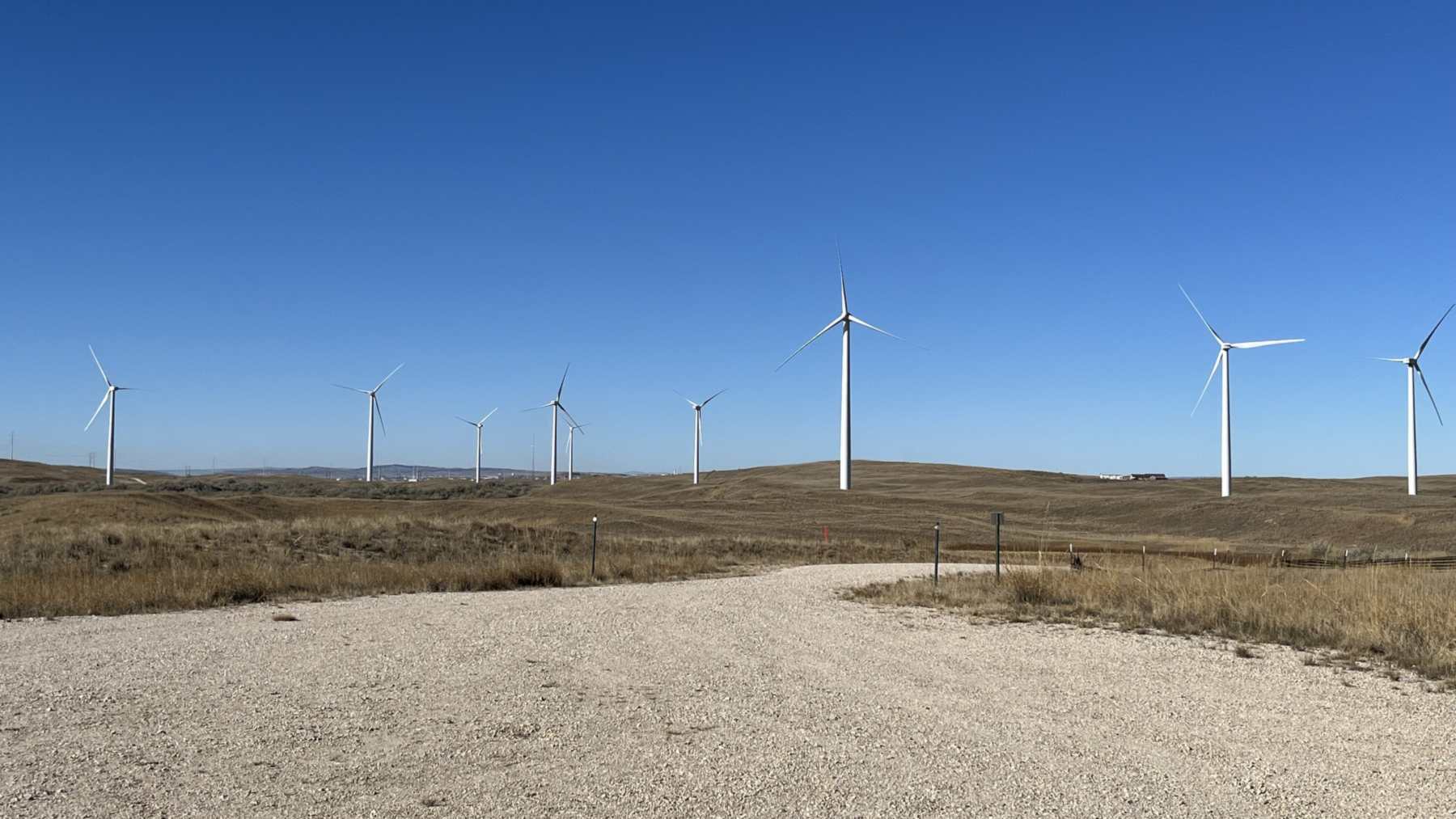
Casper’s landfill in Wyoming, United States, received 1,124 turbine blades between May 2019 and September 16, 2020. This is stated in a city hall information sheet. In 2026, Chevron began dismantling its nearby wind farm, which opened in 2009 with 11 turbines. Its official notices do not specify where the blades will go.
The Casper Regional Landfill sheet describes the method: each blade measured 120 feet (about 36.6 meters) and arrived in a single truck, cut into three 40-foot sections (12.2 meters), and the workers tucked the two smaller-diameter pieces inside the thickest one. Thus, each blade occupied between 23 and 34 cubic meters of space. With the maximum, the 1,124 blades total around 38,500 cubic meters, the volume of about 15 Olympic-sized swimming pools.
An unlined debris cell
The blades came from wind farms in Glenrock, Saratoga, Hanna, and Arlington. The landfill buried them in its construction debris cell, which has no impermeable lining. The city argues that fiberglass is “one of the most inert (non-toxic) materials” it accepts.
The City also noted the height, latitude, and longitude of each burial area, which, according to the document, would allow the blades to be excavated and recovered in the future.
$444,412 for the blades
In fiscal year 2020, the landfill earned $444,412 from the blades, and in 2021 it received about 250 more, somewhat shorter, for which the city estimated another $158,300. In total, the project exceeded $800,000.
The permit only authorizes Wyoming waste, and to accept blades from another state the city would have to amend it with the Wyoming Department of Environmental Quality (WDEQ). The city reiterated this blade information sheet in an informational packet on December 20, 2024.
Explosives at the Chevron wind park
When it opened, the Casper wind park had 11 GE wind turbines of 1.5 megawatts each, totaling 16.5 MW. It began generating electricity in December 2009 on land of a former Texaco refinery, according to an EPA case study. Chevron calculated then that it supplied electricity for about 4,000 homes.
In July 2026, Chevron U.S.A. announced on its own website that dismantling would begin that summer and that a contracted company would remove the turbines over several months. On August 21 it notified neighbors that it would demolish some towers with controlled explosives, with a 72-hour notice window starting Monday the 24th at 8:00.
On August 27, the company declared the explosive phase finished. According to that notice, cranes would continue dismantling the rest of the wind turbines and trucks would carry away the parts. No notice states whether the blades will go to a landfill or be recycled.
Backfill for coal mines
A 2020 state law opened the door in Wyoming to using inert blades and towers as backfill in open-pit coal mines. On January 13, 2025, the federal mining office (OSMRE) approved the regulation in the Federal Register.
The blades can only be placed on the mine slopes and final voids, at least 6 meters above the pre-mining aquifer level and 6 meters below the final surface of the fill. The nacelles housing the generator, as well as the mechanical and electrical parts, are left out. The mine operator pays the state 25% of what it charges for receiving them.
At the WDEQ, Suzanne Engels, who heads the Solid and Hazardous Waste Division, explained that there is no land left to keep sending blades and towers to the landfill, something she called “unsustainable,” and piling them up would be “unesthetic and environmentally problematic.”
There was an attempt to go further. The HB 89 bill aimed to require each wind farm to bury its own blades and shutter municipal landfills, but it did not leave the committee, where it died on March 3, 2025.
Recycling, from Iowa to Halmstad
For the Department of Energy (DOE), between 85% and 90% of a wind turbine’s mass can already be recycled commercially; blades are the difficult part. In its January 2025 report, the DOE acknowledges that this will vary by region, depending on disposal costs, how far they must be transported, and who wants the material.
Since 2020, Veolia North America shreds blades and feeds them into cement kilns, where they serve as both fuel and feedstock. The company says it has processed more than 7,000 blades, and that each one saves about 5 tons of coal, 2.7 tons of silica, and 1.9 tons of limestone.
Iowa has a plant that converts wind blades into material for concrete and asphalt, and in Tennessee the company Carbon Rivers recovers fiber from old blades with DOE support.
In Europe, on May 12, 2026, Stena Recycling and Vestas announced a pilot plant in Halmstad (Sweden). Their chemical process separates epoxy resin, fiberglass, and the rest of the materials. “We can apply our method directly to existing blades,” said Henrik Grand Petersen, director of Stena Recycling in Denmark.
The company expects to bring it to market “in a few years.” In Spain, Iberdrola’s EnergyLOOP and FCC already treat blades in Navarra. According to Stena’s note, several European countries already ban sending them to landfills.
Chevron does not disclose the destination
Chevron has not published the destination of the blades from its Casper park, and it is not known whether the municipal landfill would accept them. The city’s sheet is from 2020, and there has been no official tally since then.
That the city recorded the coordinates does not constitute a plan to unearth the blades, nor does it guarantee that doing so would be worthwhile. There is also no indication whether any Wyoming mine has already received blades.
Chevron’s latest notice was posted on August 27, 2026, on the official decommissioning website.
Photo: Chevron U.S.A.
