
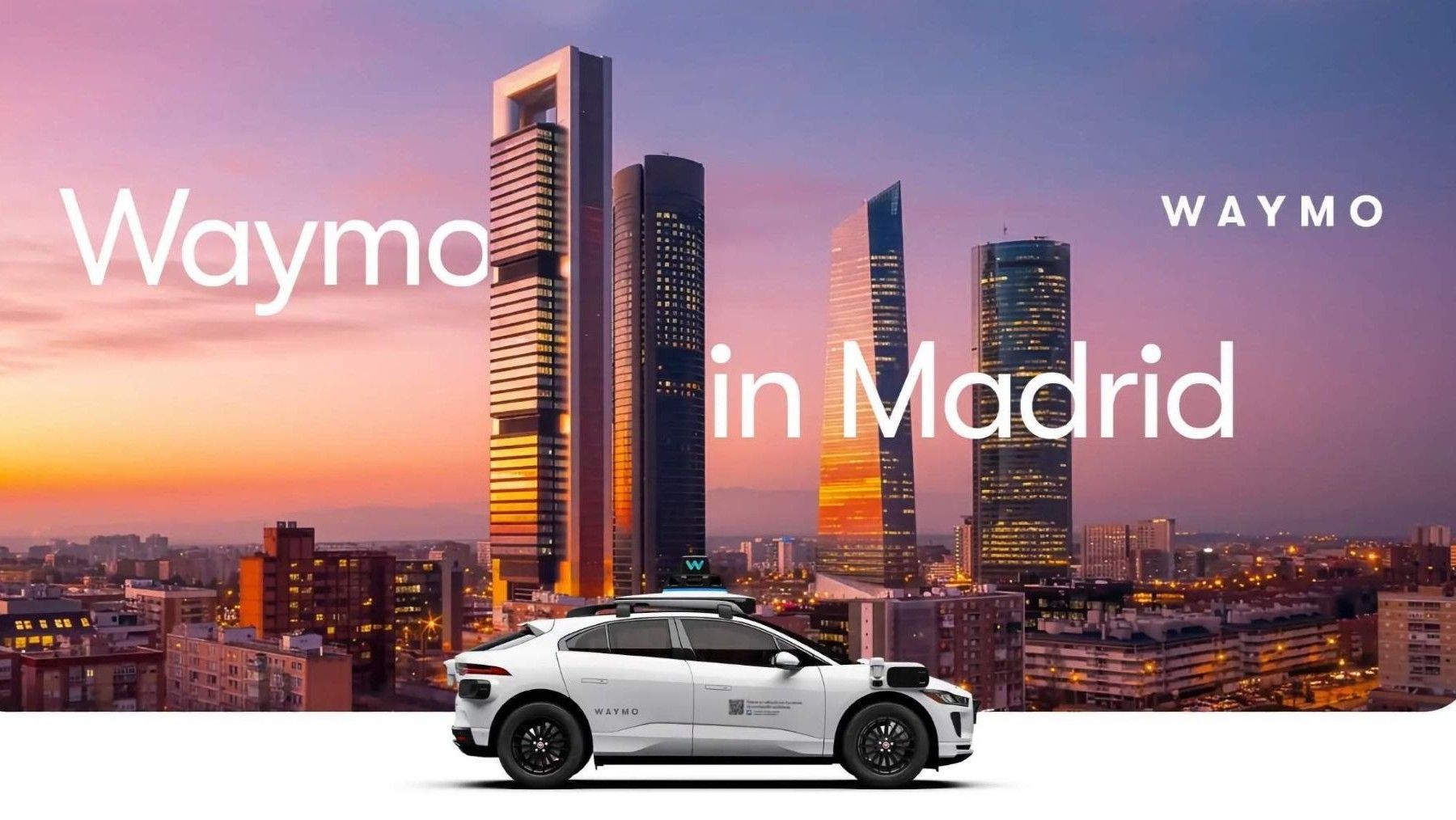
Uber and Waymo are testing new autonomous cars in Madrid, operating in zones cleared by the DGT, while the maker behind the electric Jaguars plans a gradual rollout with professional drivers at the wheel.
Autonomous cars in Madrid are starting to appear, though still with professionals at the wheel. Uber and Waymo have already begun testing in several municipalities and in areas authorized by the General Directorate of Traffic in the Spanish capital. The next step Waymo envisions is to welcome its first riders in 2027, after validating the technology of these electric vehicles under Madrid’s traffic conditions.
The company will progressively deploy in the city 16 Jaguar I-PACE electric vehicles. The preparation starts with manual driving and will continue with various autonomous-driving tests supervised by local specialists. The aim is to tailor the system to the streets, signage, and traffic patterns of the region, before moving toward fully autonomous operations, with respect to the autonomous cars in Madrid.
Waymo has not yet begun offering commercial trips within Madrid. Its arrival also sparks debate about how these services will be integrated into the city: Josep Laborda, CEO of Factual, argues that they should complement public transport and connect underserved areas, avoiding increases in congestion and pressure on urban space.
Autonomous cars in Madrid: robotaxis in the capital with professional drivers at the wheel
Mobility companies Uber and Waymo have begun circulating, in various Madrid municipalities, their first autonomous cars and robotaxis, restricted to specific zones authorized by the General Directorate of Traffic (DGT).
The Waymo spokesperson for relations in Southern Europe, Elia Ferre, stated at a meeting organized by Factual and promoted by the Madrid City Council that in the near term 16 units will be circulating for testing.
The autonomous electric cars are supervised on board and driven by professional drivers. In Waymo’s case, it is the Jaguar I-PACE model and, for now, they carry red plates.
The Waymo rollout of autonomous cars in Madrid will be carried out «in phases and where safety comes first,» Ferre noted regarding this initial validation period to adapt the vehicle’s algorithms to Madrid’s traffic patterns and road conditions.
Target for 2027
The objective on Waymo’s agenda is to be able to offer autonomous car service in Madrid to its first users in 2027. Regarding the benefits of this future mobility, Elia Ferre highlighted the technology’s role in promoting road safety. In her view, the autonomous car eliminates driver distractions, fatigue, speeding, or the failure to maintain a safe following distance, among other arguments.
Waymo One has operated since 2024 in several U.S. cities, including Los Angeles, with a private on-demand autonomous transportation service available to the public 24/7.
Regarding another company present at the event, the American Tensor announced that this Tuesday it activated the robotaxi service in Munich, Germany, under MTZ’s operation.
Tensor, specifically, has unveiled at the event its new autonomous car in which the occupant decides on each trip whether to take the wheel or, alternatively, the car itself handles the driving, for which the steering wheel folds away, the pedals disappear, and the display moves.
For Josep Laborda, the CEO of Factual, the deployment of autonomous vehicles must complement public transport, improve connectivity in underserved areas, and prevent an increase in congestion and pressure on urban space.
Robotaxi tests
The DGT public registry helps quantify the scale of the deployment of autonomous cars in Madrid: it lists 16 vehicles authorized for Waymo and another 20 for AVOMO CARS, linked to WeRide and Uber, both for SAE Level 4 robotaxi testing.
Altogether, the autonomous cars in Madrid total 36 authorized units, a figure that does not correspond to the number of cars circulating simultaneously, nor to a commercial fleet available to travelers. The data show that technological preparation is advancing through differentiated programs, whose scope should be distinguished from future public-service operations.
