
Each Spanish person generated 43.55 kilograms of plastic packaging waste in 2024, according to data published by Eurostat on October 22. The European Union average stood at 35.9 kilograms per person. Among the countries with data for that year, only Ireland and Portugal were above Spain.
When it comes to recycling, the situation is exactly the opposite. Spain recycled 38.4% of those packaging materials, four percentage points below the EU average, although when considering all of its packaging the rate reaches 74.6%. How do two such divergent figures fit together?
More than two million tonnes
In total, the country produced 2,128,625 tonnes of plastic packaging waste in 2024. Of these, 817,240 tonnes were recycled, according to Eurostat’s packaging database. The difference far exceeds a million tonnes, almost 27 kilograms per person that did not get recycled.
Here we are talking about nearly everything we bring home after shopping. We mean the water bottle, the chicken tray, or the plastic wrap from the loaf of bread. The figures also account for what businesses and administrations generate, not just households.
What stands out the most is the pace. In 2023, each Spaniard generated 37.99 kilograms, so in one year the figure rose by more than five and a half kilograms per person. That is no small amount.
Far from the 55% target for 2030
European regulation requires recycling at least 55% of the weight of these wastes by 2030. Spain is short by almost 17 points. And the margin is just over four years away, with packaging consumption that, for now, continues to rise.
According to Eurostat’s analysis of packaging waste, only Latvia (71%), Belgium (58.2%), and Poland (56%) were already meeting that target in 2024. Germany (51.3%) and Italy (50.1%) are close. At the other end are Denmark (22.5%), Finland (26.9%), and France (27.4%).
Moreover, the Spanish series has moved backward. In 2023 the plastic recycling rate stood at 46.2%, almost eight points higher than now. Eurostat does not explain in its note what accounts for this drop.
Glass and cardboard save the average
If all packaging is viewed together, the result changes completely. With that 74.6%, Spain already surpasses the 70% that the EU asks for by 2030. Only six countries achieve it, and the other five are Belgium, the Czech Republic, Italy, Slovenia, and the Netherlands.
The European targets themselves reflect that not everything recycles as easily. By 2030 they require 85% for paper and cardboard and 75% for glass. For plastic they set 55%, and Spain already has a head start with the glass recycled that returns to packaging factories.
Anyone who separates trash at home senses why it is harder. A glass jar is pure glass. A plastic container, on the other hand, may combine layers, caps, and labels made of different materials, and that greatly complicates proper separation.
Thirteen kilos more than in 2014
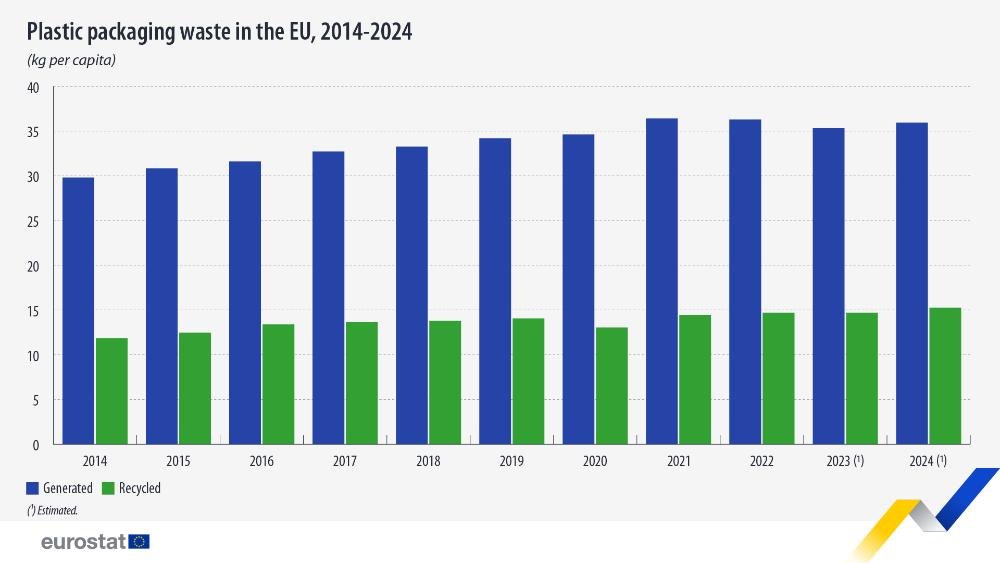
A decade ago, each Spaniard generated 30.53 kilograms of plastic packaging per year. Across the EU the rise since then was much smaller, 6.1 kilograms per person. In Spain the jump is around 13 kilograms, more than double the average.
Europe also recycles more than before, albeit slowly. Each European recycled 15.3 kilograms of plastic packaging in 2024, barely 3.4 more than in 2014, while what was produced grew by 6.1. The EU’s average recycling rate rose from 41.6% to 42.4% in the last year, though it is an estimate.
New rules since August
Since August 12, 2026, the new European packaging regulation has been applied across the EU. It maintains the 2030 recycling targets. According to the European Commission, it also aims that by that date all market-available packaging be recyclable in a cost-effective manner.
From 2026 onward, data will be counted under this new law. At the same time, other elements remain on the table, such as the packaging deposit-return system. Also on November 21 comes the prohibition on exporting plastic waste outside the OECD.
In practice, every kilogram that is not generated is a kilogram that no one has to collect, separate, or recycle, whether at home or at the plant. The data were published by Eurostat, the European statistical office, in its note of October 22, 2026.
Photo: © European Union, 2020
