
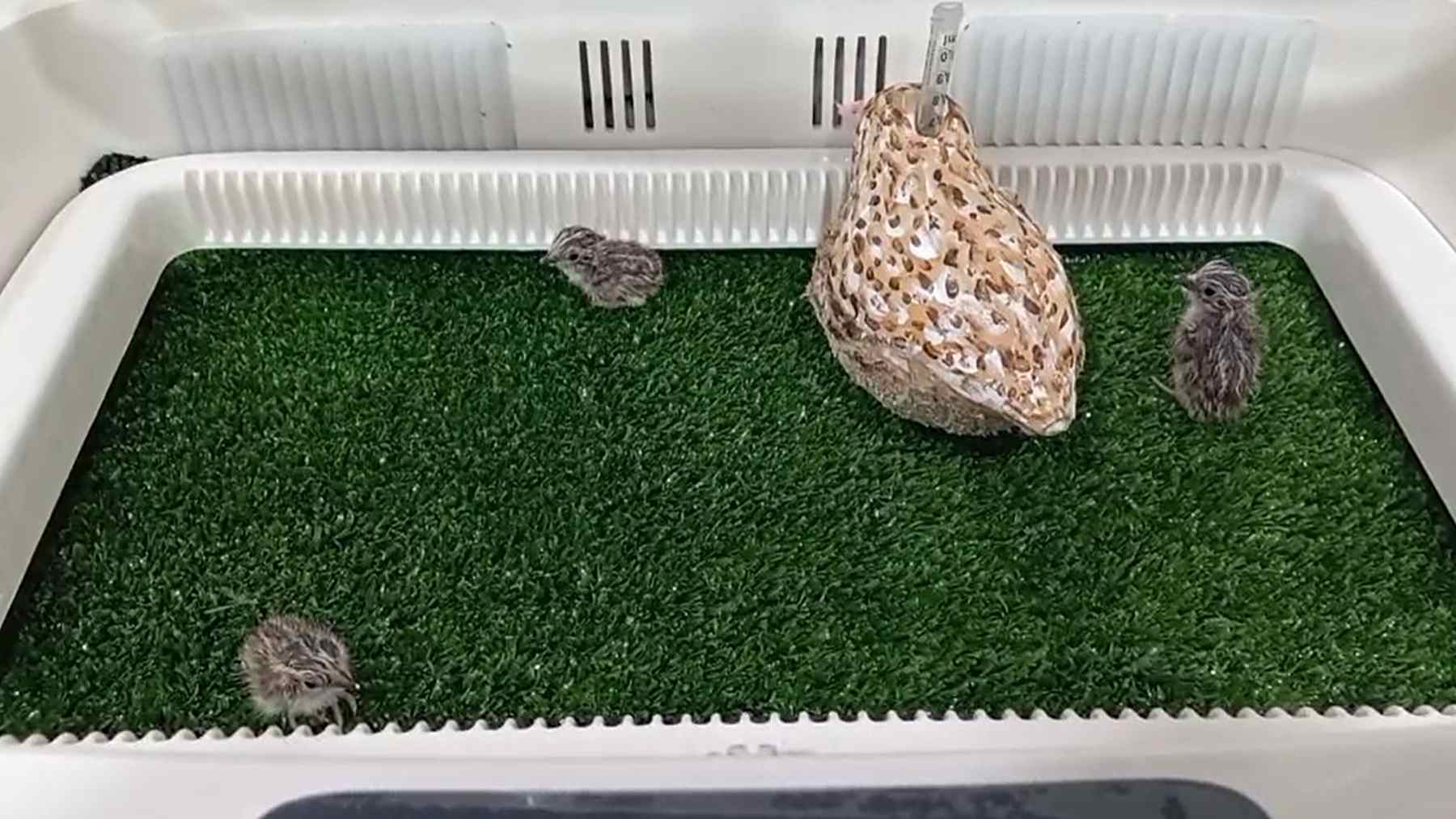
The Jerez de la Frontera Zoobotanical (Cádiz) has raised the first six chicks of the Andalusian torillo, a bird extinct in Spain. They hatched on October 11 and 12, 2026 as part of the species’ reintroduction program. Their mothers are two females from the group of 18 individuals that arrived from Morocco in September.
Seven eggs in a month and a half
According to the Ministry of Sustainability and Environment, the 18 “founders” adapted very well to their enclosures. In barely a month and a half, two females laying their first clutches. There were four eggs in one facility and three in the other.
All were incubated artificially, with temperature and humidity adjusted to the species. Twice a week, technicians inspected the embryos with candling (a light that reveals the interior of the egg). They also measured each egg and kept samples to study how the torillo reproduces.
In the end, the first six eggs hatched without anyone needing to intervene. The chicks emerged between the early hours of Sunday, the 11th, and the afternoon of Monday, the 12th. And they are progressing well.
Feeding every half hour
After birth, the offspring moved to the hatchery, where heat and humidity are controlled. There the temperature drops by about 0.5 °C per day, depending on the age of each chick. Each one wears a ring to monitor its growth separately.
In the first days they receive a feed every 30 minutes. In each feeding, the number of pieces eaten by each specimen is recorded. Anyone who has ever cared for a chick knows what that entails.
At first there are mealworms and small crickets. Then come canary seeds, insectivore feed, carrots, leafy greens, and millet. Such records help plan pairings and avoid inbreeding (mating between relatives).
Supervised sand baths
The adults are fed first thing in the morning and always have fresh water. Twice a day they receive mealworms. This helps them maintain the instinct to search for and catch prey.
In daily monitoring, caretakers note their sand baths, their songs, and their preferred corners. If an individual seems uncomfortable in its group, it is moved to another enclosure. At night they rely on 250-watt heating lamps.
Several surveillance cameras complete the control, including in the incubator room and the brood room. With them, they track the hatchings without disturbing the chicks. It is no small feat with such a shy animal.
The Iberian lynx pathway
The ex situ rearing, outside the natural environment, provides, according to the Junta, “a margin of safety against extinction risk.” The plan follows the route used with the Iberian lynx. Jerez already has experience, with projects such as the little bittern (cerceta pardilla) breeding center or the hermit ibis raised at the Zoobotanical.
First, a solid breeding nucleus must be formed. Later, its descendants can be released in selected coastal enclaves of Andalusia. To achieve greater genetic diversity, there will be at least four more campaigns in Morocco in the coming years.
In parallel, another breeding nucleus operates at the Aïn Sebaâ Zoo in Casablanca. The two are coordinated, and the genealogical book (the “studbook”) is kept from Andalusia. According to the International Union for Conservation of Nature, Morocco, the Ministry for Ecological Transition, and the Junta participate in the project.
A few hundred in the wild
The only known population of the Andalusian torillo (Turnix sylvaticus sylvaticus) lives on the Atlantic coast of Morocco, in the Oualidia area. It depends on orchards and traditional agriculture. They are a few hundred birds and increasingly scarce.
In former times, this bird occupied a large part of the Mediterranean basin. Coastal urbanization and intensive agriculture in the 19th and 20th centuries are among the causes of its decline. It had already been observed how changes in land use pushed the torillo to extinction.
In Jerez, its physiology and behavior will also be studied to better understand that retreat. It is another piece alongside what was known about the last refuge of the Andalusian torillo in Morocco. Six chicks do not save a species, but they open the door.
The official note on the first torillos born in Jerez has been published on the Junta de Andalucía’s Environmental Portal.
Photo: Junta de Andalucía
