
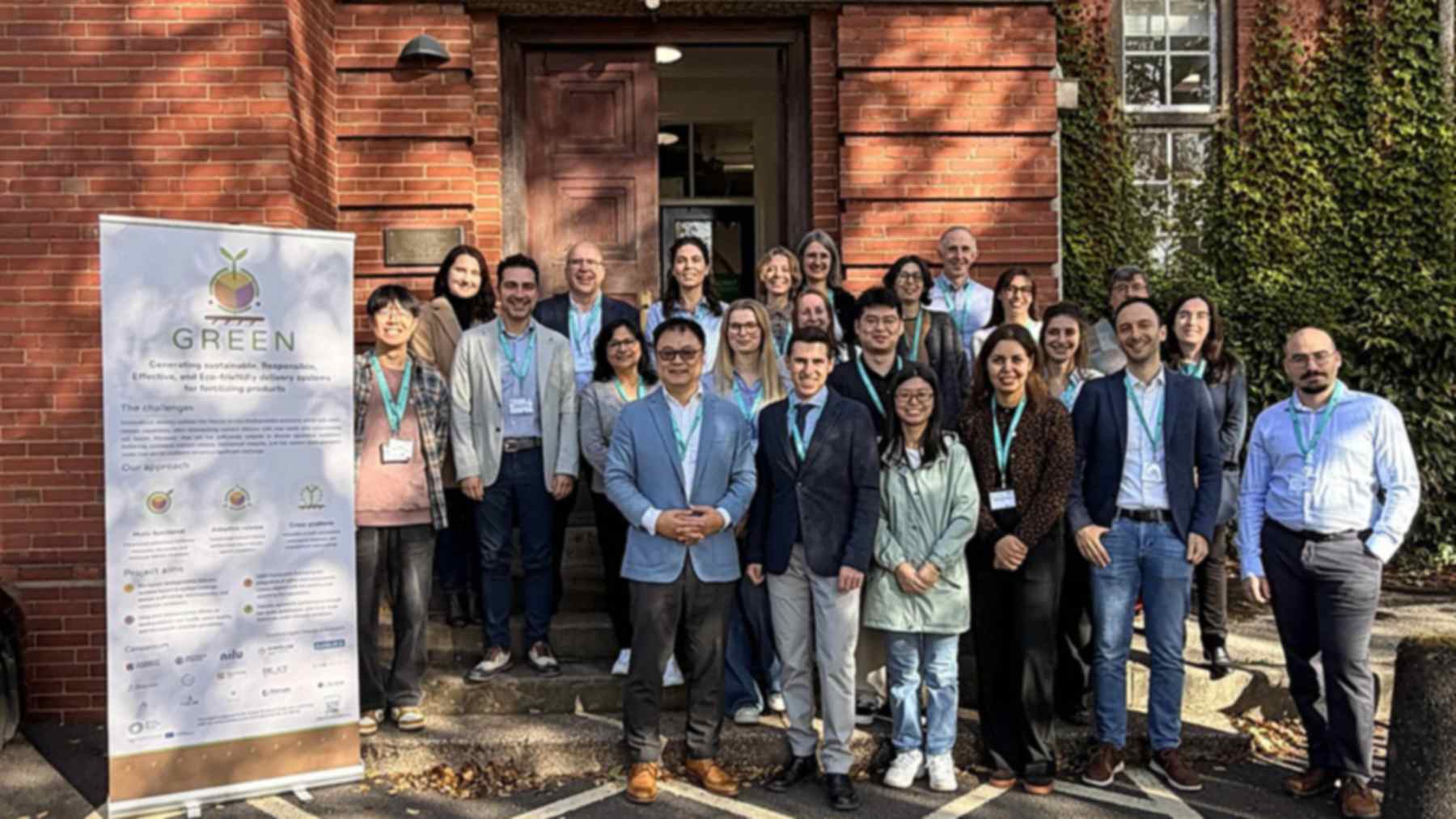
Coated fertilizers leave about 22,500 tonnes of microplastics in the European Economic Area each year. This is the calculation of the GREEN consortium, a European project that has just kicked off. Twelve partners from ten countries, with the Valencian technology center AIMPLAS among them, want to replace those plastic coverings with plant-based alternatives.
It is coordinated by the University of Birmingham, with just over 3 million euros from the Circular Bio-based Europe Joint Undertaking (CBE JU). The underlying idea? That the fertilizer continues to release its nutrients gradually, but with a coating that degrades in soil and in water.
Plastic inside the fertilizer
Across much of European farming, the so-called enhanced-efficiency fertilizers are used. They are granules with a thin coating that releases nitrogen or phosphorus over weeks. This helps the plant utilize it more effectively and reduces losses from rain, something anyone who has fertilized a garden before a storm can relate to.
What fails, according to the researchers themselves, is that coating. It is often a polymer that does not biodegrade and remains in soils contaminated by agricultural plastics. According to the project’s official brief, these systems also release nutrients irregularly.
Far from easing up, the pressure on agriculture is only going to grow. The project page on the CBE JU notes that global food demand could double by 2060. And that tightens things.
Microcapsules from Paterna
From its headquarters in Paterna (Valencia), AIMPLAS will develop part of the new systems. They will be microcapsules and polyelectrolytes, manufactured using several techniques. One of them is mechanochemistry, which drives reactions by grinding or pressing the materials.
This plastics research center does not start from scratch. It has already studied how to accelerate the biodegradation of compostable bioplastics, a piece that fits this challenge.
The other two Spanish partners in the consortium are in Navarra. They are Timac Agro España, based in Orcoyen, and the cooperative A N S.Coop., in Tajonar. They join, among others, the Milan Polytechnic and the Swedish University of Agricultural Sciences.
Twenty prototypes, two climates
According to the project listing on CORDIS, the team will create 20 distinct systems. There will be coatings, porous scaffolds, microcapsules, and molecular complexes. With these, they will assemble 10 combinations, five for humid climates and five for dry ones.
From all those combinations, six final products will emerge. They will be tested in the laboratory, in a greenhouse, and in the field, including organic farming. The raw materials will come from forestry by-products, agri-food by-products, and animal-origin materials, and the nutrient release will respond to what each crop needs according to the environmental conditions.
At the end of the road, the consortium hopes to have four fertilizers at scale. Each would feature a production line of at least 20,000 to 25,000 tonnes per year. The same techniques will be tested on coated seeds and on plant-protection products.
More than a hundred farmers trying it
A new fertilizer is of little use if no one applies it on their farm. Therefore GREEN will involve more than 100 farmers, cooperatives, and agronomists, who will provide feedback on the design, carry out trials on their plots, and receive training. If it goes well, three regional value chains across Europe could emerge from it.
“Carrying nutrients to crops over an extended period in a safe and sustainable way is a complex task,” says Zhenyu Zhang, who leads the Birmingham-based research. There, the team first gathered on October 14, 2026, as the University of Birmingham notes.
Then there’s the money, of course. Those running a farm watch every bill, and the consortium is aware of this, so a cap has been set and the new systems should cost no more than about 20% above the current ones. In Spain, other teams are pursuing similar paths, such as nanotechnology-enabled smart fertilizers from the CTC.
90% in 48 months
The good news is that the target is already written down, leaving little room for excuses. The material would need to degrade by 90% in soil within 48 months. In water, more than 40% within a year, with no detectable microplastic residues.
The consortium also aims to cut nutrient wash-off to rivers and aquifers by 30%. It also aims to improve their utilization by 20% and to boost yields by 10%. And it seeks a 20% reduction in greenhouse gases tied to fertilization.
It is worth noting that all of these are goals, not results. The project started on October 1, 2026 and will run until September 30, 2030. Until the field trials arrive, we won’t know how much of this will actually be achieved.
The official statement has been published on AIMPLAS’s blog.
Photo: AIMPLAS
