
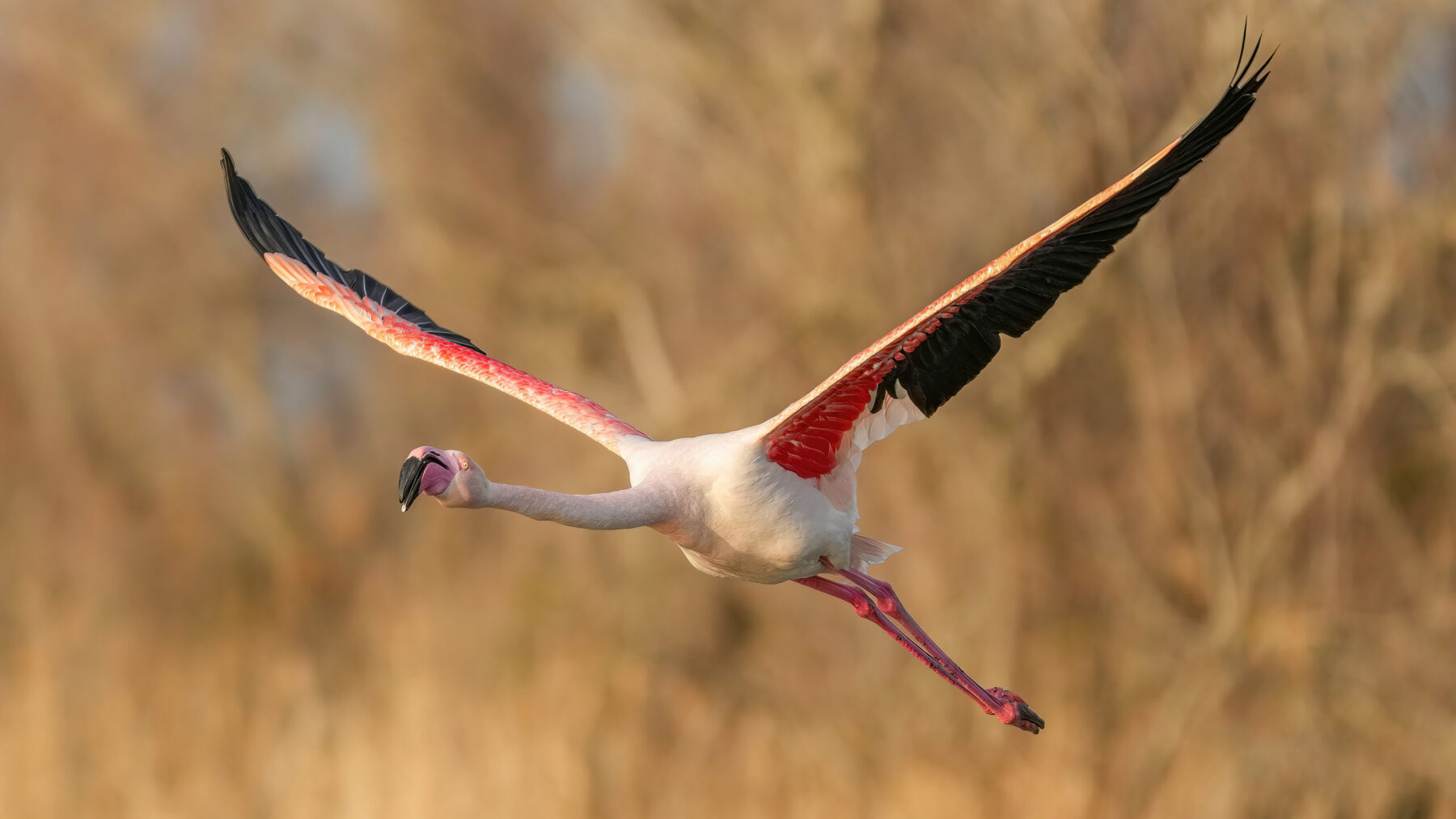
The pink color of a flamingo comes from pigments called carotenoids, and the bird obtains them in two ways: by eating them and by applying them. The pigments arrive with the algae and the small crustaceans in its diet (as summarized by the San Diego Zoo’s fact sheet). Afterwards, the flamingo rubs its cheek against the uropygial gland (the gland at the base of the tail that produces the plumage oil) and spreads that secretion, loaded mainly with cantaxanthin, along the neck, chest, and the front of the back.
That makeup is described in the species fact sheet from the IUCN Flamingo Specialist Group, based on the review by Salvador, Rendón, Amat and Rendón-Martos for Birds of the World (2024). The bird applies more makeup during the courtship season, when the plumage looks more colorful, and the color fades for the rest of the year. The wing coverts of the wing (ranging from salmon to crimson) depend in part on the carotenoids it ingests.
What it eats is filtered with the bill: insects and their larvae, crustaceans, mollusks, annelids, microalgae and protozoa, according to SEO/BirdLife. In appearance, the flamingo would fit among creatures that seem from another world, such as the capybara. And it isn’t the only instance where a pigment explains a rarity, as green-blood lizards show.
They are born pale and take years to become pink
A flamingo chick is not born with pink plumage. The San Diego Zoo describes gray down and a pink, swollen beak and legs that turn black within a week, while the Smithsonian National Zoo mentions white down in the American flamingo, so the most accurate description is that they hatch with pale plumage, somewhere between white and gray. Juveniles are brown-gray and without pink, according to SEO/BirdLife.
The change happens slowly: in the first year a few pale pink feathers begin to appear, in the second the plumage is intermediate, and some individuals still retain it in the third year, according to Birds of the World. The Smithsonian only mentions several years and molts. The adult ends up with the wing coverts ranging from salmon to crimson, the flight feathers black (hidden when resting), the beak pink with a black tip, and the legs reddish. The Junta de Andalucía places reproductive maturity between 3 and 10 years.
Each pair lays a single egg per season, which incubates for 27 to 36 days, and the chick flies between 71 and 98 days (Birds of the World). According to SEO/BirdLife, the bird spends a few days in the nest, then joins the creches (groups of chicks within the colony) and leaves around 100 days. ECOticias recounts a captive case, that of four Chilean flamingos born at the Oceanogràfic in Valencia in 2012.
When and where to see the Fuente de Piedra flamingos
The Fuente de Piedra lagoon (Málaga) hosts the largest colony of common flamingos in the Peninsula. In 2026, 35,177 pairs were counted there, the highest figure since the colony has been monitored (1984), according to a Junta de Andalucía note dated August 8, 2026. SEO/BirdLife estimates that in Spain breeding occurs for between 14,000 and 38,000 pairs depending on the year, with more than half of them at this lagoon, which the official Reserve sheet lists, alongside the French Camargue, as the most relevant colony in the western Mediterranean and the northwest of Africa.
There is no fixed breeding date, since it depends on the water. In 2026 the lagoon reached 101 centimeters in March (most years do not exceed 50), with 663 liters per square meter recorded for the hydrological year up to the date of that note, the fourth-highest in 50 years. The first clutches arrived in the second half of February on Senra Island, and by mid-March the colony also occupied the Canchones del Suroeste. In 2025, according to the Junta’s note of April 8, the colony had already begun nesting on the central islet after 183 millimeters of rainfall in March (183 liters per square meter), and in 2024 the water disappeared by mid-May, truncating breeding. That same note states that they had bred in 35 of the previous 41 years. SEO/BirdLife writes that “the breeding season usually begins around April,” but in 2026 it began in February, and when it starts in 2027 will depend on the rainfall of the winter of 2026–2027.
The 2026 record is counts of pairs, not chicks: 15,500 pairs recorded, compared to more than 22,700 in 2025, the highest number on record (ringing note of 2025). On August 8, 2026, 600 were ringed, as ECOticias reported in its ringing chronicle. The program marks its 40th anniversary and has tagged more than 21,000 flamingos, with more than 167,000 ring readings (read at a distance, without capturing the bird) in 23 countries, from Guinea-Bissau to Cyprus. More than 30% of those readings are taken at the lagoon itself.
To view them, the Junta’s Visitor Window recommends spring, at first light, and notes that March, April and May concentrate more birds. These are the reserve’s observation points:
- Viewpoints: Cantarranas, Cerro del Palo, El Laguneto, Las Latas and La Vicaría.
- Observatories: Cantarranas, El Laguneto, Laguna de las Palomas and La Vicaría.
- Trails: the El Laguneto and Las Albinas trails, and a cycling route along the roads. Binoculars can be rented.
The fact sheet does not publish hours or phone numbers, so it’s worth checking before planning a visit.
Other wetlands with flamingos in Spain
Outside Málaga, the colonies are smaller and less regular. SEO/BirdLife describes those in the Ebro Delta and Doñana as newer, much smaller, and with a tendency to fail in dry years, and mentions small and occasional colonies in El Hondo, the Santa Pola salt flats and Pétrola. We have not found official 2026 figures for any of them.
Delta del Ebro (Tarragona). The 2025 season is covered in this report about the flamingos of the Delta del Ebro. For visits, the Parc Natural’s website lists the Deltebre Information Center (Avenida Catalunya, 46; 977 48 21 81) as contact, and the Parcs Naturals of Catalunya’s equipment page includes the Ecomuseu, with a rammed-earth hut that serves as a bird-watching observatory. That page does not provide hours or mention flamingos, so it’s better to call ahead.
Doñana. The José Antonio Valverde Visitor Center (Aznalcázar, Seville) is listed as temporarily closed: a Junta notice dated February 9, 2026 closes the center and its observatories with no reopening date. For the rest of the area, our Doñana guide and the other national parks are applicable.
Marismas del Odiel (Huelva). It is a Natural Site, Ramsar since 1989 and a Special Conservation Area since 2025, and its official fact sheet highlights the importance of its flamingos without giving figures or a timetable. The Anastasio Senra Visitor Center (road to the Juan Carlos I Dique, km 3; 682 654 491) has an observatory overlooking the lagoons, and the Salinas de Bacuta trail, another, but the center’s sheet provides no hours. ECOticias reported in May 2025 the return of flamingos to Odiel after rains.
Salinas de Santa Pola (Alicante). The park’s visitor center is at Zaragoza Avenue, 45, in the Salt Museum building. It opens daily, including holidays, from 9:00 to 14:00, and closes on December 24, 25 and 31 and January 1 and 6. We could not confirm what observatories it has or whether there was breeding in 2026.
Flamingos in autumn and winter
Flamingos migrate a lot: ring readings from Fuente de Piedra extend to 23 countries. We have not found an open source that states how many remain in each wetland month by month, and the Red List of Spanish Birds classifies them as Data Deficient as winter visitors (and Near Threatened as breeders), according to SEO/BirdLife. In ECOticias we review in September 2026 the autumn journey of flamingos through wetlands and, in March 2026, their settlement in Cantabria.
If the plan is to head to a wetland this autumn of 2026, it is worth also looking at other wetland birds, such as cranes, and saving the Fuente de Piedra colony for spring 2027.
