
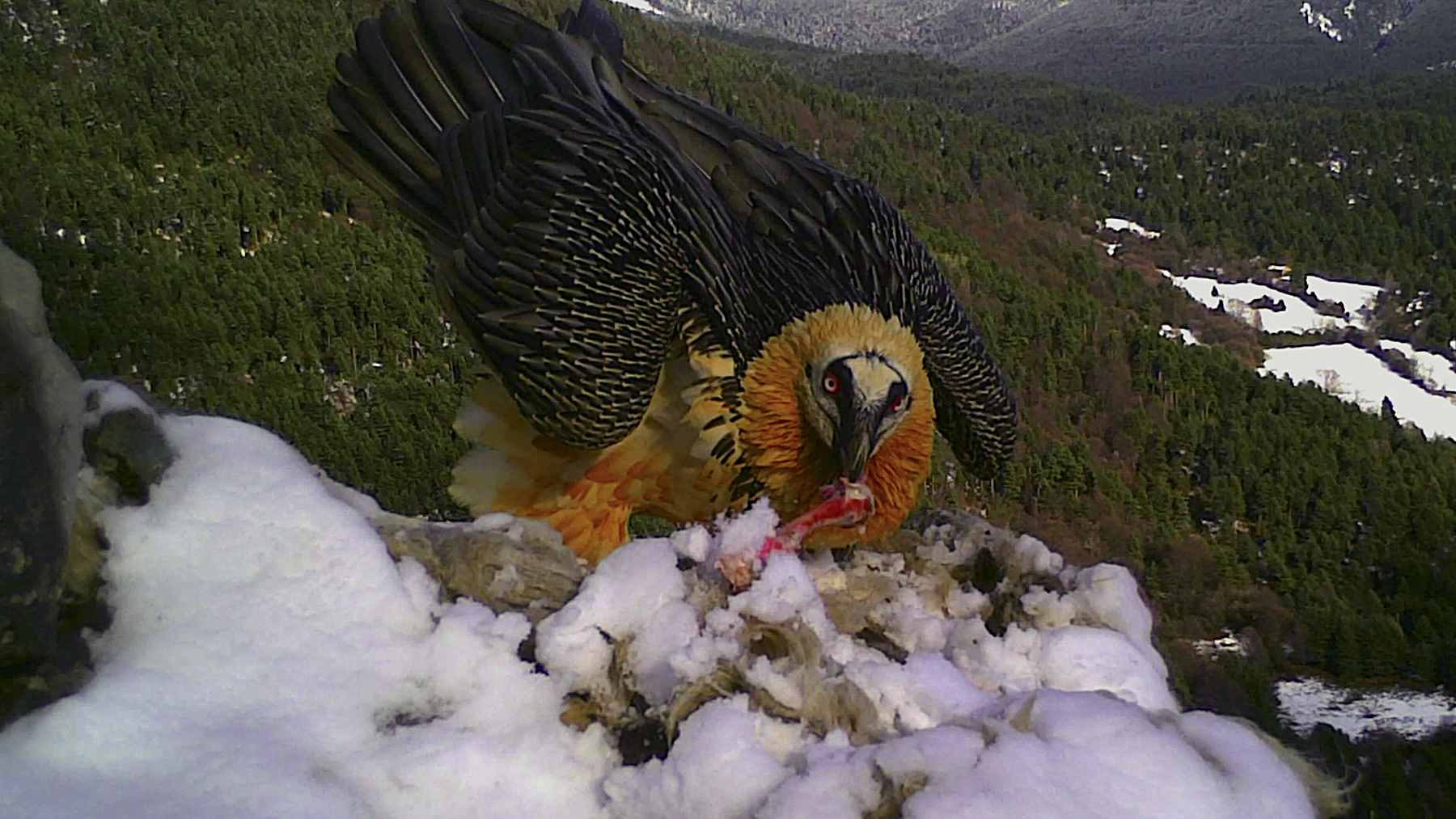
The bearded vultures of the Aragonese Pyrenees that eat bones with a vitamin boost lay larger eggs and with thicker shells. The dose is half a gram of a vitamin and mineral supplement per kilogram of body weight, sprinkled on lamb bones. The Bearded Vulture Conservation Foundation (FCQ) has tested it for four seasons.
The chicks of pairs that received that extra boost were born heavier and with stronger defenses. The foundation announced it on October 26 on its website, and is already considering expanding the species to other mountains, such as the Cantabrian Range.
A diet of carcass leftovers containing toxins
Between 75% and 90% of what this raptor eats consists of remains from other animals. The problem is that those animals themselves ingest feed contaminated with environmental toxins, according to FCQ. Over time, that alters the bird’s metabolism and basic functions such as breeding, growth, or defending itself against infection.
Adding to this, extensive farming is declining in Huesca. Fewer flocks, less food on the mountains. “In a decade there will be a million fewer heads of sheep in Aragon,” recalls Juan Antonio Gil, founder of the FCQ.
Nor were sheep always on their menu. “Fifty thousand years ago there were no sheep in the Pyrenees,” says Gil. Back then the bird fed on remains of wild goats, sheep, and aurochs, and when they disappeared it adapted to what was available.
Lamb bones at Escuaín
Initially several slaughterhouses provided remains. Later the Grupo Pastores joined, thanks to an agreement with the Government of Aragon. With it came the food that best suits the species: lamb bones.
To distribute them, the Escuaín feeding station was chosen, where birds of all ages from the Pyrenees converge. “Everyone is going to eat there,” notes Gil, so the supplement reached many individuals at once. The preparation includes vitamins A, E, and B, as well as minerals, and it was sprinkled just before leaving the bones.
Why start so early? The fat-soluble vitamins take between one and a half to two months to reach a good blood level. That is why distribution started in October and continued through January, with 2,800 kilograms of bones for 10 breeding pairs.
39 eggs rescued in four seasons
To check whether it worked, the team used eggs rescued from nests of 19 pairs, between 2020 and 2023. They gathered samples from 39 eggs and from one chick. Only 5 of those pairs had received the supplement.
In the end, 24 eggs and 14 chicks raised in captivity from those rescues were analyzed. Blood was drawn from the chicks at 20 or 30 days old. The shells, meanwhile, were examined under an electron microscope.
Heavier and stronger chicks
The chicks from supplemented pairs had higher levels of vitamin A, vitamin E, and beta-carotene in their blood than almost all the others. In other words, the bird consumed the supplement and utilized it. Their analyses also point to immune defenses that respond better to heat or to infection.
The eggs of those females were also larger, and from them hatched chicks that were heavier and gained weight more quickly in their first weeks. It’s no small feat. “We have managed to improve their immune system and produce stronger offspring and eggs,” sums up Gil.
The shells of those eggs were also reinforced. They contained more calcium carbonate and more calcium in the palisade layer. Moreover, they were among the thickest of all analyzed.
Lack of shell-breaking tests in the laboratory
That said, caution is wise. A thicker shell with more calcium should withstand more, but the authors themselves admit that this remains to be proven. Fracture tests with tensiometers are needed, and they have not yet been performed.
The sample is also small, with only five supplemented couples. An increase in hatching and survival of young has been observed in other birds, but it has not yet been measured in the bearded vulture. Therefore the study speaks of improvements that “seem” to translate into those results.
From Alto Aragón to Cantabria
In the 1970s the species was on the brink of extinction. Today, according to the foundation, pairs and trios are approaching a hundred in Alto Aragón. In recent decades, moreover, the population has surpassed 500 individuals.
For Gil, growth in the Pyrenees is stabilizing. “The challenge now is reintroduction,” he says, and he speaks of the Cantabrian Range, the Sistema Central, and the Sistema Ibérico. In Cantabria, bearded vultures are already being born in the wild in the Picos de Europa, and in Gredos bearded vultures have resumed flying.
Uniting those mountains depends on ecological corridors for the bearded vulture. In the meantime, the vitamin plan continues. The study has been published in the journal Lucas Mallada, of the Institute of Aragonese Studies.
Photo: Bearded Vulture Conservation Foundation
