
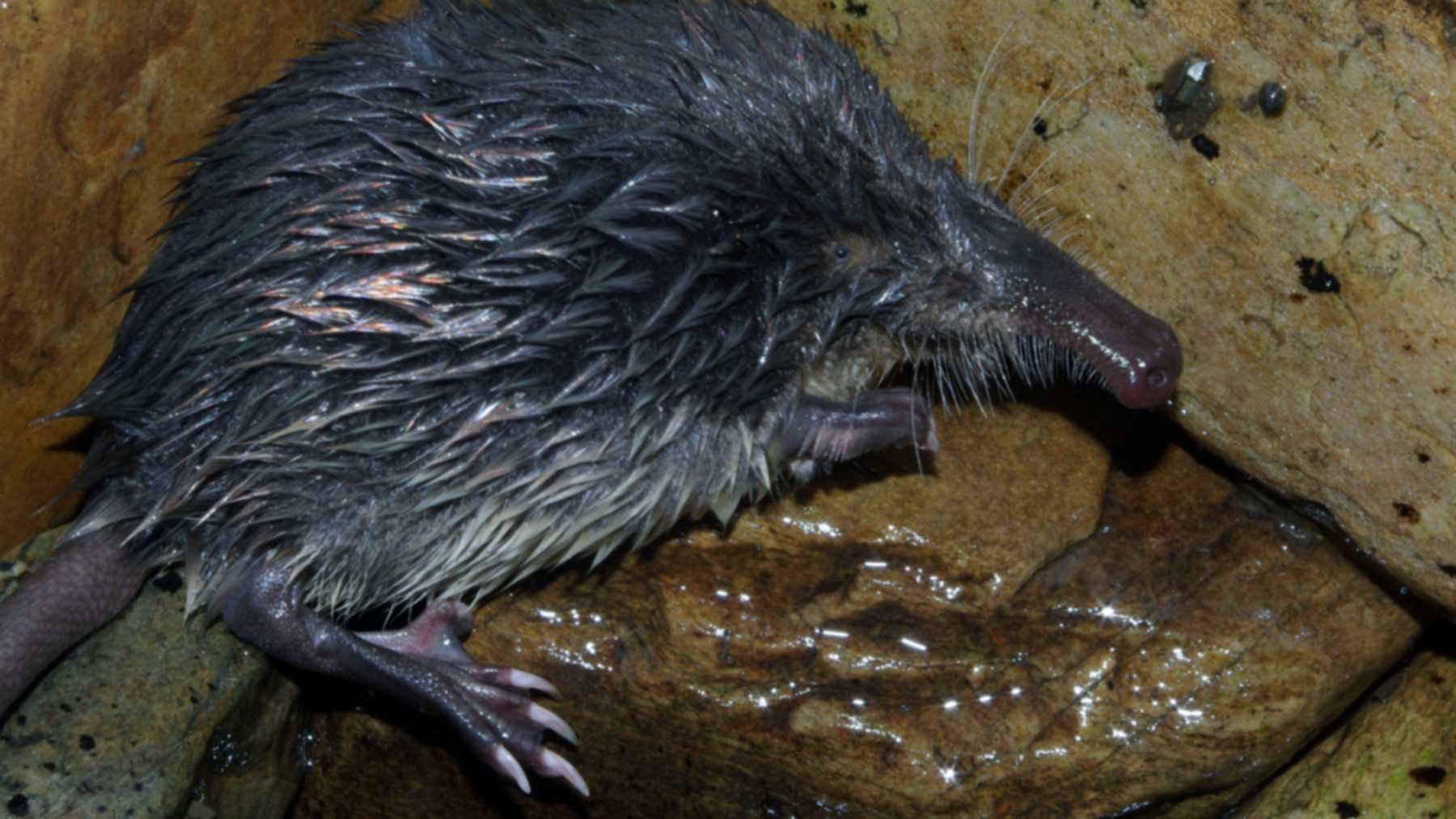
The Iberian desman (Galemys pyrenaicus) has lost almost 69% of the territory it occupied over the last thirty years, according to the presentation by geneticist Luis J. Royo, who cites the IUCN Red List. It is a small mammal that lives in mountain rivers and is found only on the Iberian Peninsula. Now, a group of geneticists from the University of Oviedo has tested in four rivers a method to detect it from the DNA it leaves in the water, without seeing or capturing it.
Royo explained it during the Guadarrama National Park Scientific Sessions in September. The park published the summary of his talk on 29 October 2026. The underlying idea is straightforward: the river preserves a genetic trail of everything that lives in it.
A Mole’s Relative That Swims
The desman belongs to the Talpidae family, the same as moles. But it is tailor-made for water. It has a long, flexible snout it uses to orient itself, webbed hind feet for swimming, and a thick, waterproof coat.
According to the presentation, its body measures between 11 and 16 centimeters, and its tail between 12 and 16. In May, we already registered the alert about its possible disappearance in Spain.
Dammed Rivers and American Minks
In a BBVA Foundation survey conducted in 2026, no respondent spontaneously named it among threatened species. How many of us could recognize it in a photo? Meanwhile, its populations live in increasingly isolated clusters.
The geneticists distinguish five evolutionary units that should be managed separately. Dams, reservoirs, and canalizations alter its habitat. Added to this are the loss of riverbank vegetation, pollution, climate change, and the American mink, an invasive species that continues to spread.
That is why the authors insist that “protecting the desman also means preserving connectivity, water quality, and the biodiversity of riverine ecosystems.” If the desman remains, the river tends to be healthier.
Sterile Gauze and Digital PCR
All living beings release DNA into the environment through skin cells, mucus, feces, or urine. The Oviedo team describes the river as a “biological archive.” This technique is already used to detect dozens of species in wetlands in Catalonia.
For the desman, the group placed in the river capsules containing sterile gauze that capture the DNA carried by the current. They tested it at 21 points across four rivers in northern Spain (Espinaredo, Narcea, Pigüeña, and Teverga). Of 83 valid samples, 26 tested positive, 31.3%.
What made the difference was the technique. Classical qPCR did not detect DNA in the river samples, while digital PCR did, because it is more sensitive when material is scarce. In controlled tests, detection reached 86.5% in flowing waters and rapids, versus 30.3% in pools.
What Feces Tell
Excrement collected from the riverbed provides still more clues. With their DNA one can identify which species left it and whether it was male or female, thanks to the X and Y chromosomes. They also reveal whether the American mink is nearby, all without touching a single animal.
Moreover, feces help study gut microbiota and reconstruct the diet. That diet is then compared with the small invertebrates found on the riverbed. This shows what is available and what is actually eaten.
The team has verified that fresh feces collected in the river do not retain all the genetic information. They do preserve “a substantial portion.” That is not a small thing for such a reclusive animal.
75 Desmans and a Dam
Hair is another source, though here one must capture the animal. From the root, microsatellite profiles identify individuals. They also measure diversity, kinship, and isolation.
In the presentation there are 75 specimens from the five evolutionary units, analyzed with 24 markers. The geographic groups appear differentiated, as expected. The next step is to measure whether dams hinder genetic exchange, and there is already a first analysis with 48 desmans.
The laboratory has also managed to culture cells from animals that had died up to eight hours earlier. They would be suitable for germplasm banks. The problem is finding the carcasses in time, something that is not common in a river.
A Paper Still Under Review
Be careful with the percentages, because these come from the talk. The work on digital PCR (Montes-Bernardo and collaborators) has been submitted for publication and has not yet undergone peer review. The feces study remains in preparation, so the method is not yet final.
The authors view it as a complement to field censuses, useful in remote areas, within a six-pronged recovery plan. Will it arrive in time? It will depend on whether genetics goes hand in hand with river restoration.
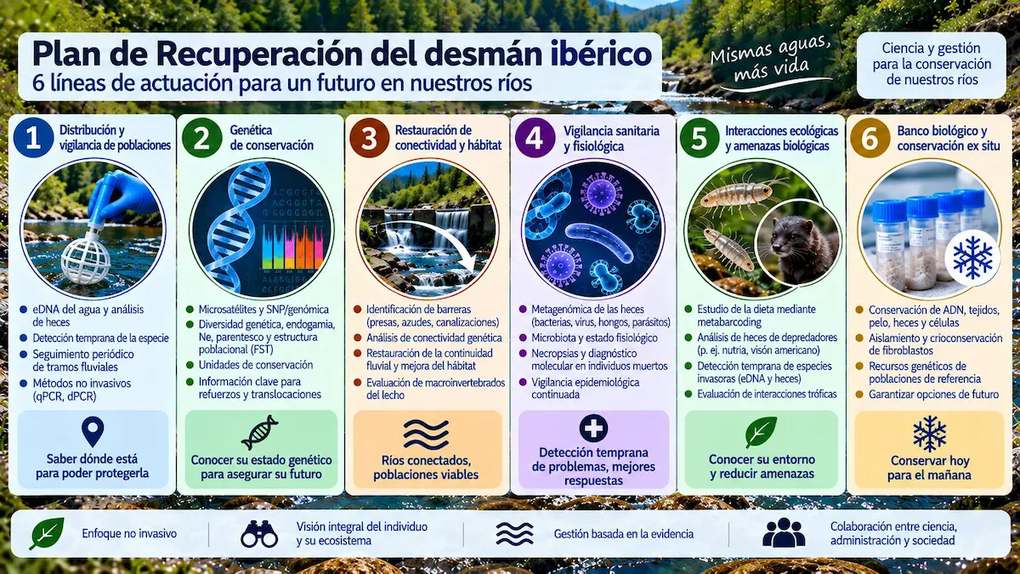
The summary has been published on the Guadarrama National Park blog, together with the full presentation of the talk.
Photo: David Pérez, CC BY 3.0
