
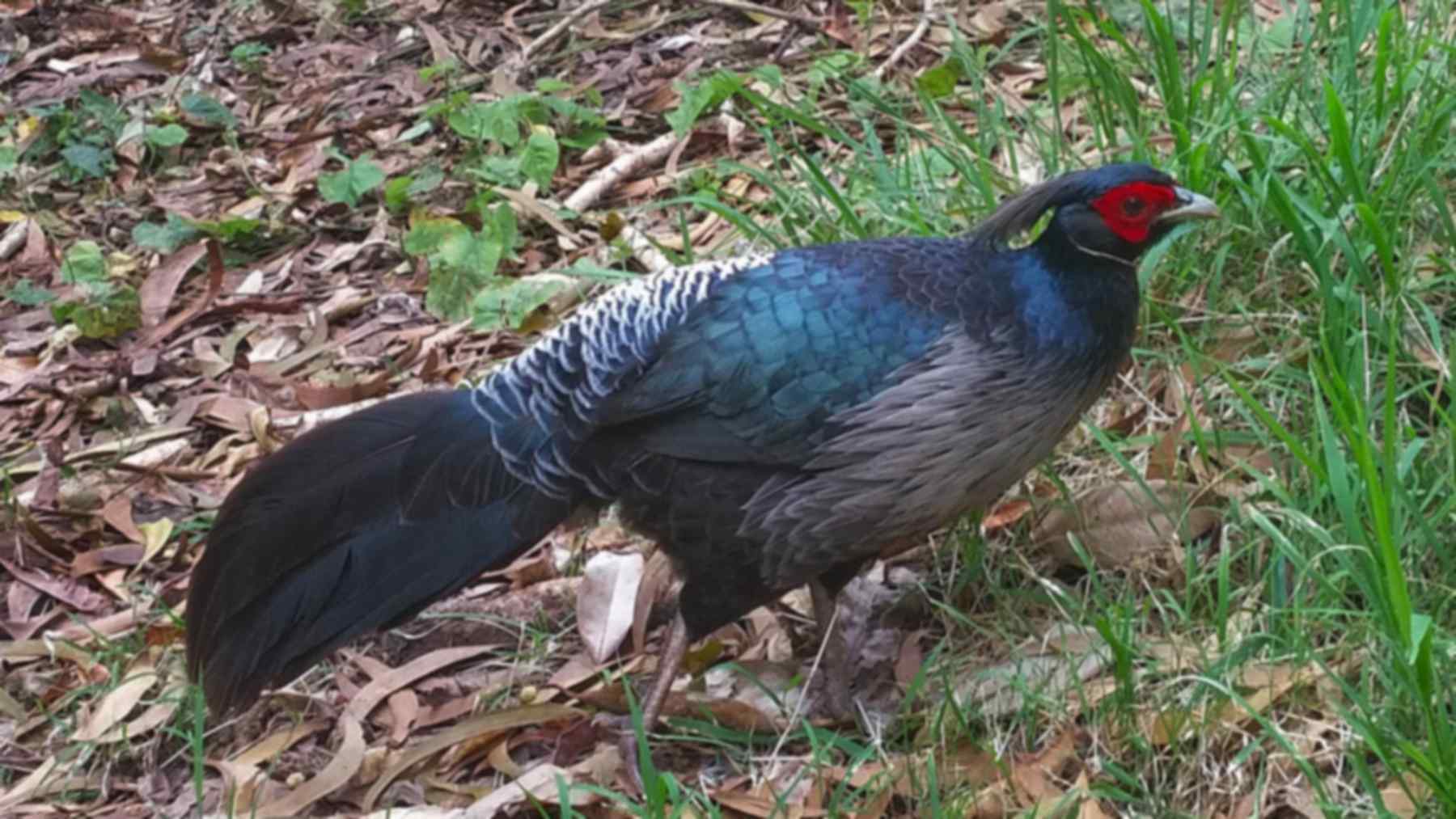
Hawaiʻi released 67 kalij pheasants in 1962 at Puʻu Waʻawaʻa Ranch on the Big Island of the archipelago, to debut a new game bird. Today the United States National Park Service points to them for spreading banana poka seeds. That invasive vine blankets entire trees.
How does a bird bred for hunters end up complicating life for a forest? Well, by eating fruit and walking a lot. Although the story has a twist, because a 2022 study found that these pheasants also destroy almost all the seeds they swallow.
The last of twelve
Hawaiʻi had no native ground-dwelling game birds, so they imported them. The Hawaiian Volcano Observatory, which is part of the United States Geological Survey, lists twelve species including pheasants, quail, partridges, peafowls, and wild turkeys. The kalij, native to Asia, was the last to arrive. According to a study published in The Auk, the 67 birds from 1962 came from game farms in Michigan and Texas.
By around 1985, and indeed they had adapted, they already occupied all the island’s forests above about 610 meters in altitude. Today the Hawaiʻi Volcanoes National Park describes them as common birds throughout its territory.
According to the observatory, the males are monogamous and behave like “model fathers.” The families defend their patch of ground with determination. Many offspring stay with them until the following spring.
Eight kilometers per year
A study presented in 2010 by researchers from the University of Hawaiʻi and the U.S. Army summarizes the expansion described in 1984 by Lewin and Lewin. The kalij colonized most of the island’s forested areas in just 14 years. They advanced about 8 kilometers per year, and that’s not bad at all.
That 1984 study identified 19 plant foods in their crops and gizzards, as well as slugs, snails, scale insects, and earthworms. Among the invasive plants they ate was banana poka. And that is where the problem begins, because what goes in through the beak can travel much farther out.
An Andean vine
Banana poka comes from the Andes and was first collected on the island of Hawaiʻi in 1926, according to the University of Hawaiʻi’s weed guide. Its elongated fruit ripens yellow. It is spread by feral pigs and birds, so free dispersers are plentiful.
The Hawaiʻi Volcanoes National Park describes it as “a major threat to Hawaiʻi’s forests” on its invasive plants page. It forms dense mats and climbs to smother tall trees, like throwing a blanket over a piece of furniture.
Controlling it with herbicides is difficult when the mass is out of reach and on top of other plants. Many cut stems regrow if not treated. The park also attributes the spread of wild raspberry and guava to the pheasant, as well as diseases such as malaria.
Less than 5% survive
Here’s the nuance, because Samuel Case and seven other researchers fed seeds to captive kalij pheasants and Erckel’s francolins. They then studied what these birds dispersed in the wild, on Oʻahu and on the island of Hawaiʻi. Fewer than 5% of the seeds survived passage through the digestive tract.
Passing through the kalij’s guts also reduced the germination of those that emerged intact, especially for native plants. Larger seeds fared worse. In the field, these birds moved native and foreign seeds in similar proportions.
Villain then, or not so much? The authors describe it as a double-edged sword. These birds can curb some invasive species by eating their seeds, but they also end up consuming seeds of native species.
Oʻahu already has its own
The story repeated itself in the Waiʻanae Mountains on Oʻahu, where kalij appeared after one or more unauthorised releases. The first pair was spotted in 2003. By 2010 there were 56 sightings and at least 10 family groups.
Those technicians already wondered whether it was too late to eradicate them. They feared for endangered plants and native land snails, though as a possible risk, without measuring it. A similar scenario has occurred on other islands with the removal of invasive goats in the Galápagos, which forced the culling of more than 140,000 animals.
Nor is this the only imported hunt or fish that ended up costly. New Zealand experienced issues with brown trout released for sport fishing. And there are many invasive plants capable of conquering new climates quite easily.
The tally remains without a percentage
It remains to be seen how much banana poka can truly be attributed to the kalij and how much to pigs or other birds. The park provides no figures. It also does not specify how many hectares the vine has gained due to the pheasant.
Therefore it’s wise to read the story with a degree of caution. Banana poka had been on the island for decades when those birds arrived, and other animals also move it. And that makes it quite difficult to pin down a single culprit.
The study on seeds and introduced birds has been published in Biological Invasions.
Foto: Andy y Fiona Potts / Hawaiʻi Birding Trails (DLNR de Hawái)
