
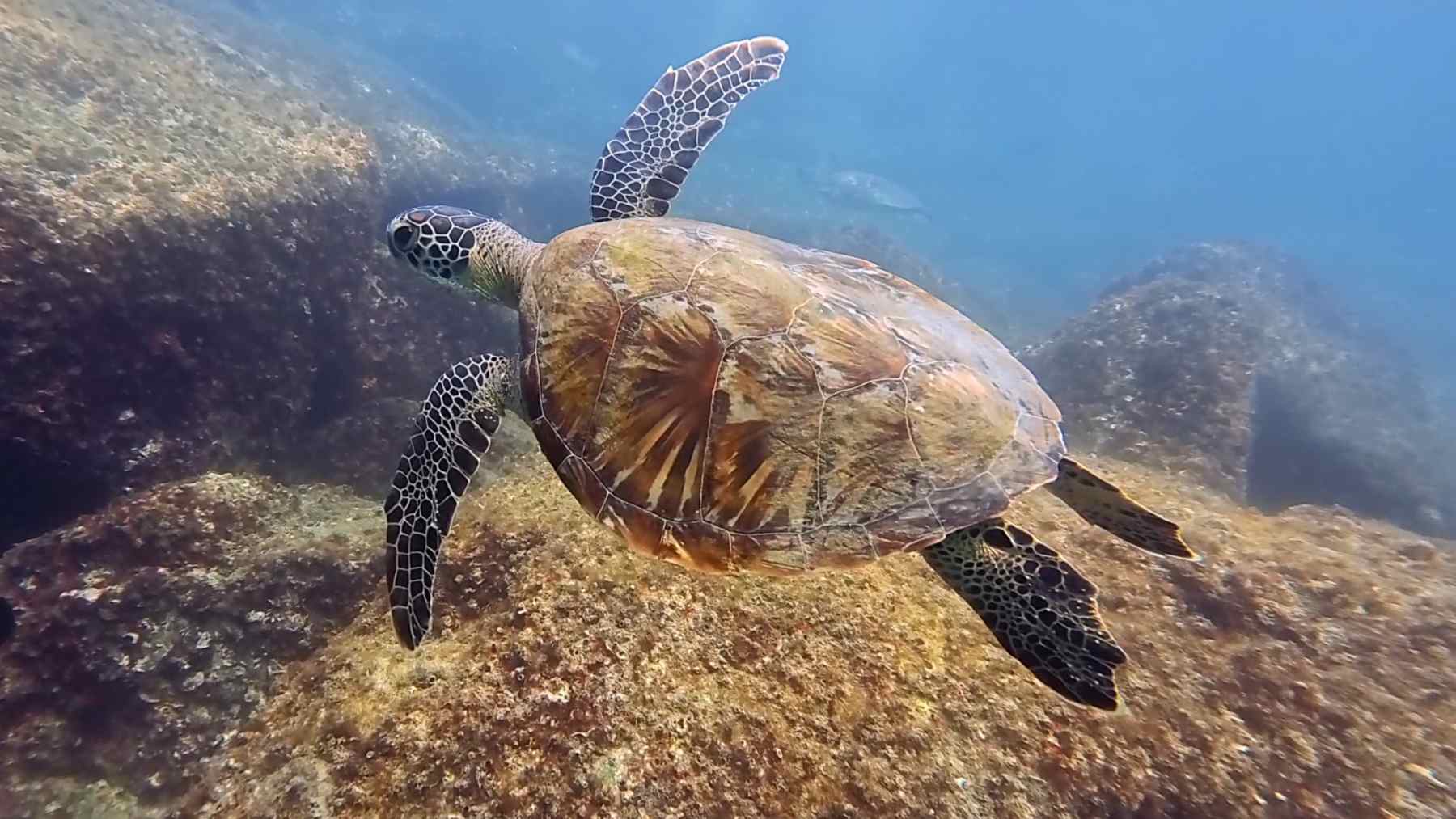
Nine young green turtles tracked by GPS in the United Arab Emirates spent more than 80 percent of their time in a protected wetland. Curiously, where they concentrated was in an artificial lagoon dug in 2003 for a leisure and commercial project. The study was published this week in the Aquatic Conservation journal.
It is authored by the Sharjah Environment and Protected Areas Authority (EPAA) and the University of Exeter in the United Kingdom. Can a project designed for promenades and leisure serve as a nursery for a marine species? According to their data, yes, although with one condition that depends on the adjacent mangrove.
Nine GPS-Tagged Turtles
The researchers tracked nine juvenile green turtles (Chelonia mydas). All of them had a carapace measuring less than 60 centimeters. To follow them, they used high-precision GPS telemetry that records their movements day and night.
According to the study, the turtles proved to be “highly resident.” They generally did not venture more than 3 kilometers from the entrance to the wetland. For the authors, this confirms that the area serves as a nursery for them to grow before venturing into open sea.
A Lagoon Without Its Project
The protected area is named Al Qurm Wa Lehhfaiiah and is located on the coast of the Gulf of Oman. Since 2013 it has been a Ramsar site of international importance and a Key Biodiversity Area. Inside there are mangroves, forests of trees and shrubs that tolerate saltwater.
The lagoon was excavated in 2003 as an extension of the Khor Kalba mangroves. Initially it formed part of a large recreational and commercial seafront, according to the Exeter note. Over the years the project changed, but the lagoon remained and nature eventually occupied it.
Today the Sharjah government protects most of the area from construction, fishing and navigation. It is, according to the researchers, the last mangrove remaining on the east coast of the United Arab Emirates.
Algae and Few Sharks
In the artificial lagoon, the turtles were five times more likely to use the area than the mangrove’s natural channels. Additionally, 77% of their main use zones fell within that water body. There they spent the night and, most likely, also fed.
And why right there? “The bottom of the lagoon is covered with algae, which probably provides food, and we believe few predators, such as sharks, cross the mangrove to reach this particular habitat,” explains Owen Exeter of the University of Exeter. In other words, food at hand and few scares.
The researcher himself calls it a “happy accident.” For him, it is an example of how wildlife makes its way in an increasingly human-dominated world. But he warns that, without the natural mangroves beside it, it would be unlikely to have happened.
The Channels, Gateway to the Sea
That the lagoon provides shelter does not explain everything, let alone fully. According to the study, the mangrove’s natural channels are what connect the turtles to the sea. Through these channels they go in and out at the rate set by the tides.
In fact, their presence in those corridors followed a clear tide-driven pattern. For this reason the authors propose protecting the channels that connect the wetland to the ocean. In their view, this would further improve conservation outcomes.
“Our results show how important coastal wetlands can be for young green turtles,” insists Exeter. Wetlands, moreover, are among the planet’s most threatened ecosystems. They face a fate similar to mangroves, which are only now beginning to reclaim ground after decades of retreat.
Over 700 Kilometers to Oman
One of the tracked turtles undertook a long southern migration. It swam more than 700 kilometers to the heart of Oman. That route makes clear that, as these animals grow, they require protection well beyond Sharjah.
In the Galápagos, by contrast, other satellite-tracked green turtles hardly strayed from the marine reserve. And although it was expected they would migrate, the species has improved so much that the IUCN removed it from the endangered species category.
Beaches and Nets Not Studied
The study is limited to nine juveniles from a single Emirati wetland. It does not say how adults fare or how turtles from other coasts are doing. It also does not measure what happens on nesting beaches, many of which have already been lost due to coastal construction.
In the open sea they also face fishing, boat traffic and pollution, the official note reminds. “Overall, our results show that coastal wetlands, including constructed ones, can offer a valuable habitat for young turtles, provided they are designed with ecological connectivity in mind and human pressures are subsequently minimized,” concludes Brendan Whittington-Jones of the EPAA. The study has been published in Aquatic Conservation.
Photo: Owen Exeter/University of Exeter
