
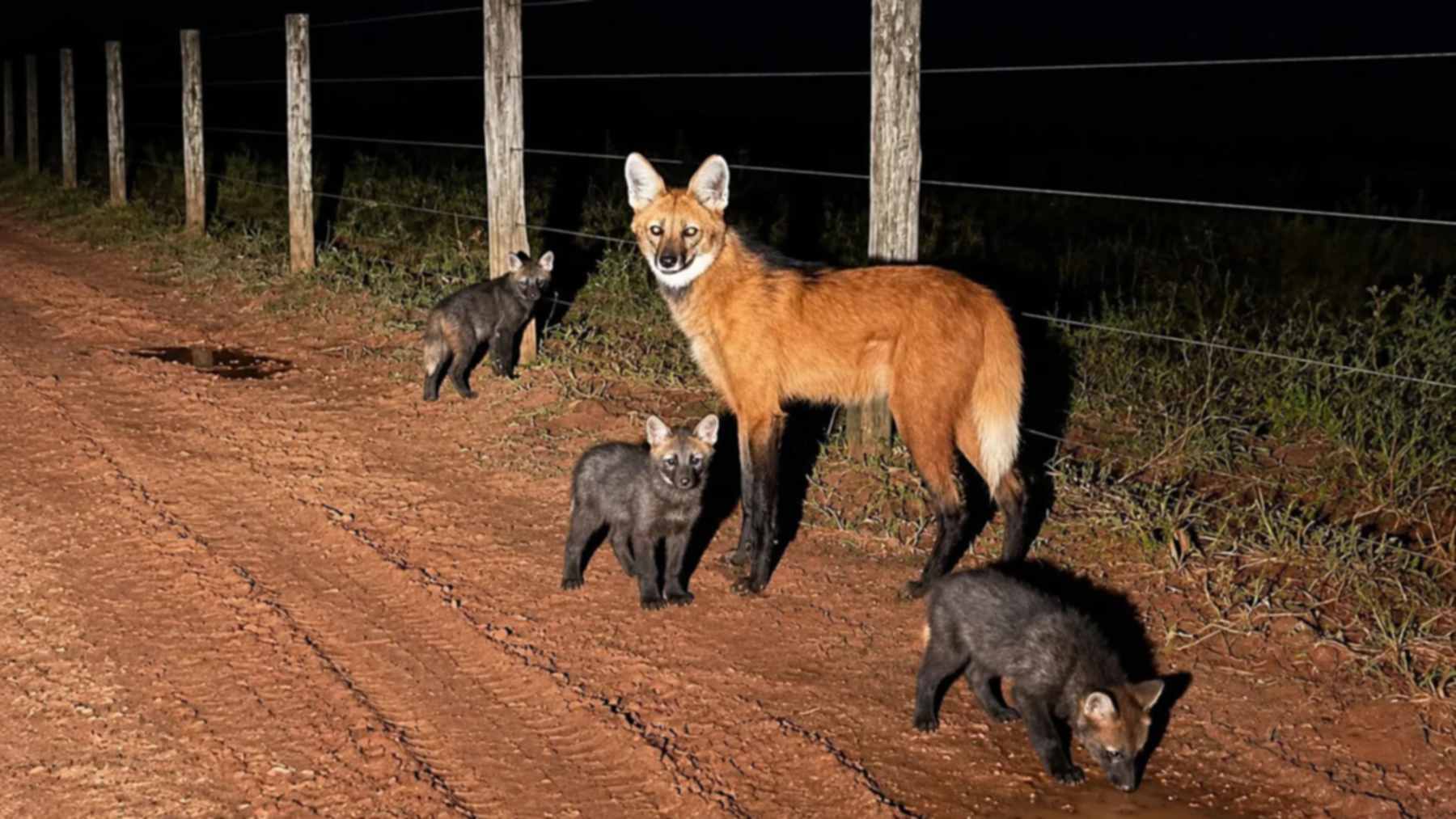
A maned wolf and its three cubs have been sighted near the Barreiro Rico Ecological Station, between the Piracicaba and Tietê rivers in the interior of São Paulo. The report arrived on November 6 from the official government agency of São Paulo. And this isn’t just any photo, because the species is threatened with extinction.
As if that weren’t enough, that area hasn’t recorded a forest fire since 2018. Could one thing be connected to the other? The official note does not prove it, although those who manage the space interpret it as a good sign.
Orange groves, eucalyptus and roads
We are talking about South America’s largest canid, the same animal known as aguará guazú or lobo de crin in Argentina. It has long legs, a narrow snout, and reddish fur. It usually roams freely, traversing large areas in search of food and shelter.
Since 2020, more than ten individuals have been sighted at various points in Barreiro Rico, according to the Forestry Foundation, which manages these spaces. It is mainly associated with the Brazilian Cerrado, but it also moves through orange plantations, eucalyptus stands, and sugarcane fields.
When roads come close, trouble often follows. “This sighting reinforces hope for the species’ conservation,” says João Marcelo, manager of the station, who calls for “doubling the care to prevent collisions.” Anyone who has driven at night along a rural road knows what this is about.
A bridge for the muriqui
To reduce roadkill, in Barreiro Rico they have identified the most dangerous stretches and keep track of animals killed on the road. They have also put up signs. In 2024, they completed an aerial crossing for the muriqui (a primate) and other wildlife, extending to the Hacienda Bacury forest.
Here, it isn’t merely the luck of a single animal that is at stake. The maned wolf feeds on small mammals, birds, and reptiles, and also on fruit such as lobeira. It then disperses the seeds through its feces, giving a hand to vegetation.
Eight years without fires
According to the manager, the fires have not come without a price. Behind the effort are the Forestry Foundation, other agencies, brigades, and rural landowners who create firebreaks, patrol, and even visit schools to explain the issue. Without the owners of the fields and their workers, they acknowledge, this would not last.
“We are celebrating the octet, eight years without forest fires in the area,” sums up João Marcelo. The last fire occurred in 2018 and the worst in 2012. In a landscape of crops and pastures, this is no small feat.
Three hundred hectares and much more around
Founded in 2006, the ecological station enjoys full protection and spans less than 300 hectares. Surrounding it is a protected area established in 2018 for sustainable use, which now exceeds 30,000 hectares, spanning Piracicaba, Botucatu, São Pedro and Anhembi.
There, citrus, sugarcane, eucalyptus, and cassava blend with pastures, riverbanks, and large tracts of forest. Among these remnants of forest lies a massif of more than 1,500 hectares.
There is much more than wolves in the area, of course. The management notes more than 37 species of mammals, including five primates and four felids. It also accounts for more than 200 birds and over 500 plant species.
Sarcoptic mange, distemper, and roaming dogs
Nonetheless, a beautiful photo does not erase the threats. This species loses habitat, faces hunting and road accidents, and, on top of it, contracts diseases from domestic animals. Sarcoptic mange causes itching, hair loss, and can leave the animal in tatters.
In Itirapina, the Foundation has already had to capture and treat sick wolves. Then come canine distemper and parvovirosis, and the solution is familiar to anyone with a dog (vaccinate it and do not let it roam in protected areas).
An account without a census
From 2022 to 2025, the MonitoraBioSP program recorded 3,062 observations of this species in Fundação Forestal areas. Of these, 1,392 come from the two Itirapina stations. Another 831 originate from Jataí and Luiz Antônio.
Careful with that figure, though. The note itself warns that it cannot, by itself, be used to calculate how many wolves are in the state. It also does not indicate when the photo of the family was taken or what happened to the cubs.
What it does show is where the wolves move. Andrea Pires, director of Biodiversity at the Fundação Forestal, believes these data “are fundamental” to guiding conservation. And with such an elusive species, that’s already a lot.
The official press release was published by the SP Agency of the Government of São Paulo.
Photo: Government of São Paulo
