
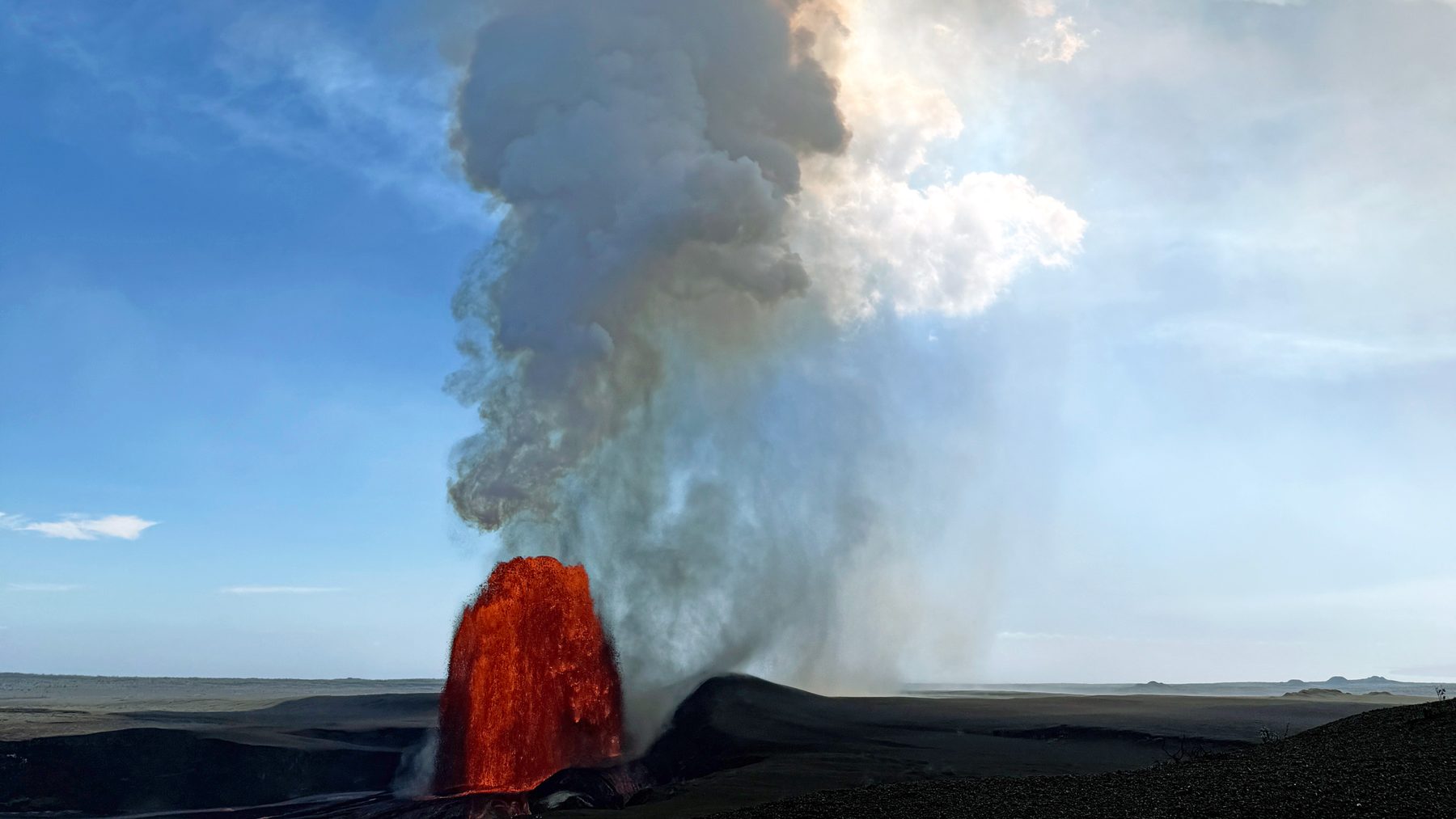
The Kilauea volcano, on the Big Island of Hawaii, could once again spew lava into the air this week. The Hawaii Volcano Observatory, part of the United States Geological Survey (USGS), stated this in writing on Saturday, November 14. It places eruption episode 57 between November 17 and 22.
The previous one, on November 5, produced lava fountains of about 200 meters. Its gas plume rose to about 5,500 meters above sea level. Since then the summit has not stopped swelling, which means the volcano is recharging.
Six hours of lava fountains
Episode 56 began at 12:10 p.m. Hawaii time on November 5 and ended at 6:01 p.m. All the lava exited through the north vent, one of the two still open in Halemaʻumaʻu crater.
During that period, according to the USGS, the volcano expelled about 6 million cubic meters of lava. Still, it was not the tallest. The USGS eruption chronology records episode 43, on March 10, 2026, with fountains reaching around 540 meters.
The summit swells again
Since the end of the last episode, the Uēkahuna inclinometer has logged nearly continuous inflation. It now totals about 11.9 microradians. In the last day, that rate did slow a bit.
That instrument measures something as simple as the ground’s tilt. If the ground slowly bulges, the volcano is loading up. If it suddenly deflates, lava has started to flow out.
With these signals, the observatory sees a high likelihood of another episode in the coming days. The alert remains at advisory level, with the aviation color code Yellow.
Lava lakes in the crater
That the eruption is paused does not mean the volcano is asleep. Cameras captured at night a glow ranging from moderate to strong in the north and southwest vents. In a helicopter flight on November 10, geologists observed lava roiling at depths of about 40 to 50 meters in both vents.
One day before the last episode, on November 4, the lava pond in the north vent measured about 30 meters across. The one in the southwest was roughly 40 by 20 meters.
According to the latest update, Kilauea also continues releasing gas. On November 13 it emitted about 3,000 tonnes per day of sulfur dioxide, which the trade winds carried toward the southwest. In the Canary Islands it’s well known, because La Palma keeps gas monitoring after Tajogaite.
Pele’s Hair on the Road
What happens at the crater does not stay at the crater. On November 5 the plume swung to the northwest, toward Mauna Loa. Most of the tephra (the fragments ejected by the volcano) fell to the southwest, in a restricted area of Hawaii Volcanoes National Park.
On a stretch of Highway 11, west of the summit, fine ash and Pele’s hair rained down. That is how Hawaiians refer to slender threads of volcanic glass, as thin as a hair. They are named after the island’s volcano goddess from local tradition.
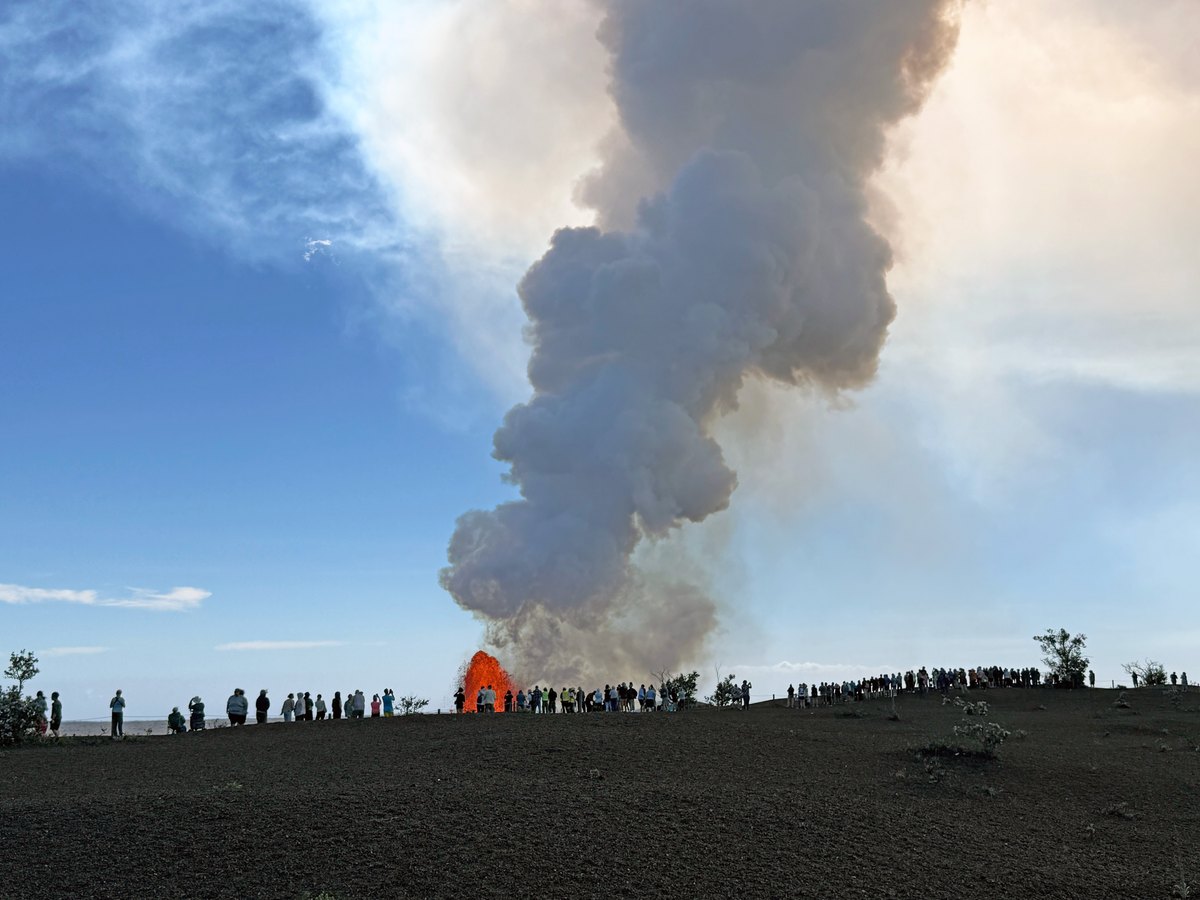
Many people, moreover, did not want to miss it. The photo chronicle of episode 56 shows a crowd at the Uēkahuna overlook, watching the lava fountain from the north vent beneath a huge gas cloud.
Casi dos años de episodios
Since December 23, 2024, lava from Kilauea intermittently emerges through two main vents at Halemaʻumaʻu. The episodes typically last less than 12 hours, with pauses of two weeks or more. Something similar has been seen at the Icelandic volcano that erupts again and again.
Until episode 50, the USGS had already calculated 284.7 million cubic meters of lava, which so far has not left the crater. It isn’t the first time this volcano has sparked discussion. Its 2018 eruption even triggered an algal bloom in the North Pacific.
For visitors to the island, geologists point to risks such as gas, tephra, earthquakes, and ground cracks. The crater rim is a highly dangerous area, and for that reason it has been closed to the public for years.
No fixed time or height planned
The window from November 17 to 22 is a forecast, not a fixed appointment. The USGS does not reveal when episode 57 will start or how high the fountains will reach. And the wait afterwards could be short or long, because after episode 55 there were 19 days and after 54 as many as 52.
Forecasting a volcano remains difficult, though there are advances such as the Spanish system for predicting eruptions that the UN has chosen as a model. Meanwhile, the USGS streams the crater live on YouTube. The forecast was published by the Hawaii Volcano Observatory in its daily update on Kilauea.
Photo: L. DeSmither/USGS
