
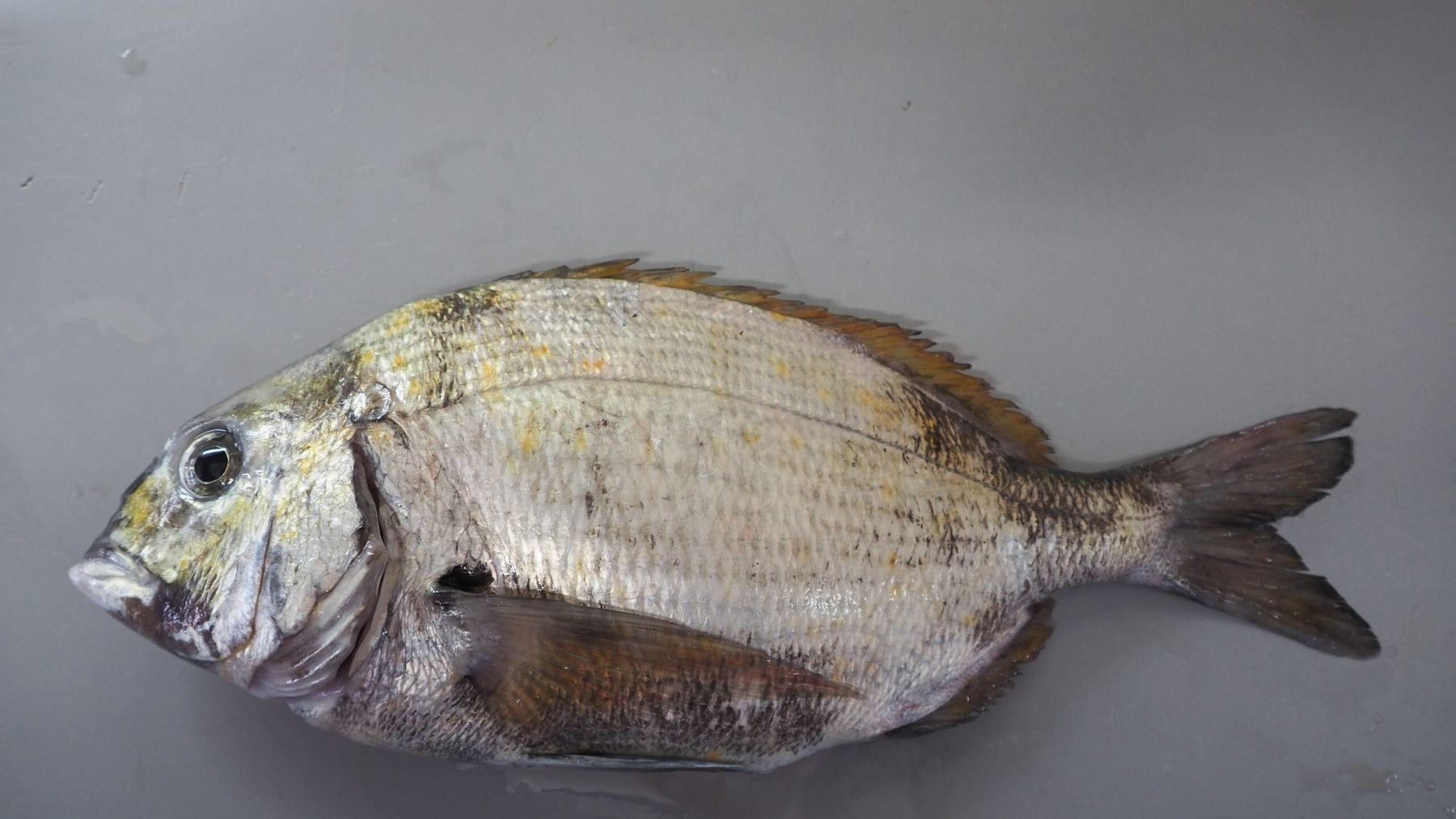
A sole with a dark underside, a common seabream with an anomalous coloration, and a toadfish with pigment loss. These are the three cases of coloration anomalies recently described by a team from the Spanish Institute of Oceanography (IEO-CSIC). Universidade de Vigo also participated, and the fish were found in waters off Galicia and Andalusia.
The sole has proven to be far more than a local oddity. Building on that fish, the team reviewed what has been published worldwide. There are records of this anomaly in 79 species of flatfish. Does that mean something is wrong in the sea? Well, no one can say yet.
The Two-Faced Sole
Anyone who has cleaned a sole at home will have seen it. From above it is dark, to blend in with the bottom. From below it tends to be white, because that side is almost always pressed against the sand.
But the Vigo estuary specimen, a Senegalese sole, carried the underside pigment almost completely. Specialists call this ambicoloration. It sounds like a rare disease, but it simply means there is color where it shouldn’t be.
From Baiona to Cádiz
The other two cases have nothing to do with a flatfish. Perhaps that is why they draw so much attention. In January 2026, a common seabream was landed in Baiona Bay. According to the IEO, it had a mixed pigmentary anomaly, i.e., a color that does not fit the normal for its species.
Further south, in the Gulf of Cádiz, scientists found a toadfish with pigment loss. What is seen in it is compatible with oculocutaneous albinism. With such a markedly changed animal the eye can mislead, so the team confirmed the three species with genetic analyses.
The work comes from the same institute that detected 63 humpback whales in the Rías Baixas. This time, with considerably smaller animals.
Three suspects underwater
There are three more fish in this story, but with an asterisk. While diving in the Vigo estuary during 2025, scientists photographed common seabreams and corkwing wrasses (Labrus bergylta) with unusual markings.
Those have not been given a definitive label yet. They may be anomalies, or they may not, because natural variations or physiological color changes cannot be ruled out. And that makes sense.
Hundred studies, 79 species
The real story came later. The Vigo sole prompted the team to review what has been written about soles, turbots, and plaice. These are the flatfish with both eyes on the same side of the head.
After going through about a hundred publications, they gathered cases across 79 species from ten families. According to the IEO, no one had previously conducted a global review of this coloration anomaly in wild populations. It is no small feat.
Some specimens carry only dark blotches and others have the underside nearly entirely pigmented. The skin of fish, by the way, continues to throw up surprises in other aspects, such as the microbes associated with terrestrial fish.
Pollutants, heat, or poor diet
The color of a fish depends on chromatophores, the cells responsible for its pigmentation. Behind them lie genes, hormones, and physiology. When something goes wrong there, albinism, melanism, or ambicoloration can occur.
Other studies point to genetics and developmental faults. They also point to pollutants, temperature changes, or poor nutrition. That is why it matters, as it does to understand whether coastal urbanization provides more food and more stress to fish.
Rafael Bañón, a researcher at the Vigo Oceanographic Centre and the lead author, sums it up cautiously. Recording these cases with a method, he says, can improve knowledge of the processes that regulate fish coloration. And it can also “provide new tools for environmental surveillance.”
Years of follow-up are needed
That said, it’s prudent to proceed with caution. These fish appeared by chance, without any sampling behind them. The authors themselves warn that one cannot link their color to environmental status. Neither in the Vigo estuary, nor in Baiona, nor in the Gulf of Cádiz.
Nor is it known how often this truly happens. For that, long-term monitoring with standard methods and environmental data would be needed. Only then will we know if these can serve as indicators of the health of the sea.
For now, a dark two-faced sole is a clue and not a diagnosis. The study has been published in Marine Pollution Bulletin, and the IEO-CSIC reports it in its official note.
Photo: IEO-CSIC
