
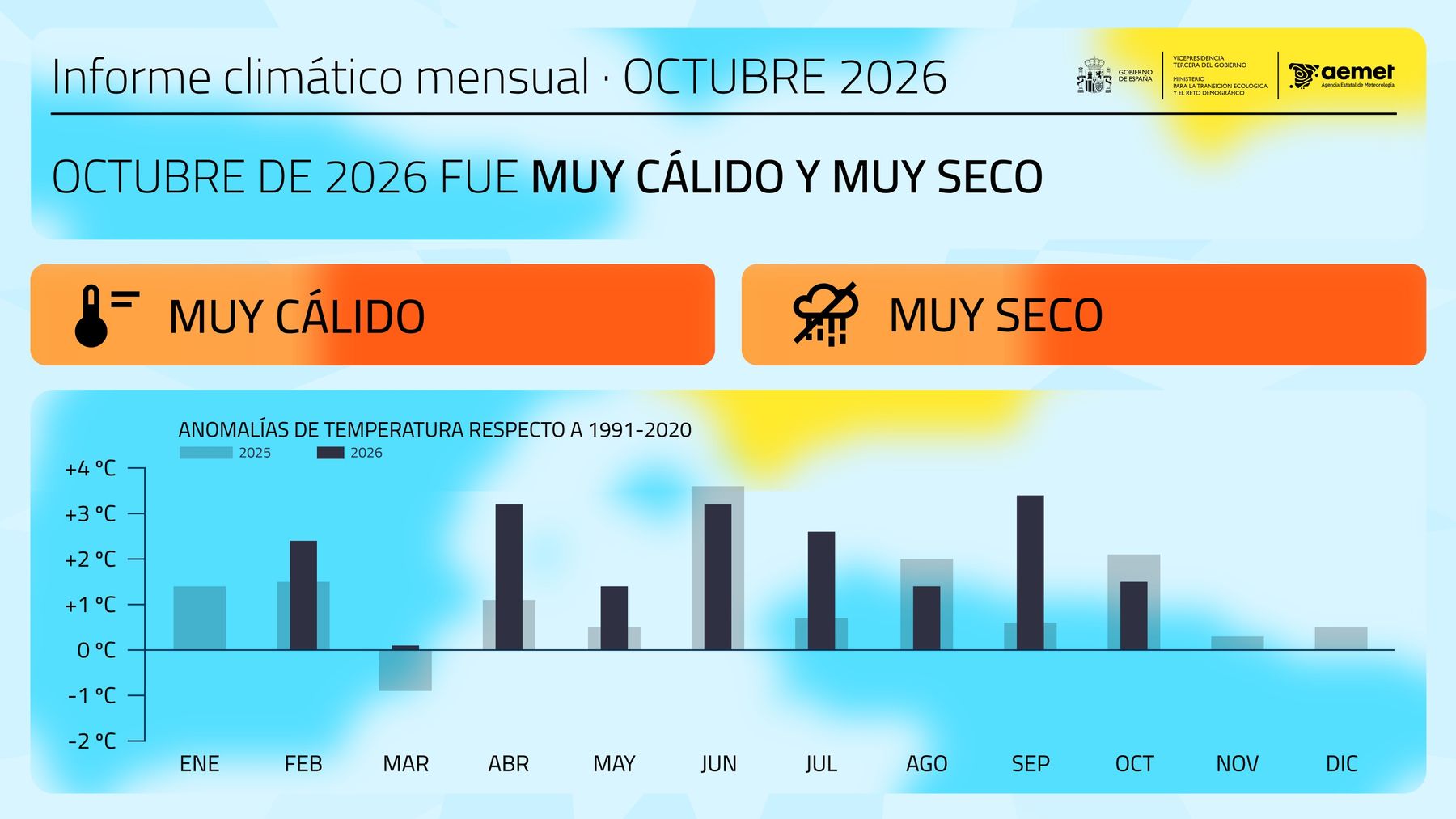
October 2026 was a very warm and very dry month across the entire peninsular Spain. This is how the State Meteorological Agency summarizes in the advance of its climate balance. The average temperature stood at 16.1°C, 1.5 degrees above normal, and rainfall amounted to two-thirds of the usual amount.
The distribution was highly uneven, because while Galicia and the southwest experienced an extremely dry month, the Mediterranean endured torrential rains. In Pego (Alicante) 620 liters per square meter fell in a single day, according to the Ministry for Ecological Transition’s note.
An October 1.5°C warmer
The October average for the 1991-2020 period is around 14.6°C. This year the month has clearly exceeded that. It is the tenth warmest October since the series began, and seven of the nine that surpass it are from the 21st century.
The heat pressed mainly on the Balearic Islands and along the southern coast. It also affected the Guadalquivir depression and the low plains of the Tagus and the Douro. On the Costa del Sol and the southern Almería it became extremely warm.
Only some areas of Galicia remained at normal values. The islands were not spared from the heat either. The Balearic Islands closed the month with an average of 20°C, 1.2 degrees above normal, and the Canary Islands with 21.3°C.
Seville, 34.5°C
The highest temperature among the main stations was recorded at Seville Airport. It reached 34.5°C on the 14th. A day earlier, Córdoba and Morón de la Frontera had marked 34.2°C.
The nights were also exceptional in some spots. Six main stations beat their record for the highest minimum temperature on an October day. In Huelva, the day’s minimum on the 3rd did not fall below 21.8°C, two tenths above the 1985 record.
The lowest minima of the month occurred on the 24th. Molina de Aragón registered −1.1°C, Salamanca −0.9°C and Burgos −0.6°C. In the Navacerrada pass, the thermometer had already fallen to 0.2°C on the 9th.
Rain, at 67%
Across the peninsula, 52.1 mm fell. It is 67% of the usual October rainfall. About 26 mm short of the 1991-2020 average, which stands around 78 mm.
It was the twentieth driest October since 1961 and the fifth of the twenty-first century. The very dry character dominated in Galicia and the western part of Castile and León. It also affected much of Extremadura and the western part of Andalusia.
In areas of Galicia and the southwestern Andalusia the month became extremely dry. By mid-November, rainfall had raised the water reserves to 57%.
The Adam DANA in Pego
In the east, a good part of Catalonia and the Valencian coast experienced a wet or very wet month. The same happened in sectors of Castilla-La Mancha and the southeast, with zones extremely wet. DANA-type systems like those of this autumn find more fuel in a increasingly warm Mediterranean.
The heaviest rains arrived with a high-level isolated depression, or DANA, nicknamed Adam. On the 18th, Pego accumulated 620 mm. It is almost 12 times what fell on average across the peninsula during the entire month.
Ibiza, Tortosa and Barcelona
Several stations beat their daily October rainfall record. San Javier (Murcia) collected 180 mm on the 2nd and Ibiza 177 mm on the 18th. Gijón and El Hierro also exceeded their records, with 74 and 75 mm.
In the monthly total, Tortosa (Roquetes) added 312.6 mm and Barcelona airport 303.6 mm. The two hover around six times the peninsula’s average. They were followed by Ibiza, with 264.9, and San Javier, with 256.6.
Ibiza and El Hierro also had October’s wettest month on record for their stations. Across the Balearic Islands, rainfall amounted to 105.4 mm, 133% of normal.
A preliminary assessment from the main stations
According to AEMET itself, this balance remains a preliminary view. It collects figures from the main stations on the peninsula, in the Balearic Islands and in the Canary Islands.
Beyond that network, there are records such as Pego, which the agency cites separately. The complete station-by-station data are in AEMET’s October 2026 monthly climate report.
Image: AEMET
