
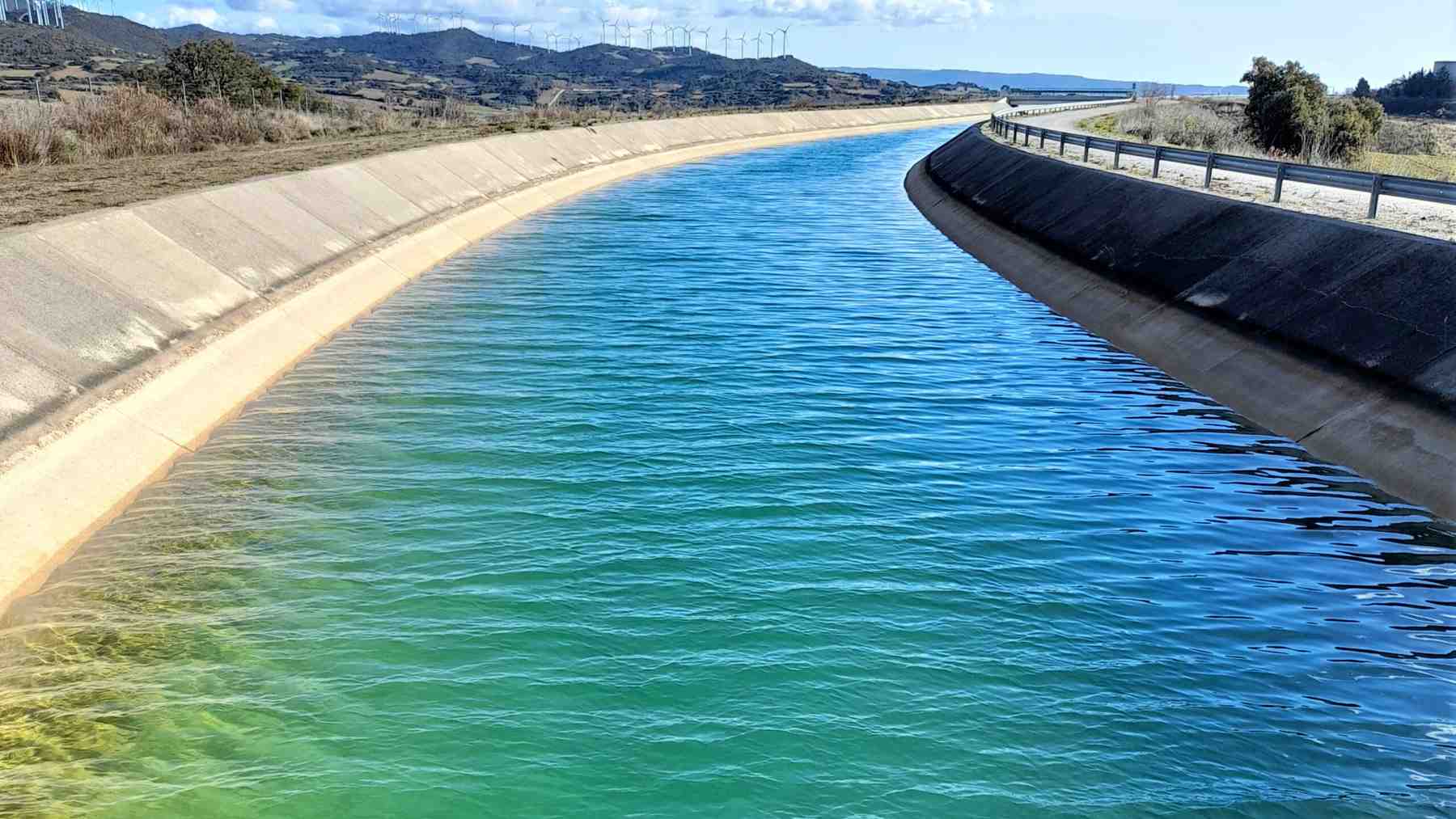
The Canal de Navarra aims to deliver drinking water and irrigation to La Ribera, in the southern part of the autonomous community. To achieve this, it requires its second phase. The Council of Ministers authorized on November 17 the second agreement with the Foral Community, which sets out how the remaining funds will be financed: 354.4 million euros.
According to the Ministry for Ecological Transition’s statement, the canal’s total budget amounts to 850 million euros, excluding VAT and financing costs. Of that figure, 495.6 million correspond to works already completed.
Water for 350,000 people
One of the canal’s three objectives is to supply water to more than 350,000 inhabitants, about 60% of Navarre’s population. It already provides water to the associations within the Pamplona region, Mairaga, and Izaga.
The second objective is to convert up to 57,976 hectares into irrigation. With the first phase and its expansion completed, the canal serves around 35,000 hectares, according to the company that built it.
The third objective is to generate electricity. Its two hydroelectric plants, one at the Itoiz dam’s foot and another at the canal intake, amount to 48.6 MW. According to the company, they produce the equivalent of about 6.5% of Navarra’s energy consumption.
20,214 more hectares in La Ribera
The second phase will cross the Aragón and Ebro rivers to the Lor lagoon in Ablitas. According to Canal de Navarra’s official description, it will enable irrigation across a maximum of 20,214 hectares.
It will also connect to the supply network of several towns in the Navarrese Ribera. The aim is to guarantee them high-quality drinking water. This has become an increasingly pressing concern, as discussed when explaining whether tap water is safe to drink.
The project for this phase is approved, though not yet built. It includes two additional regulating reservoirs, Mostrakas and Tudela, which will join the existing ones at Villaveta, Monreal, and Artajona. Together, the five reservoirs will be able to store 16.27 cubic hectometers.
A 192-kilometer canal
The canal starts at the Itoiz reservoir, on the Irati River, north of the Pamplona basin. It holds a concession of 400 cubic hectometers and was designed to transport 45 cubic meters per second originally. When completed, it will measure 192 kilometers.
That is 100 kilometers for the first phase, 21 for its expansion, and 71 for the second phase. In the first phase, the water passes through 10 tunnels, 6 siphons, and an aqueduct. The remainder runs through a large-diameter buried pipeline.
The southern expansion of irrigation has not been free of criticism. In 2023, Ecologistas en Acción filed objections to the second phase of the canal due to concerns about water guarantees, nitrates, and its passage through Natura 2000 sites.
Who pays the 850 million
The new agreement maintains the cost-sharing arrangement that already existed between the two administrations. Half of the investment will come as equity of the public company Canal de Navarra, S.A. (CANASA). This capital is contributed by the State, at 60%, and Navarre, at 40%.
The other half will be financed with bank loans, which will be repaid with the tariffs paid by water users. In other words, irrigators and water supplies end up funding that portion of the project.
Before the end of 2026, the two administrations have a capital increase of 63.3 million pending. The State will contribute 38 million and Navarre 25.3 million.
Itoiz, until 2068
Navarre will provide the land for the works and act as the expropriation authority. It will also be responsible for restoring the affected services.
The Foral Community will also promote that the transfer to CANASA of the Itoiz hydroelectric rights be extended to 2068 and, in any case, until the full amortization of the investments. Additionally, the repayment of an advance granted for “anticipatory uses” will be postponed to the period 2055-2068.
The agreement will remain in force for 42 years, the period calculated to recover the costs. The canal was declared of general interest by Law 22/1997, of July 8.
No dates for the works
The ministry’s note focuses on the money and the obligations of each administration. It does not provide a schedule for the second phase. The irrigators of La Ribera still do not know when the water will arrive.
It also does not mention how much water will be available in the Ebro basin in the coming years. The latest weekly data placed the Ebro’s reserve at 45.3%, well below half of its capacity.
Imagen: MITECO
